
 10 min read
The Architect & The Housewife
The Groninger Museum is starting a new chapter under Roos Gortzak.
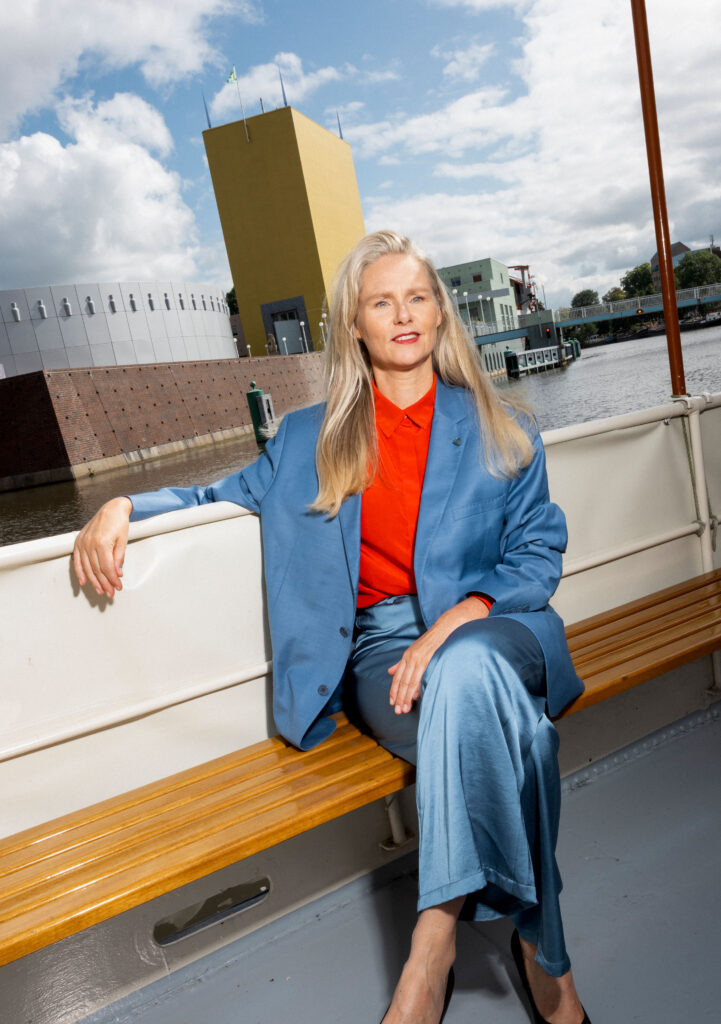
„We want to create a place for connection, not just for objects,“ notes Roos Gortzak at the opening weekend, on which the Groninger Museum, with four exhibitions, opens a new chapter under Gortzak’s artistic direction. In addition to Gortzak, Nynke Stellingsma, the commercial interim manager of the museum, and the curators Clare Molloy and Judith Spijksma are also present on this day. Gradually, some of the artists currently exhibiting arrive and fill the space, which is designed with seating furniture and mobile sideboards by Sol Calero (born 1982 in Caracas). The furniture at the intersection of art and design is intended to continue serving as a meeting point and a place to linger and read.
This setting reflects Roos Gortzaks commitment to the Groninger Museum, whose postmodern architecture emerged from the idea of thinking about art, design and life together. Gortzaks goal is clearly formulated: to create a dialogue with the building and the collection, which is more than just a museum.
It counts 60,000 objects from a total of five millennia, and by incorporating works by contemporary artists, it aims to create a vibrant space for interaction. All four opening exhibitions offer suggestions for thinking about how we live, work, spend time, and value each other.
„May is the one who directs the future!“
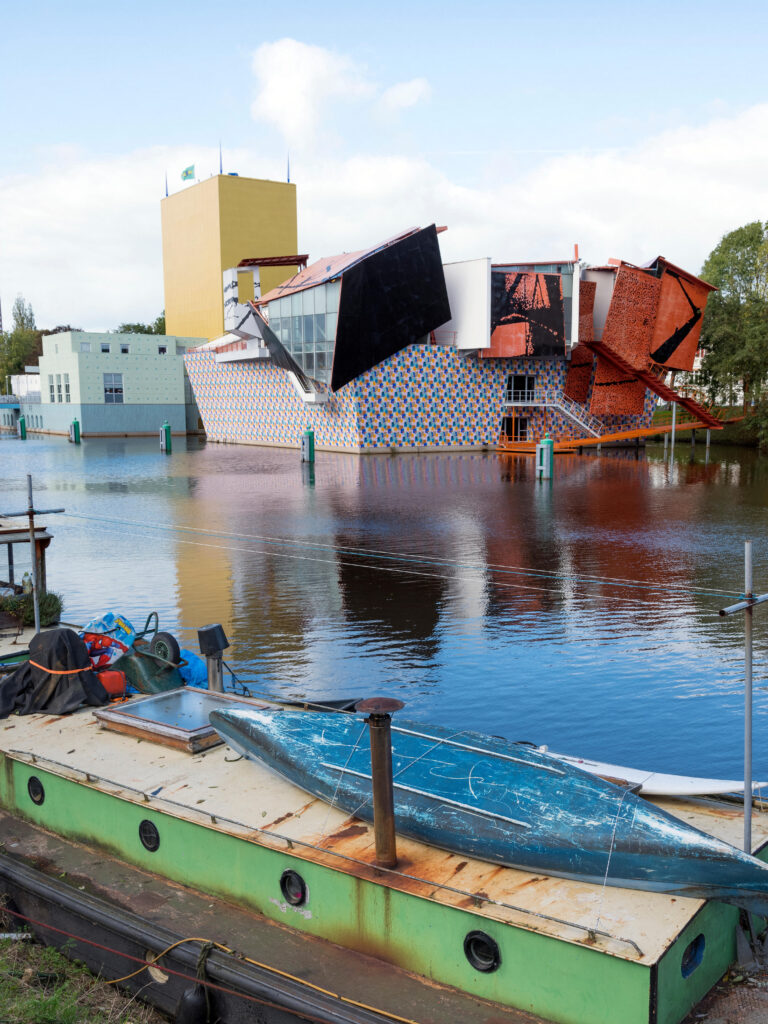
From the train station in Groningen, the yellow tower, the depot of the Groninger Museum, can be seen immediately: located in the middle of an island, it is surrounded by pastel-colored side buildings and other postmodern architecture that resemble a ship on the water of the canal that surrounds the old city. In 1987, Frans Haks (1938–2006), the then director of the Groninger Museum, commissioned the Milanese designer and architect Alessandro Mendini (1931–2019) to develop an architectural concept for the new building of the museum founded in 1874 and its comprehensive collection of fine and applied arts, East Asian ceramics, archaeology, and Groninger cultural history. The rooms of the previous museum building, which is located not far from its current location, were too small. And the idea of placing art and design at a central place in Groningen was big. „May art direct the future!“ was Mendini’s motto for a museum that was to be visible to all and that would combine life and art. The location with the connection bridge between the train station and the old town was wisely chosen. In collaboration with his colleagues Michele De Lucchi (born 1951 in Ferrara), Philippe Starck (born 1948 in Paris) and Wolf D. Prix (born 1942 in Vienna), the founder of the architectural firm Coop Himmelb(l)au, a house was created that was conceived based on the collection holdings and for the presentation of which four pavilions were designed by the architects. The Groninger Museum thus conceived in the collective form opened its doors in 1994. Gortzak continues to build on Mendini’s vision „May art direct the future!“.
The Architect & The Housewife: Cleaning the House, Building the Future
Giving the variety of the collection objects and the associated voices (again) the visibility they deserve is a fundamental idea that is to be pursued with the exhibition program of the house. The main exhibition curated by Roos Gortzak and Clare Molloy The Architect & The Housewife: Cleaning the House, Building the Future (until May 9, 2027) marks a beginning. The title of the exhibition is taken from the artist’s book The Architect & The Housewife (1999) derived from Frances Stark (born 1967 in Huntington Beach), who is also part of the exhibition with several works. The figures of the architect and housewife outlined by Stark in her book represent publicly visible work and those that remain unseen in secret – whether in the house, in the studio or in the museum storage room. For a year, the topic will frame all the exhibitions shown at the Groninger Museum. The current exhibition explores, with an interdisciplinary approach, especially how the life and work realities of artists, designers and architects are shaped within the framework of artistic production, reproductive work and public reception.
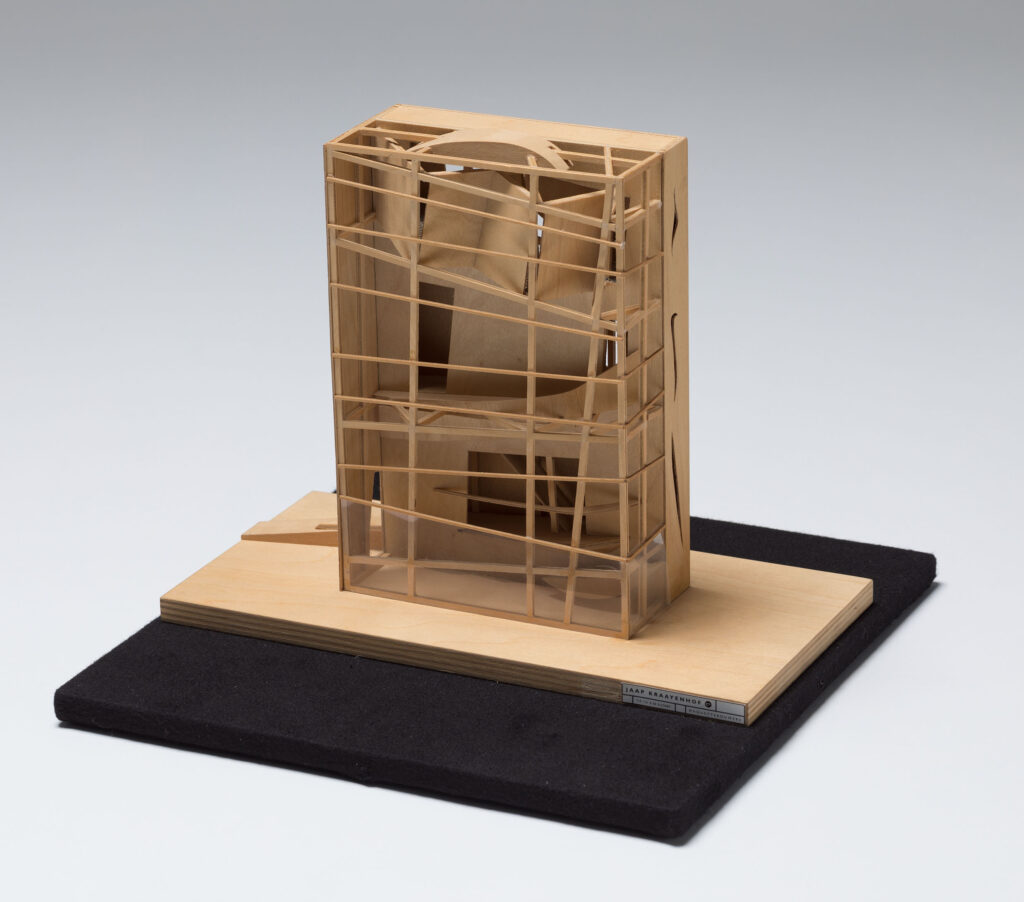
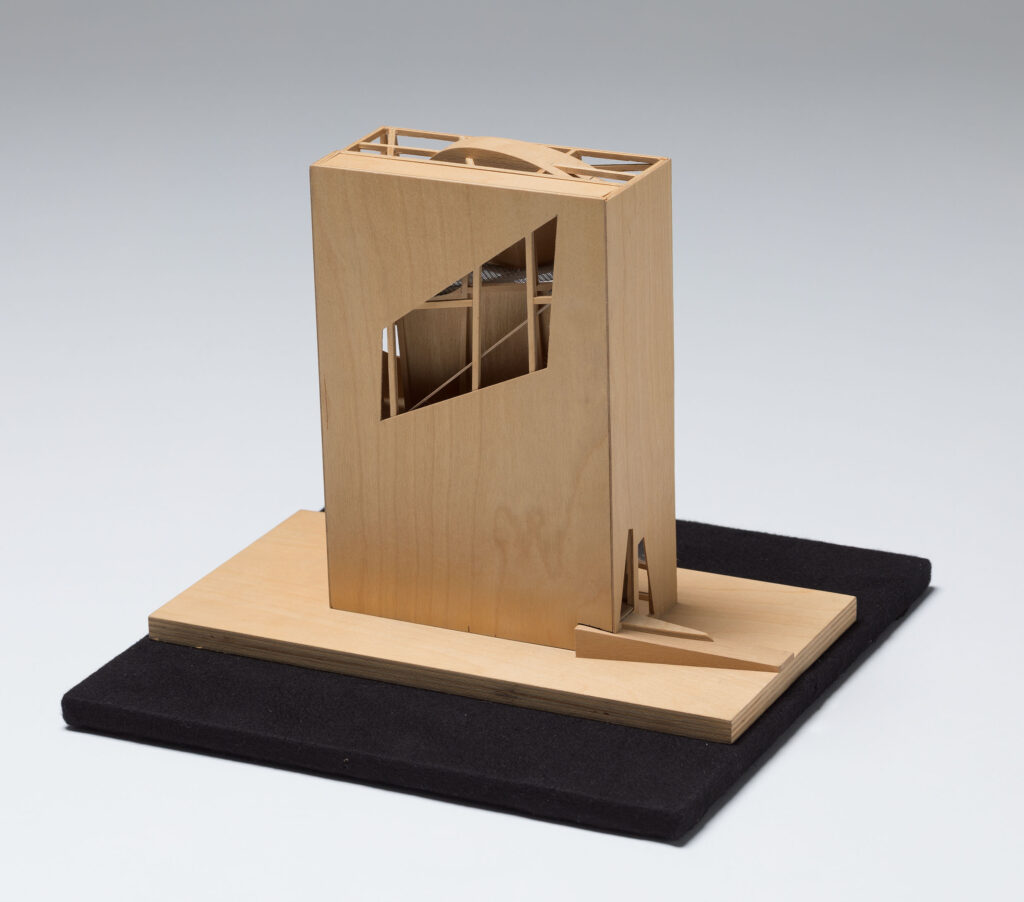
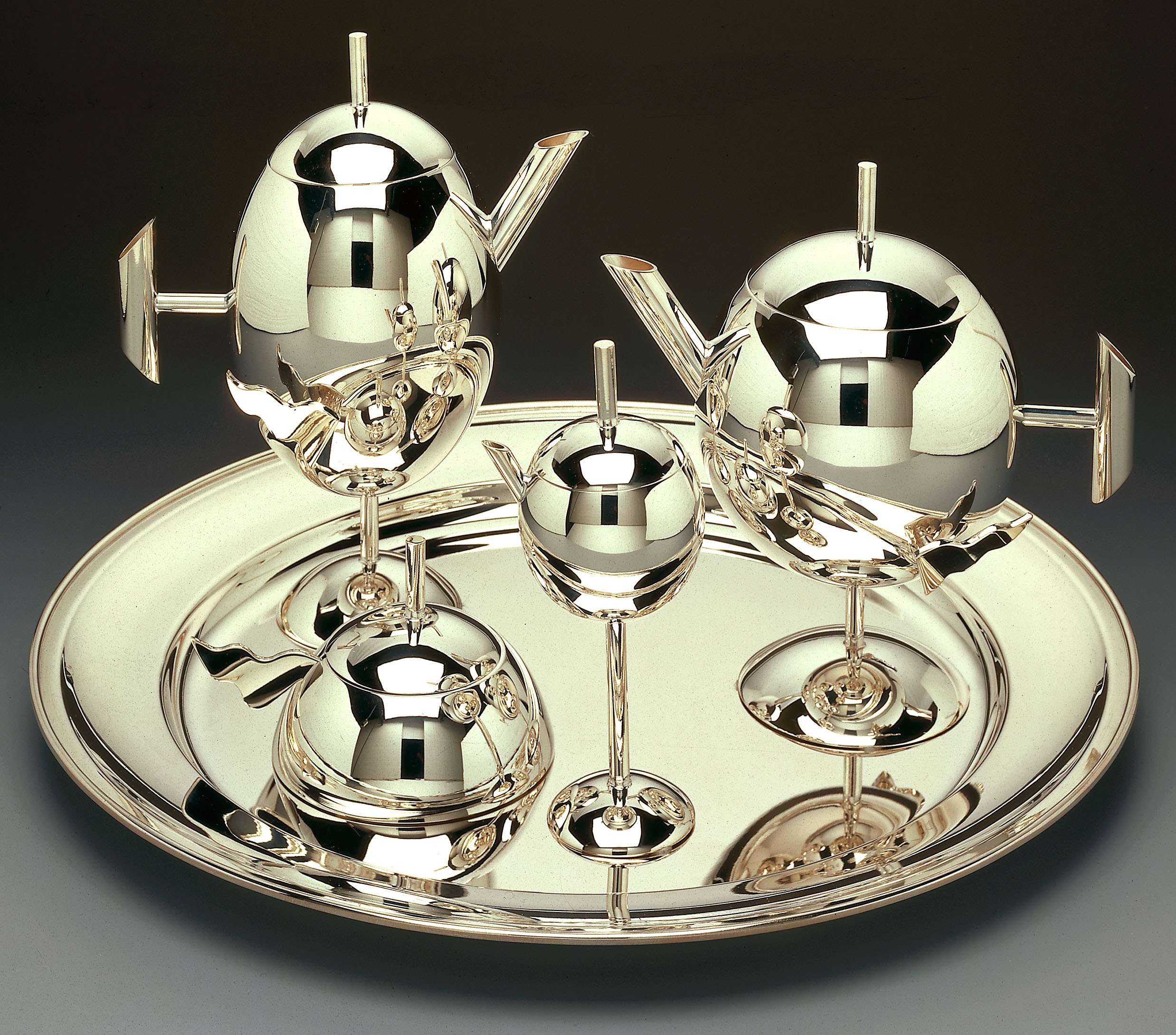
The exhibition, which can be seen in the exhibition pavilions of Mendini and Coop Himmelb(l)au, begins with Mendini's service Tea and Coffee Piazza (1983) and Zaha Hadid's architectural model Music Video Pavilion – A Box of Ideas (1990), supplemented by related graphic works and a previously exhibited painting by Hadids. The Mendini silver service, which included a tray with coffee and tea pots, a teapot and sugar bowl, served as a source of inspiration for his architectural concept for the Groninger Museum, for the development of which curator Frans Haks had commissioned him.
Zaha Hadid (1950–2016) in turn realized it in 1990 at Haks’ invitation as part of the festival held in the inner city of Groningen. What a Wonderful World! Music Videos in Architecture her first architecture. Music Video Pavilion – A Box of Ideas It has been forgotten over the years in a location in the Groninger area, but the architecture is to be brought back into the city center in perspective, thus becoming part of public life again.
The importance of maintenance work is often addressed throughout the exhibition. Three photographs by Mierle Laderman Ukeles show the artist born in Denver in 1939 in the early 1970s during her time as a student at the University of Denver. Cleaning Performances, In these institutions, she cleaned the art collections during their opening hours. In her 1969 manifesto, in which she justified the Maintenance Art, Ukeles wrote: „I do a hell of a lot of washing, cleaning, cooking, renewing, supporting, preserving, etc. So, (up to now separately) I ‚do‘ art.“ Consequently, she regarded maintenance work as part of her artistic practice.
Nicole Wermers (born 1971 in Emsdetten) translates for her Reclining FemaleSculptures (2022/2026): the artistic historical motif of the reclining female act is presented in sculptures placed on cleaning carts, as they are used in hotels to clean rooms. Her assemblages also bring the exploitation of labor into focus by highlighting the (in-)visibility of work.
The performative service Some Cleaning (2013–) by Adam Linder (born 1983 in Sydney) reinforces this approach regarding fair payment and contractual obligations: The dancer and choreographer offers his work based on a written hourly rate and was booked by the museum to cover the entire house with cleaning gestures on selected exhibition days.
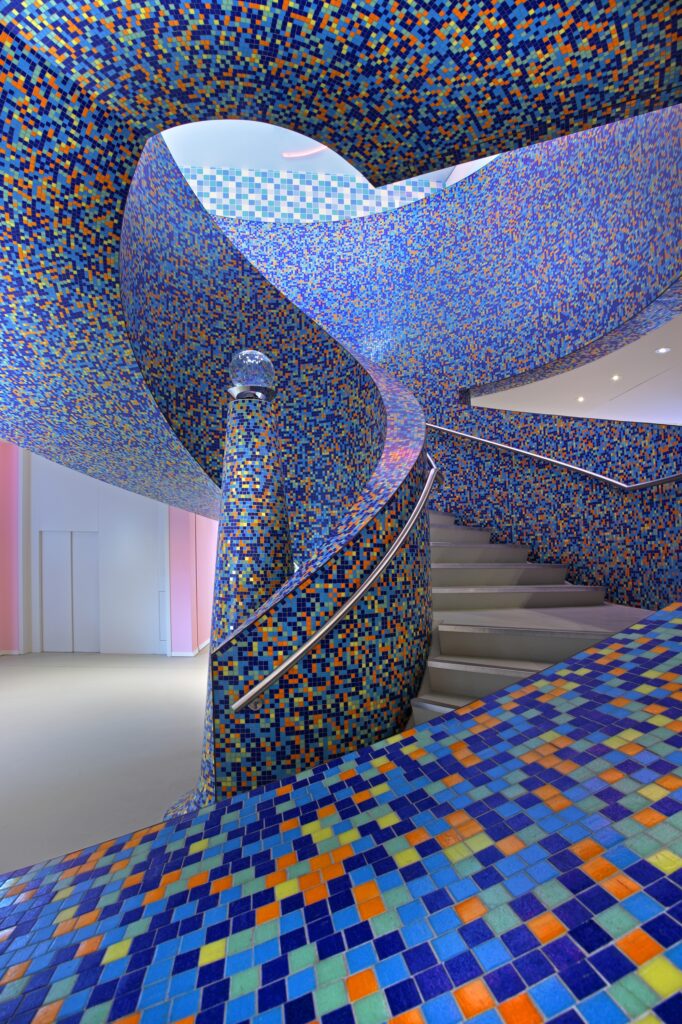
These examples make it clear that the subtitle of the exhibition Cleaning the House It is certainly to be understood in a literal sense that maintenance work has also been undertaken under the new management of the house. To approximate the museum’s appearance to its underlying design concept, walls and interior architectural elements were painted in colors that Mendini used in his book 30 Colours: New Colours for a New Century (1996) exhibits – for example, Mendini’s spiral staircase in a pink-violet pastel tone. The staircase extends over two floors of the museum and connects the pavilion structures by Mendini and Coop Himmelb(l)au.
Collages by Elisabeth Wild (1922–2020) can be seen on the wall surfaces near the beginning and end of the staircase; they relate to the staircase and the paintings of her daughter Vivian Suter (born in 1949 in Buenos Aires). Suter’s canvases, as free-hanging objects, occupy the entire empty space next to the staircase and are visible from different levels as the steps are being climbed and descended. They show abstract forms and representational motifs such as animals that Suter painted in the outdoor space, incorporating nature and the weather of the rainforest region where she lives.
From the table lamp to the climbing frame
With the exhibition curated by Judith Spijksma Playing House. An art biennial with children and young people (until January 10, 2027) works by artists who have implemented these together with children and young adults will also be united in the Mendini Pavilion. As soon as the exhibition begins, an installation by Lina Lapelytė, born in Kaunas, Lithuania in 1984, can be found: The Speech (2024–) plays soft sounds that children have created by imagining how animals communicate with each other. From puzzle pieces of a carpet depicting a landscape, coherent places and islands can be created, allowing them to listen to the imagined animal voices.
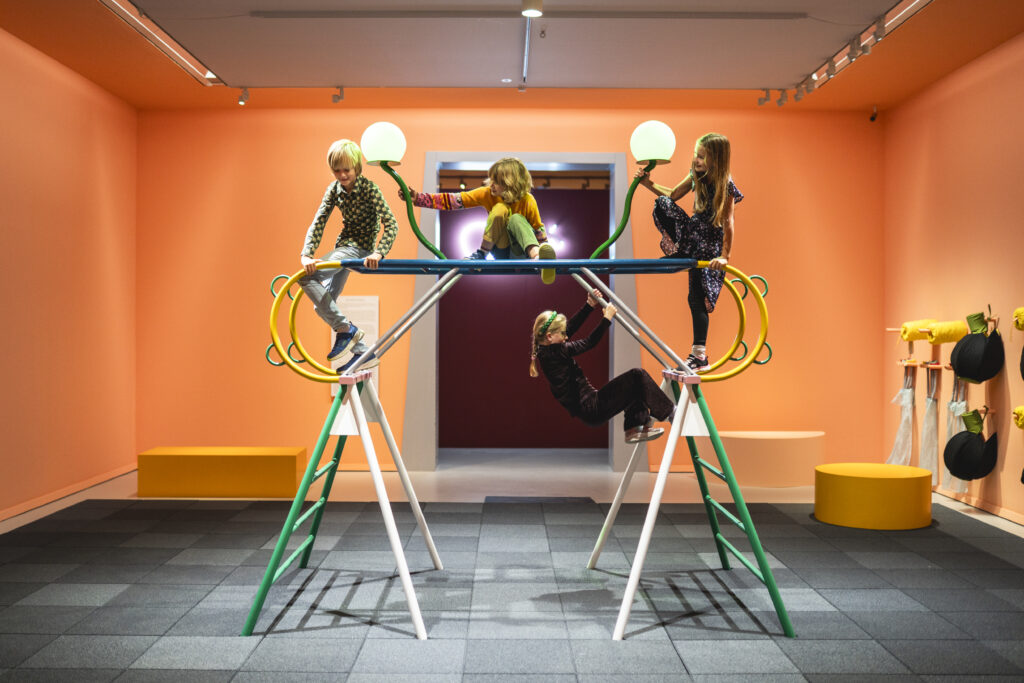
Mercedes Azpilicueta, born in Buenos Aires in 1981, has designed the series CaccHhO CucchhA (2025–) will develop a new installation that forms a reference to the color and pattern studies by Ettore Sottsass, which are in the collection of the Groninger Museum. The work CaccHhO CucchhA, Climbing on the Ashoka lamp (2026) consists of a climbing frame adorned with lamps on a playing surface and of portable fabric objects such as hats or oversized shoes filled with dried herbs and seeds. The climbing frame refers to Sottsass‘ table lamp. Ashoka (1981), which the designer designed as part of the group he founded, Memphis, which developed from the collective Studio Alchimia, to which Mendini and De Lucchi belonged. In works like these, the museum’s approach to commissioning contemporary artists to develop new, interdisciplinary forms from the research in the collection is concretely tangible.
Groningen avant-garde in a new light
This approach is also reflected in the exhibition series curated by Clare Molloy. New light in the De Lucchi pavilion, within the framework of which artists are invited to engage with the paintings and objects of the Groninger avant-garde group De Ploeg to deal with – whose works are also on display in the museum. Thus, the artist Ani Schulze (born in 1982 in Frankenberg) created a work for the exhibition New Light 1: Ani Schulze – The Convent of Pleasure (until May 9, 2027) another episode of their film series The Convent of Pleasure produced in which she creates references to the works of the De Ploeg artist Alida Pott (1888–1931), such as the figure of the harlequin and the architecture of the museum. Episode 4: Harlequin’s Arrival In atmospheric images, Schulze thus reveals details of the house, such as Mendini’s spiral staircase adorned with mosaic stones that leads from the entrance area down to the exhibition pavilions, at the foot of which a column with a crystal ball is located. The light refracted within it, like the night surface of water that surrounds the building, reflects the nocturnal water surface. For her film, Schulze collaborated with local performers, choreographers, and dancers: they wear masks, dance together, and, by juxtaposing geometric shapes, construct a house that serves them as a (spatial) ship in a vision.
Tablecloths with Eat-Art quotes and brick patterns
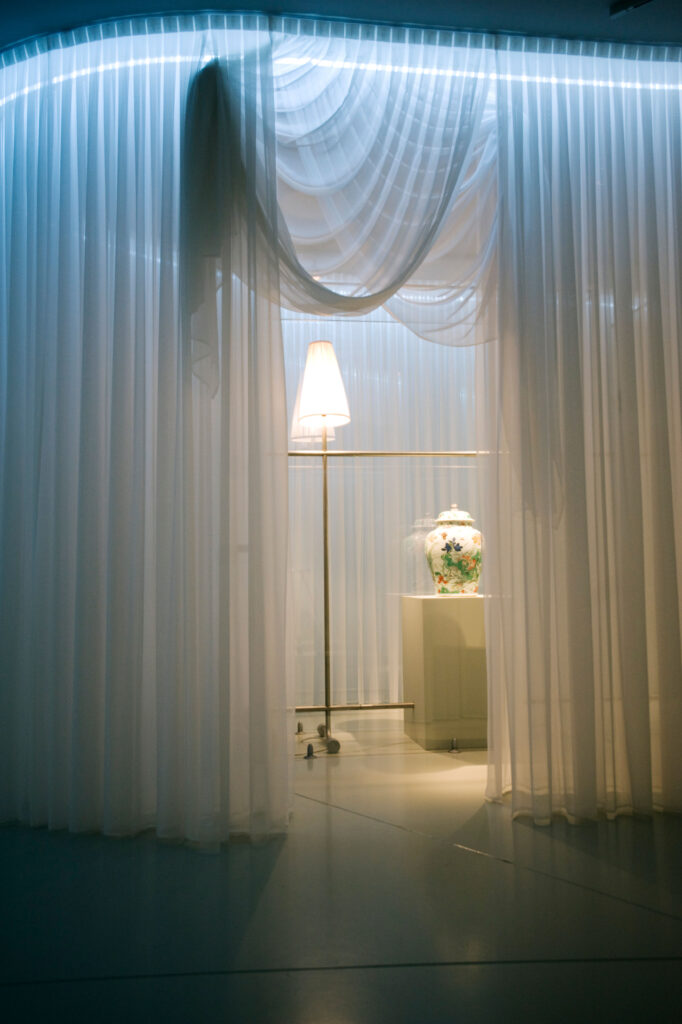
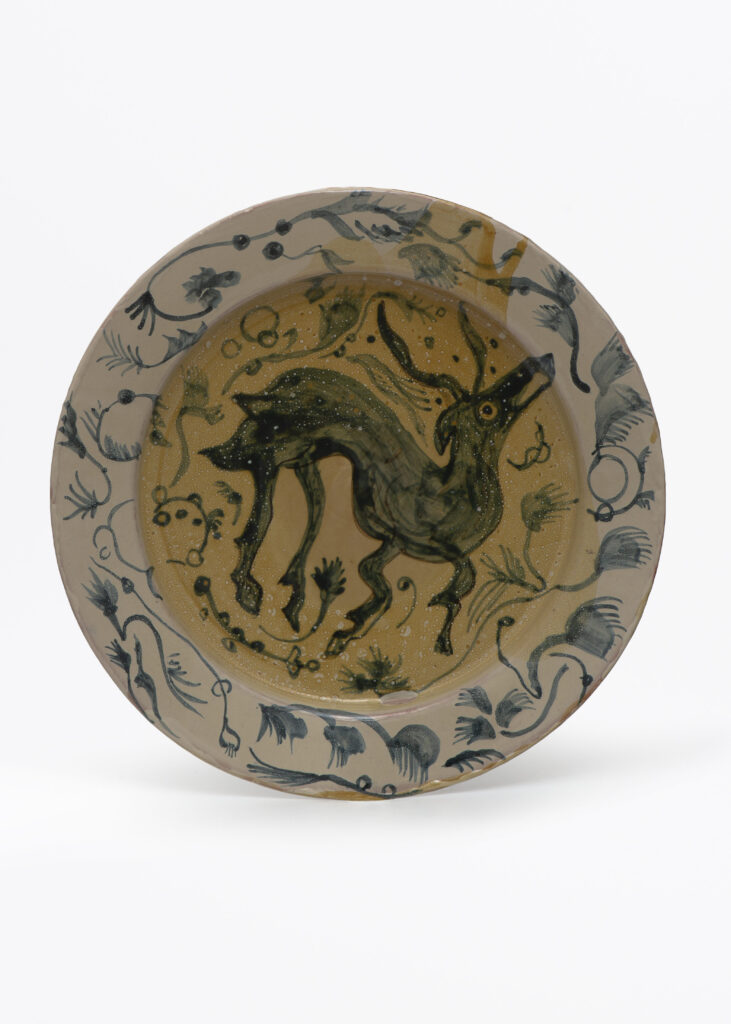
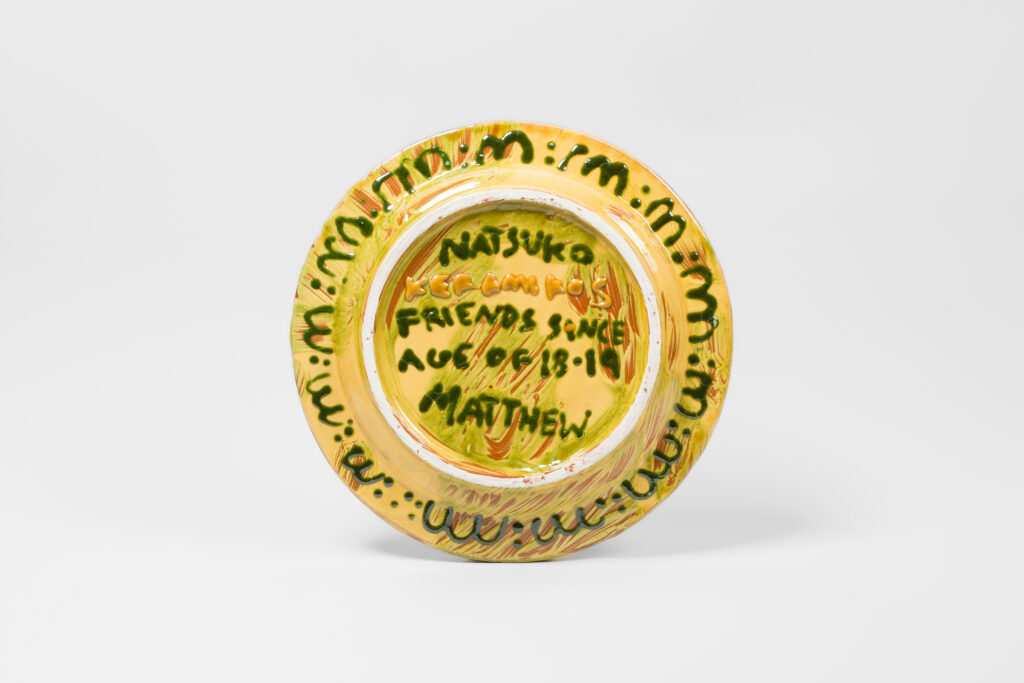
Right above the De Lucchi pavilion is Philippe Starck’s circular pavilion, defined by labyrinthically mounted curtains and equipped with mobile and fully immersive vitrines that completely envelop the space. Here Roos Gortzak and the guest curator Nicolas Trembley present the exhibition. Matthew Lutz-Kinoy & Natsuko Uchino: Keramikos Carrier Bag (until January 10, 2027), which is related to the purchase of a work group by the artist duo. The exhibition features objects from the ceramic tableware collection. Keramikos 2 by Matthew Lutz-Kinoy (born 1984 in New York) and Natsuko Uchino (born 1983 in Kumamoto) with ceramics from the collection of the Groninger Museum.
Through materials, techniques, and motifs, associative connections emerge between the historical and contemporary objects, which simultaneously tell stories of culture and colonial history. The ceramics are complemented by tablecloths hung freely in the space with printed Eat-Art quotes and food traces still visible on the cloth. They remind us that Lutz-Kinoys and Uchino’s ceramics were previously used collectively as „mobile sculptures“ within larger communal meals.
The artistic reflection on the origin and use of the objects collected by the Groninger Museum is often evident in the four exhibitions. Not least in the work installed in the Coop Himmelb(l)au pavilion. Say Cheese! (2023/2026) by Kathrin Sonntag (born 1981 in Berlin), who brings such objects from the museum’s collection into a visual dialogue with those from her own collection: for example, with design objects whose form mimics the appearance of living beings. On the occasion of the opening weekend, Sonntag set up a large table in the middle of her installation for a meal for the participants in the exhibitions: she covered the tables with a blanket printed with brick patterns; with sets that show her photographic work; or with candles that are encased in butter molds or shaped like hammers. Art, design, and life – they undoubtedly went hand in hand.
Liminality – Spaces in transition
Group exhibition at the Villingen-Schwenningen City Gallery featuring Helga Griffiths, Asta Gröting, Manaf Halbouni, David Hepp, Šejla Kamerić, Effrosyni Kontogeorgou, Adrian Paci, Lu Yang and Lukas Zerbst.
 4 min read
Expression tools at eye level
Under the title "Trouble and Appearance", the State Graphic Collection Munich presents an exhibition by the American artist Dana Schutz.
 6 min read
Christo and Jeanne-Claude: un|realized
The exhibition showcases for the first time in Germany unrealized projects by the artist duo. Kunstmuseum Pablo Picasso in Münster, April 4 – June 28, 2026.
 3 min read