
 5 min read
Arrow of Time
Emilija Škarnulytė at the Kunstmuseum St.Gallen Lokremise, August 22 to November 8, 2026.
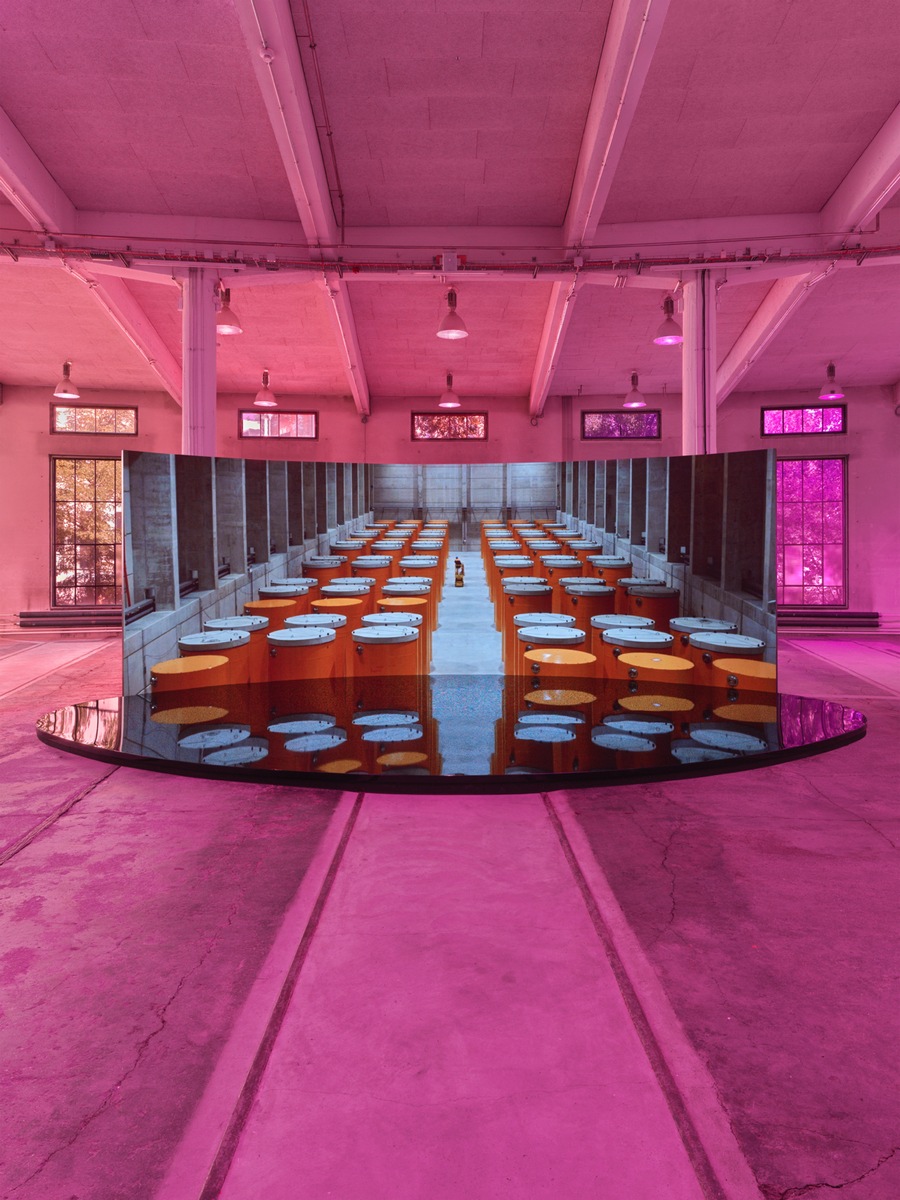
Emilija Škarnulytė presents her work The Arrow of Time, an exploration of the sites and ruins of past, present, and potential technologies, such as an altarpiece inside the locomotive depot. The curved, repurposed industrial building was originally a depot for the maintenance of steam locomotives around a turntable. The light entering through the windows is filtered into a bluish magenta; from time to time smoke enters the exhibition; the large space is dominated by a vaulted LED screen nine meters wide. A low, black oval in front reflects like an infinity pool.
The 12-minute film runs in an endless loop and alternates between filmed and computer-generated locations. Viewers can see an industrial complex, a control room, buttons and monitors, close-ups of countless connected cables, and core fuses cooling in liquid. Drone footage from a bird’s-eye view shows a dried-out shoreline of a waterway, built structures that look like round bunkers, then clear seawater in which the outlines of former architecture are visible. The view dives underwater and travels along endless pipelines to Sever rows and ends at a scaffolding that descends deep, deep into the earth. Three images of a brightly green and transparent figure that looks like a cross between a hand grenade and the Venus of Willendorf float in the room for a moment – and then we return to the industrial complex. The accompanying soundtrack provides a basic soundscape based on mechanical sounds such as fans and motors, as well as the beeps from surveillance devices, interwoven with electronic sounds and voices from the background, including children playing and a female choir.
Ignalia
The main location is the Ignalina nuclear power plant in Lithuania. As a prestigious project from the late Soviet era, it began operating in 1983, but already 26 years later all the units were shut down. Although it was the nuclear power plant with the highest ever output, it was based on the same reactor technology as the Ukrainian Chernobyl nuclear power plant. Justified safety concerns led to the closure of the plant – although it ensured the bulk of the national electricity supply – being a condition for EU accession. One might think that a monument to Soviet political ideology fell victim to the EU enlargement project.
Skarnulytė’s gaze sweeps over the grounds of Ignalina, which can be discovered in photographs and slow-motion camera footage. We see fuel elements up close and cooling containers from afar. Although the buttons are labeled and the monitors display measurement values, no one is there to read them. People appear only twice and briefly: one is a person operating a lift from a distance, and another is attaching something. Instead, the artist lingers at a Python that meanders across the wide control desk. Although the reptile appears long and heavy, it glides imperceptibly across the table; its skin is pressed by the buttons as it winds itself.
After immersing oneself in the industrial architecture of the late 20th century, one tends to interpret the snow-covered cylinders as storage halls or military concrete structures. In fact, however, they are Etruscan tombs: the necropolis of Banditaccia in the Italian region of Latium. The underwater ruins originate from the Roman settlement of Baiae near Naples, which was flooded by volcanic activity. The landscape characterized by droughts is located in Andalusia.
The „Arrow of Time“ (the arrow of time) is a concept used in physics and psychology. It assumes that time is fundamentally asymmetrical. Thus, we also experience time: we inevitably and unremittingly move forward and cannot return to the past. In her film, Škarnulytė smoothly floats over and through places that range from the 9th century BC to an imaginary future. Her perspective is all-encompassing but distanced, as she follows the traces left by human civilization and its hubris. Only Banditaccia, with its view towards a life after creation – indeed, even specifically for life after death – was built from the sites she selected. Nuclear power was introduced worldwide within a few decades without fully considering the waste products. Although Ignalina has not been producing electricity for a long time, the disposal of its waste is a project that will take until 2080, in containers with a storage life of 10’000 years. The company that manages the shutdown of the power plant, Now, it boasts of its leading expertise in this new project, without really taking into account the bitter irony.
It goes without saying that humanity has learned little from past mistakes. When the Ignalina power plant was operational, the adjacent lake was used to cool the power plant, which increased its temperature by three degrees Celsius. Although the predictable climatic effects of data centers are already documented, The introduction of AI and energy-intensive computing processes continues unabated. As Škarnulytė illustrates – and perhaps even celebrates – the human imagination seems only capable of imagining ever larger and more profound technological architectures.
Deep Time
The exhibition space of the locomotive depot is located in the largest preserved locomotive depot in Switzerland. Built in 1903 at the peak of the St. Gallen locomotive industry, it became an industrial wasteland in the 1980s. After the SBB no longer used the building, the art collection Ursula Hauser was housed there for a few years until the area was converted into a cultural center for dance, theater, and art with a restaurant in 2020. The era of locomotives is over and in its place the canton of St. Gallen is funding a zone for freedom activities. The future of the building therefore clearly lies in the leisure segment, based on the premise that society has leisure time and surplus funds – and that production and industry take place elsewhere.
But where is this „elsewhere“ now that the effects of industrialization and the IT revolution on the global environment are immediate and tangible? One might assume that we are creating more ruins of the future and thus leaving further dirty fingerprints on the world that will be seen by the descendants of humanity. Škarnulyte takes this perspective ahead of time: she shares wonders, but there is no one there to admire them. Because Škarnulyte observes from the perspective of „deep time,“ across epochs and eras, in which humanity and certainly no individual has any meaning.
Christo and Jeanne-Claude: un|realized
The exhibition showcases for the first time in Germany unrealized projects by the artist duo. Kunstmuseum Pablo Picasso in Münster, April 4 – June 28, 2026.
 3 min read
Liminality – Spaces in transition
Group exhibition at the Villingen-Schwenningen City Gallery featuring Helga Griffiths, Asta Gröting, Manaf Halbouni, David Hepp, Šejla Kamerić, Effrosyni Kontogeorgou, Adrian Paci, Lu Yang and Lukas Zerbst.
 4 min read
Expression tools at eye level
Under the title "Trouble and Appearance", the State Graphic Collection Munich presents an exhibition by the American artist Dana Schutz.
 6 min read