
 7 min read
Symbol of finitude
As a prelude to the Berlin Art Week A memorable encounter between Berlinde De Bruyckere and Caravaggio took place at the Italian Embassy in Berlin.
The visit to the Italian Embassy on the southern edge of Berlin’s Tiergarten is associated with mixed feelings, just like the visit to the German Pavilion in the Giardini in Venice. The 1938-built neoclassical Palazzo on the edge of Berlin’s government district stands out from the rarely successful modern attempts to give the terrain a metropolitan feel through the reconstruction of the historic embassy district. Despite many renovations and modifications, it remains the symbol of the fascist regime, along with Germany and Japan, the „Axis Powers“ of the Second World War. The thought of encountering a sculpture by Berlinde De Bruyckere in these historic halls is somewhat ambiguous.
The invitation to the unusual exhibition, which marked the start of the Berlin Art Week with a meeting between the 1964-born Ghent artist and the 450-year-old master Caravaggio from Milan, did not reveal what kind of work it was about. But the 1964-born De Bruyckere always creates strangely unreal figures that are in an undetermined state of transformation, made from realistic materials such as ceilings, wood, animal fur or wax.
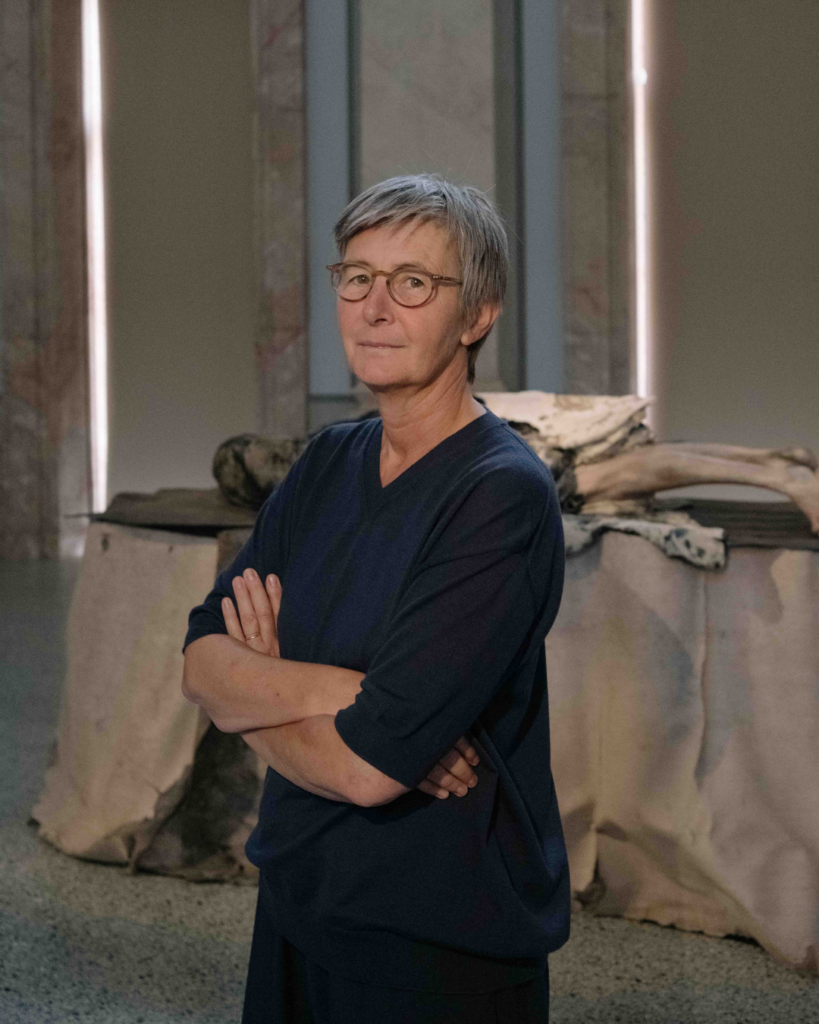
De Bruycker’s works evoke unfinished, destroyed or discarded bodies; they evoke the idea of human and animal funeral pyres, feelings of violence, pain and vulnerability – modes of suffering experienced by the victims of the fallen authoritarian rulers. Would the Hall of Honor on the first floor of the former Fascist Embassy be the right place for such an existential aesthetic?
As a „dialogue over centuries,“ Tjiöe Meyer-Hecken and Felipe Schweiger, founders of Offsite Arts, announced their project to a small group of critics in the embassy early in the evening, shortly before a festive reception: to get the event off the ground. In 2024, the two cultural managers founded the nomadic pop-up label with which they want to open up otherwise inaccessible spaces for the presentation of art and encourage institutions to present their work in more fluid ways. With the Italian Embassy under the artistic leadership of diplomat Fabrizio Bucci, they found a house that wants to open Berlin and the German cultural scene up more.
With De Bruyckere, Meyer-Hecken and Schweiger could not have found a better artist for their long-term project. The artist specializes in aesthetic dialogues. In her solo show „Khorós“ at the Bozar in Brussels last year, Lucas Cranach, but also Patti Smith and Pier Paolo Pasolini acted as dialogue partners. In the Ernst-Barlach-Haus in Hamburg, De Bruyckere took on the German Expressionists in the same year.
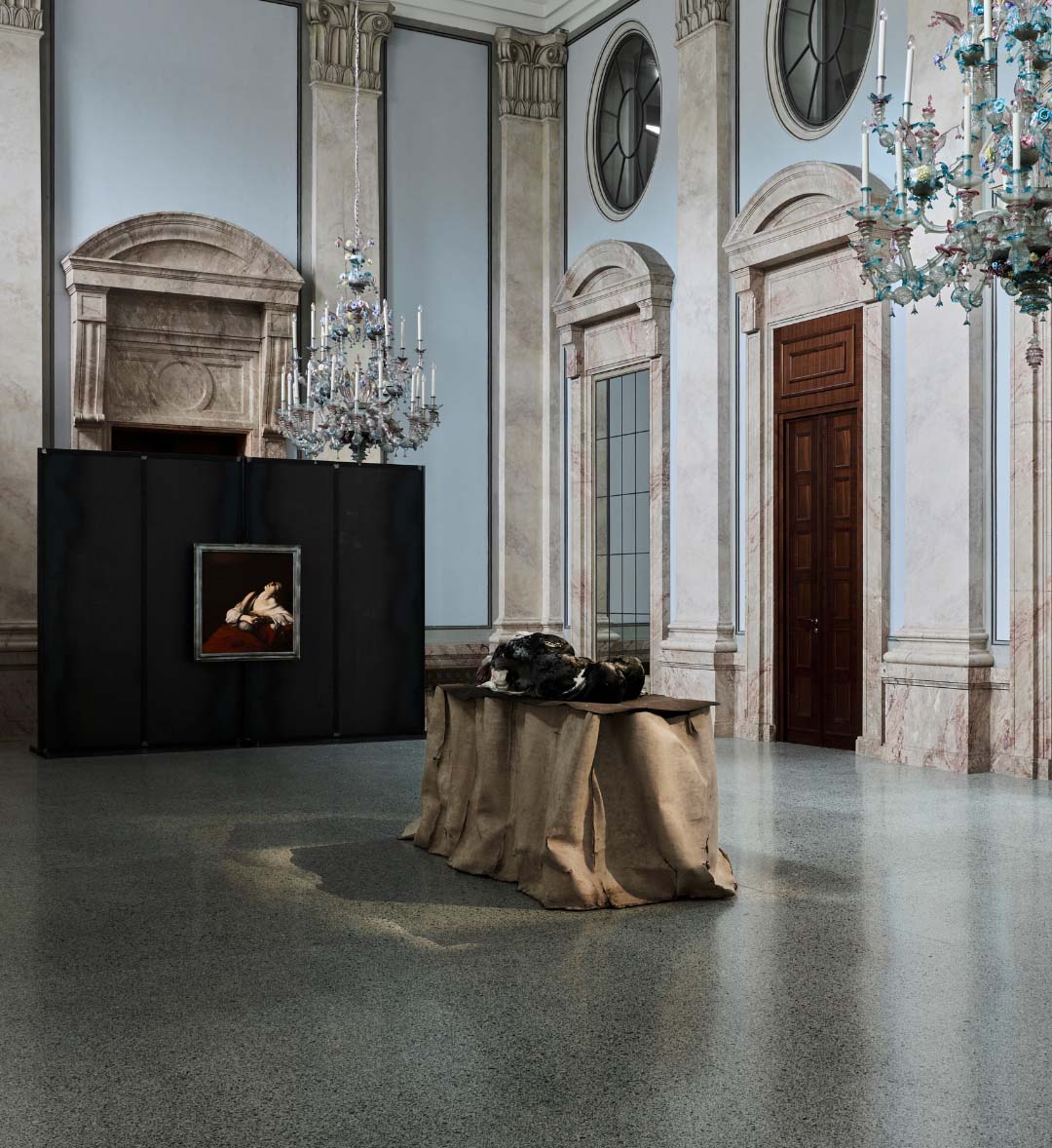
No one feels anything at first about the promised dialogue as they enter the darkened festival hall. For what the visitors see first is the platform covered with brown cloth, on which a rather inconspicuous sculpture lies flatly stretched. Like on an altar, a sacrificial site, a tombstone or a funeral hall, a figure is recognizable whose upper body was covered in grey-speckled fur.
It is only when one sees the two elongated, elaborately designed feet that protrude from the robes on the right that one realizes that they are human. De Bruyckere is confronted by the darkness of the room, which is only illuminated by a faint glimmer in the doors. His works often peel away menacingly from a semi-darkness.
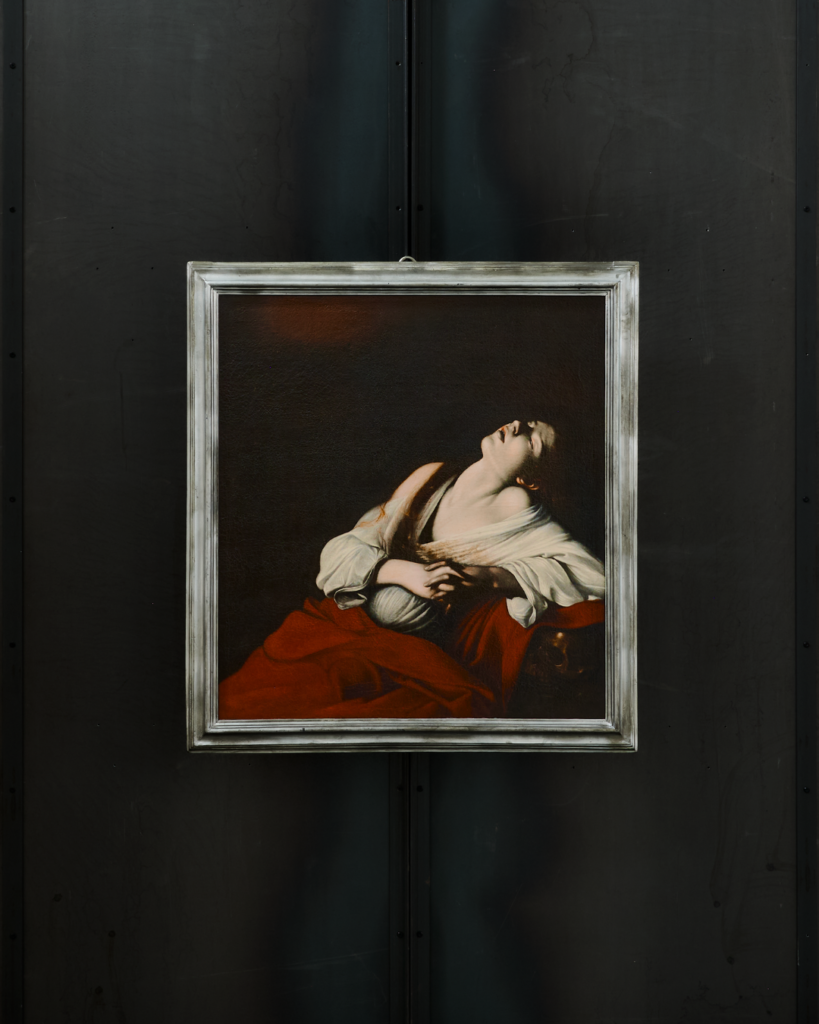
The paradox of the announced „dialogue“ is not only shown by the fact that the hidden, unknowable face of the unregulated Corpus points in the exact opposite direction from the figure with which the Belgian artist had dealt. In the right corner of the room hangs Michelangelo Merisi da Caravaggio’s „Mary Magdalene in Ecstasy“ from 1606 on a black stretcher.
Folded hands, eyes half turned to heaven, the half-lying Virgin Mary in a white blouse, open hair, wrapped in a red blanket, conveys the image of a woman between exultation and ecstasy. Discovered in 2014 by the Roman Caravaggio expert Mina Gregori in a private collection in Rome, the painting is now traded as the original in a series of 18 paintings of the same motif that Caravaggio had painted.
The fact that a Flemish artist is having a dialogue 400 years later with the master Caravaggio, who exerted a great influence on Flemish painting, is not immediately apparent to the uninitiated. Even the fact that the authenticity of Caravaggio’s work is still under dispute does not diminish the effect. However, the fact that physical extremes collide in the state of twilight is immediately apparent.
But how different the works are: On the one hand, there is a lifeless, anonymous, genderless figure, almost frozen in metaphor to a body without individuality whatsoever. De Bruycker’s figure is the truncated version of their „Arcangelo“ from 2020, during the pandemic. The fact that in the Berlin version it is lying horizontally makes the protective angel a symbol of death and finiteness.
It says something about the times that even in the center of his first exhibition as a visual artist during the Berlin Art Week, at Galerie Dittrich & Schlechtriem, the German artist and scenographer Ersan Mondtag chose a similar motif with a charred, ground-level skeleton of a monkey.
On the other side of De Bruyckere's sculpture stands an identifiable woman whom everyone knows: In the most beautiful pre-realism and Caravaggio-like detail precision, as well as in his characteristic darkness, she shows her bust, distorting the face, completely devoid of the provocative nakedness of earlier Caravaggio works. The artist creates a symbolic image of inner emotion, of devotion, of a woman of any will.
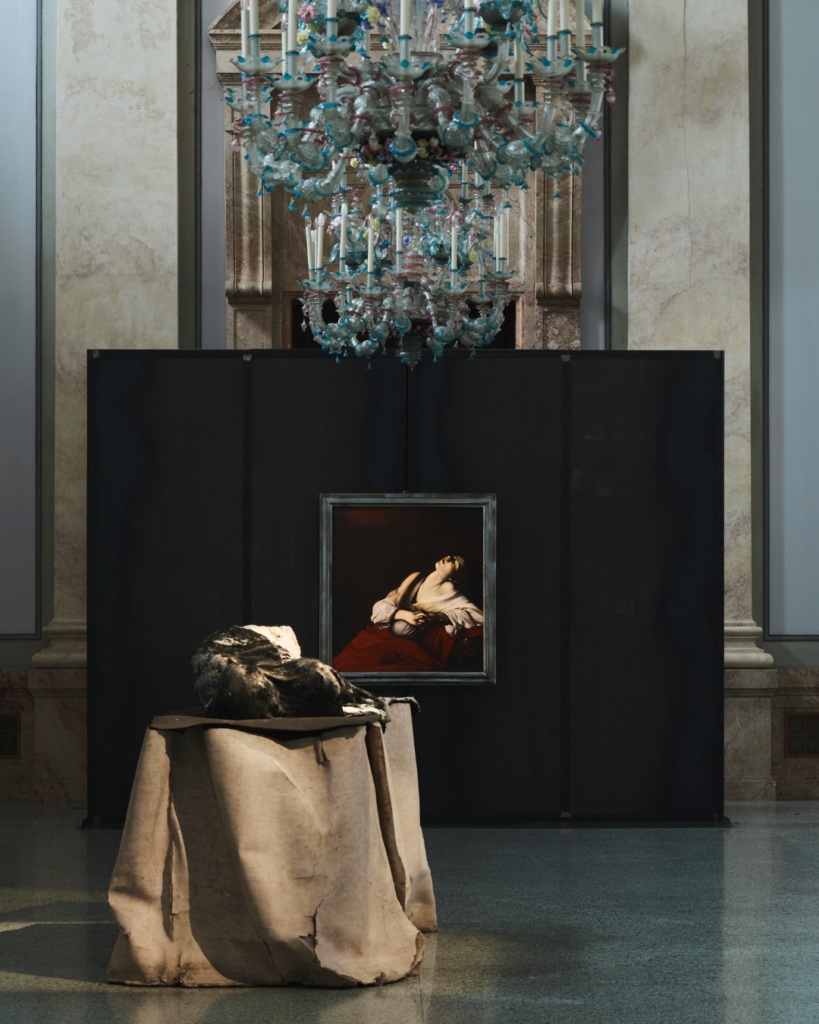
At first glance, the scene between morbidity and enthusiasm creates incomprehension. The observer helplessly searches for parallels. Until one begins to abstract from the external and allow oneself to be drawn into the inner impulses of the characters in the darkness of the message hall transformed into the burial hall. Fortunately, De Bruyckere has not simply tried to transport Maria’s ecstatic experience into the present. Instead, she has adopted the maxim „interpreting rather than imitating.“.
The visibility of the fleshiness is a characteristic of the different works. The veiled figure in De Bruycker’s sculpture evokes the imagination of a concrete body just as strongly as the realistic starkness with which Caravaggio highlights Mary’s body.
What connects the two figures at their core is not the facial expression, but a very differently articulated sense of vulnerability: One figure must have succumbed to danger, an external influence, pain, or grief. The other shows the moment when pain, joy, or the immersion in God has been inscribed in the flesh.
Posthumanism is not De Bruycker’s thing. The vulnerable body is the immovable stage on which the human states of mind play out. His oft-quoted phrase: „I understand the body as Companion. He is the one Companion, “Which we know best because we are stuck in it’ suddenly makes sense. Caravaggio would certainly have signed it. Both works thus evoke the Conditio Humana, the Ecce homo moment. A memento that fades into the glitter of the fashionable after-party opening the exhibition.
Depressed, one makes their way home through the nocturnal zoo. Richard Wagner stands resplendent on his stony pedestal at its edge, with a laurel wreath and an oak branch at his feet. Only the Tannhäuser in pilgrim attire before him and Brünhilde, lamenting beside the dead Siegfried, give some hint of the inexorable finality that summons the unequal couple De Bruyckere and Caravaggio in the Palazzo opposite and then nevertheless sets a counterpoint to the invincible heroism of fascist aesthetics.
Caravaggio x Berlinde De Bruyckere. Italian Embassy, Berlin. 11.9. to 2. 10. 2026. https://offsitearts.com
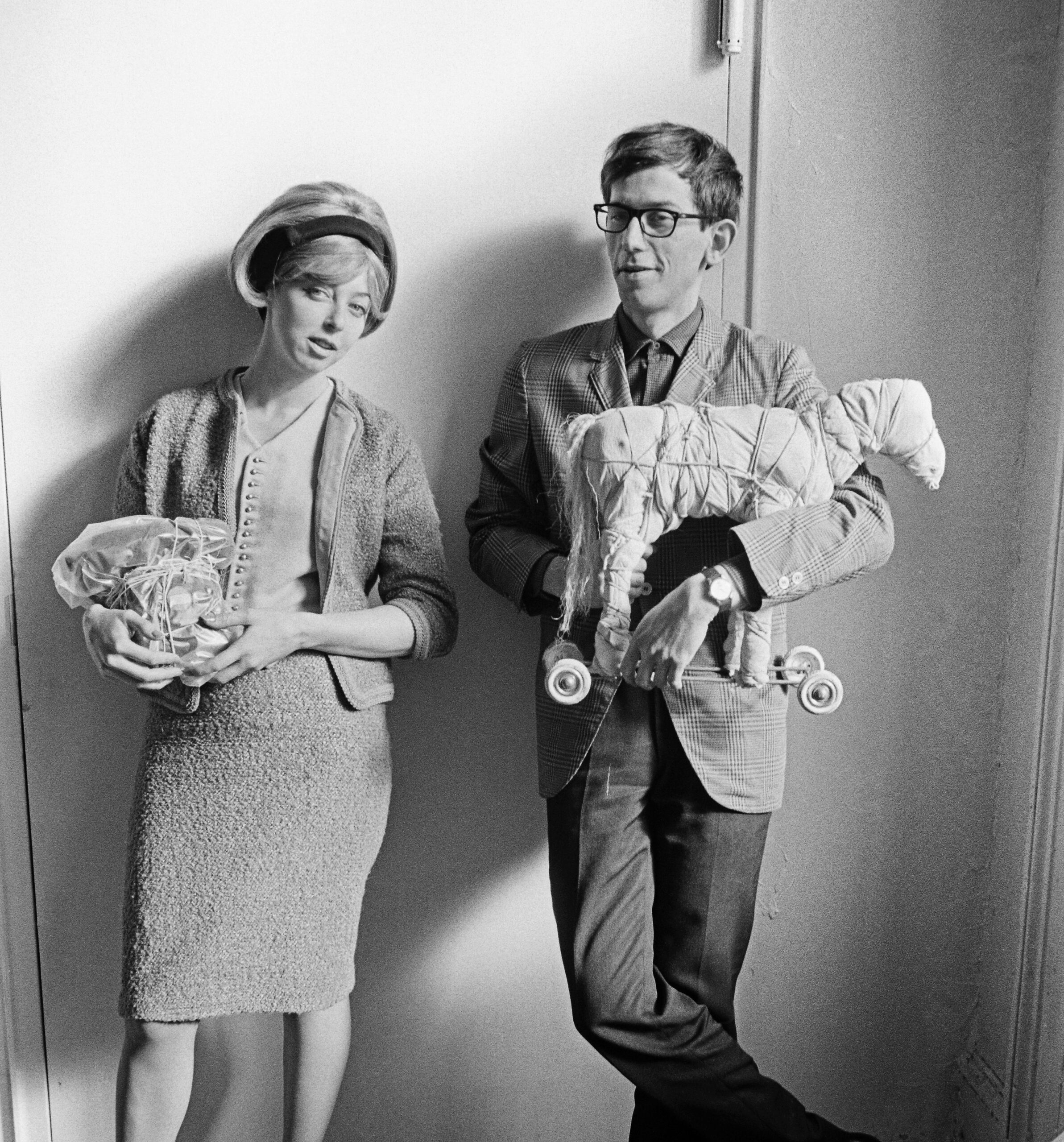
Christo and Jeanne-Claude: un|realized
The exhibition showcases for the first time in Germany unrealized projects by the artist duo. Kunstmuseum Pablo Picasso in Münster, April 4 – June 28, 2026.
 3 min read
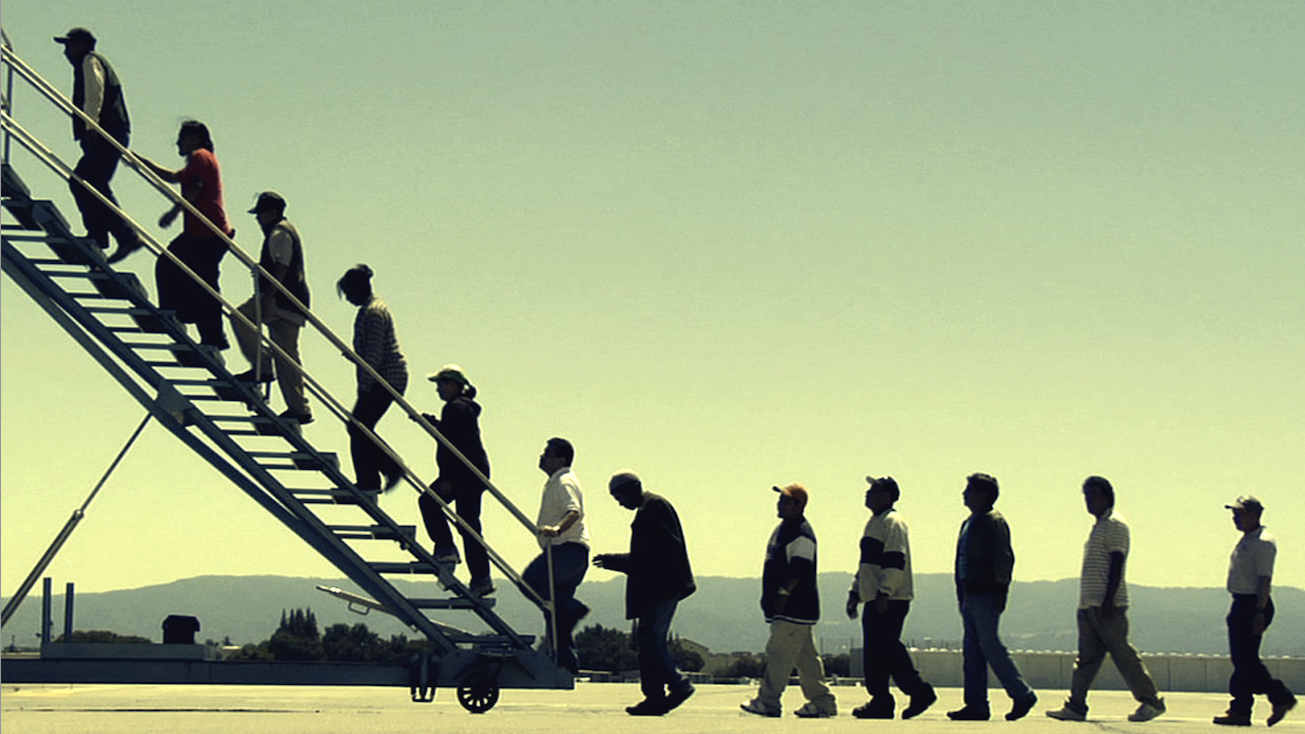
Liminality – Spaces in transition
Group exhibition at the Villingen-Schwenningen City Gallery featuring Helga Griffiths, Asta Gröting, Manaf Halbouni, David Hepp, Šejla Kamerić, Effrosyni Kontogeorgou, Adrian Paci, Lu Yang and Lukas Zerbst.
 4 min read
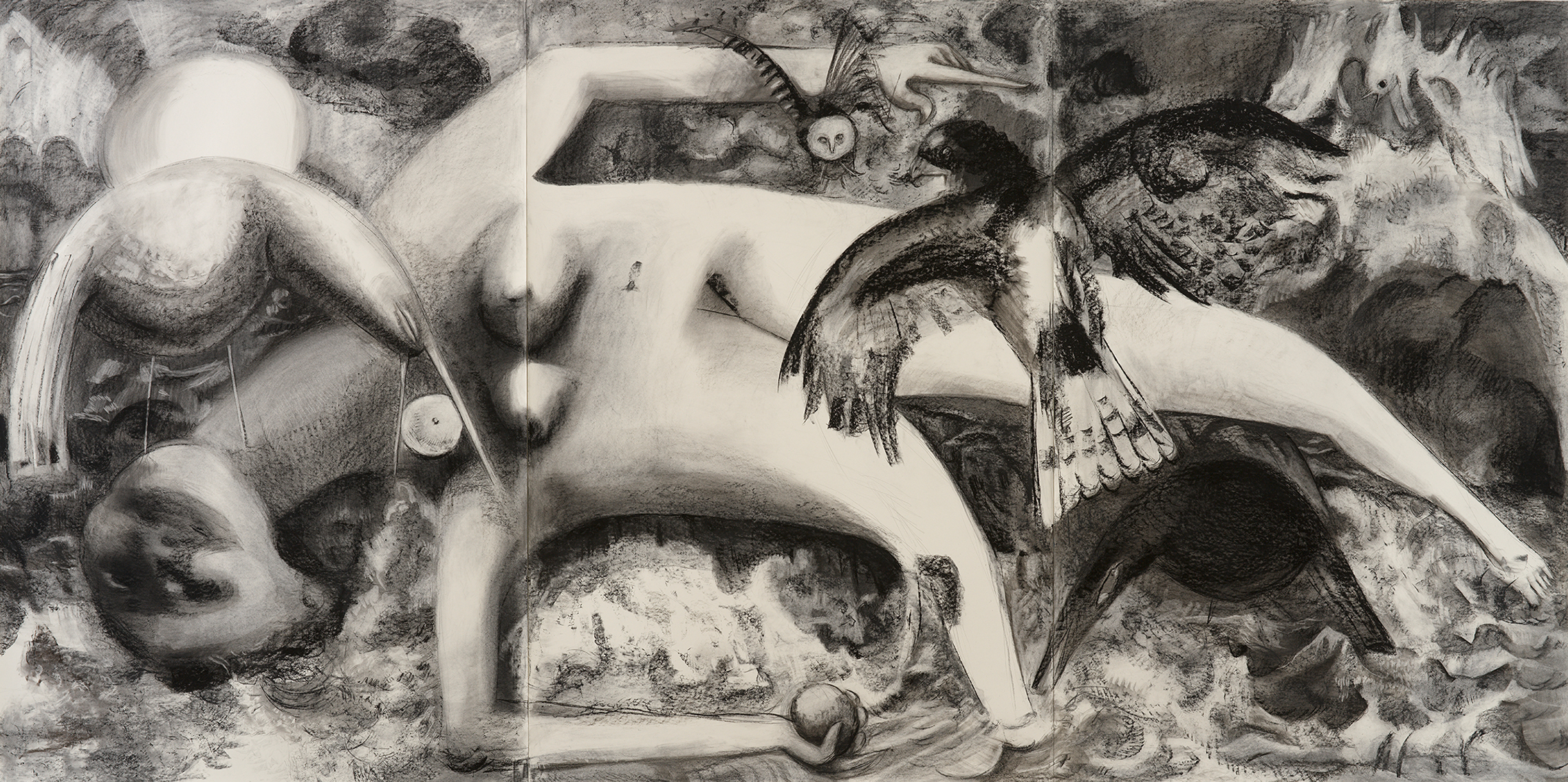
Expression tools at eye level
Under the title "Trouble and Appearance", the State Graphic Collection Munich presents an exhibition by the American artist Dana Schutz.
 6 min read