 7 min read
 7 min read
In the 1980s, it was an integral part of a literally cool interior: the Chaise Longue by Le Corbusier. Black leather and chromed steel pipes perfectly matched the aesthetics of the time, although the design actually dates back to 1928. What many still do not know is that a young woman was actively involved in its creation. Her name is Charlotte Perriand, who was just 25 years old at the time. At the same time, Mies van der Rohe, who was already past 40 at the time, built two spacious villas in Krefeld for industrialists Hermann Lange and Josef Esters. Together with the Kaiser Wilhelm Museum, these will be the venue for the comprehensive retrospectives until March 15, 2026. Charlotte Perriand – The Art of Living, the first retrospective of the French architect and designer in Germany.
Upon entering the exhibition rooms at the Kaiser Wilhelm Museum, visitors are greeted by a large portrait photograph: Charlotte Perriand looks directly into the camera of photographer Robert Doisneau. The tour begins with the reconstruction of a model apartment that Perriand, together with Le Corbusier and his cousin Pierre Jeanneret, designed for the Salon d'Automne designed in Paris in 1929. Two years earlier she had taken over the management of the interior design department at the Le Corbusier atelier and combined the developments of the past few years in the model apartment: the Interior equipment of an ideal home It was tailored to a childless couple and combined simplicity and flexibility in an environment that still looks futuristic today. In doing so, the designers deliberately transformed the concept of equipment (Equipment) to highlight the universal character of their designs. Instead of walls, the space is divided by a modular shelving system; all other furniture is flexible and movable. This flexibility was one of the central concerns of the designers and radically broke with the conventions of bourgeois interior design.
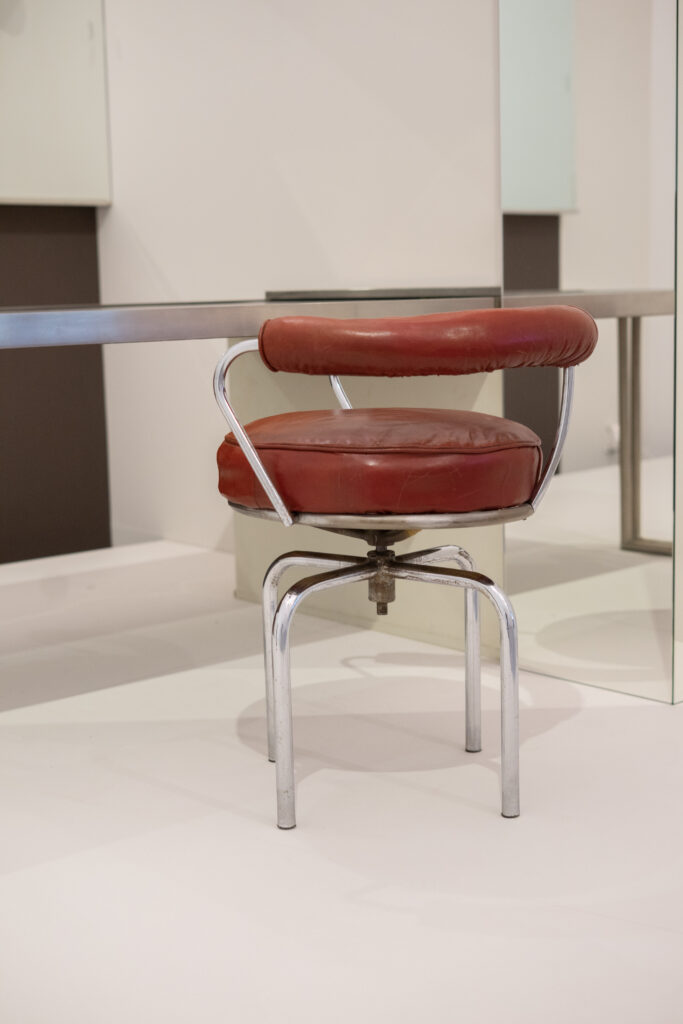
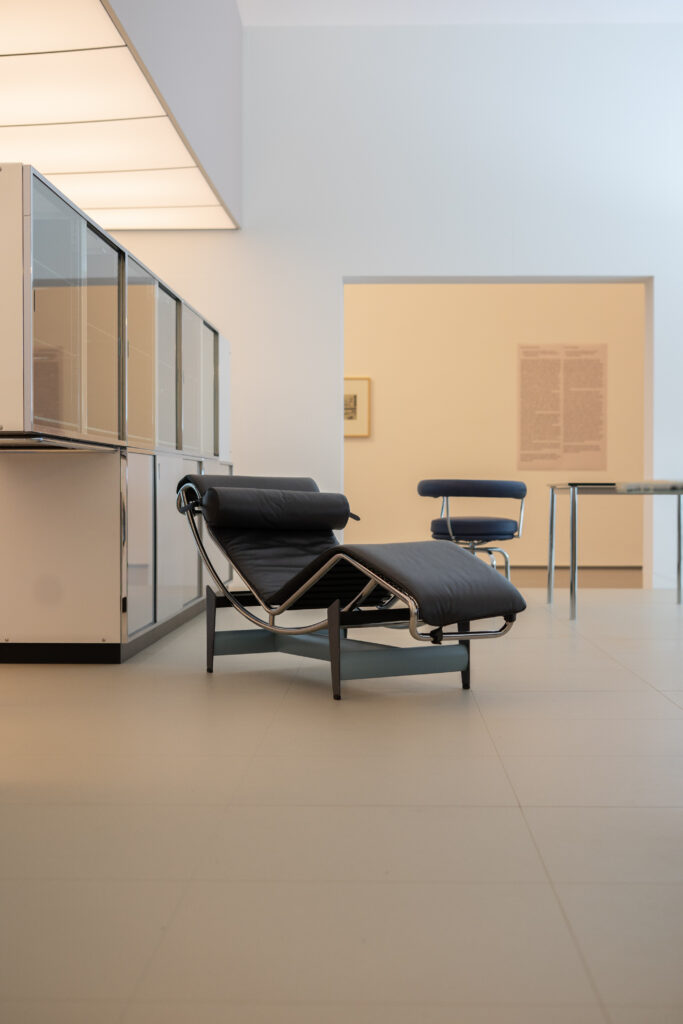
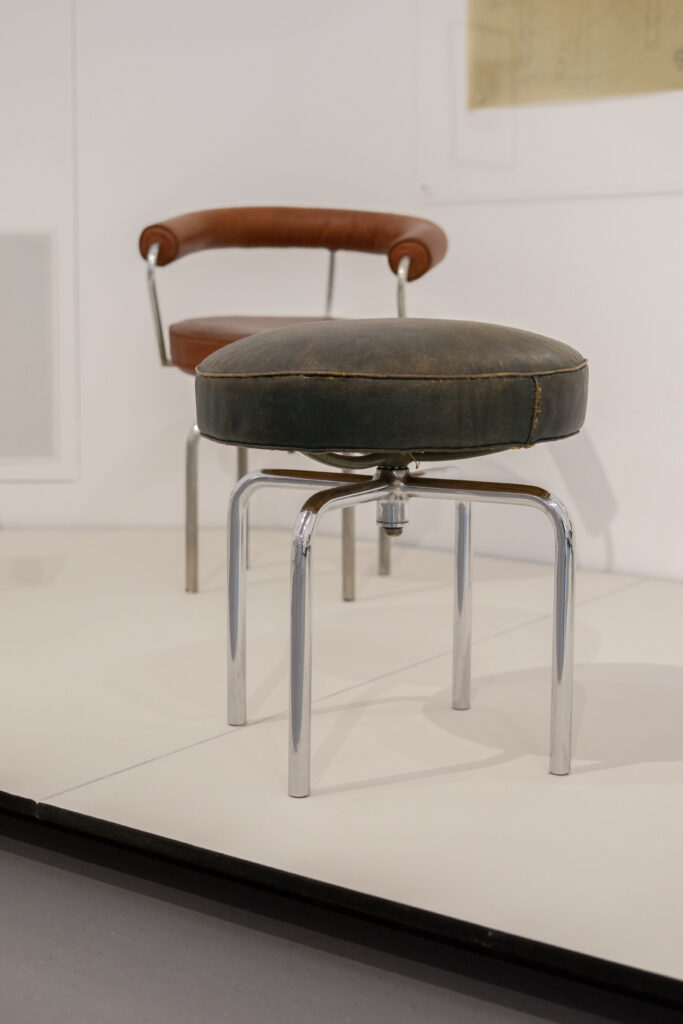
In Krefeld, all the steel tube classics of the trio of Corbusier, Jeanneret and Perriand are then gathered in the adjacent exhibition space: the Chaise Longue, the , who Grand Comfort armchair and also the swivel chairs B302 and B304. The drawings contextualize the furniture on the walls and integrate them into the work of the atelier.
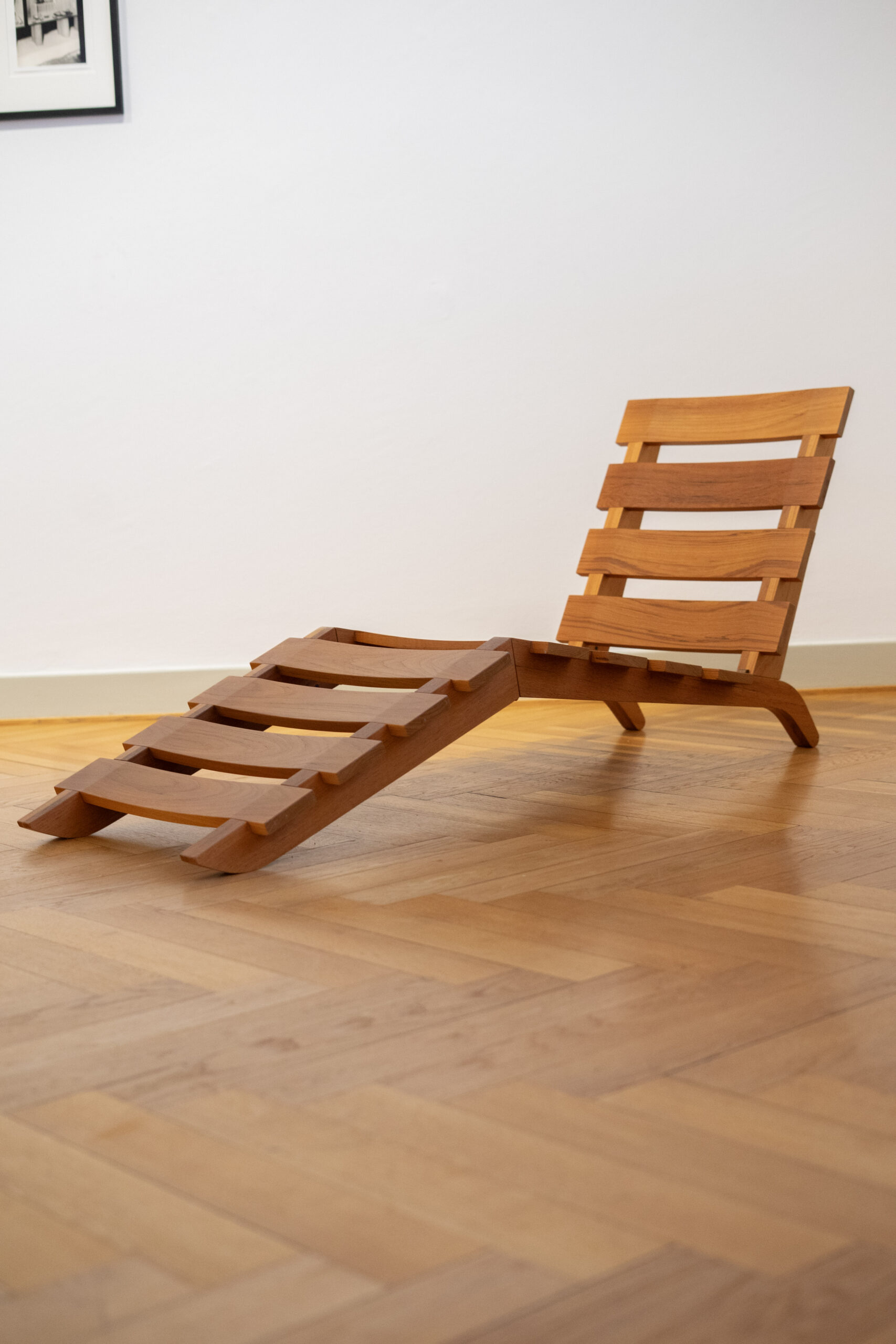
From the early 1930s onwards, Perriand’s work shows a fundamental change, which can be attributed to her growing interest in rural life. Inspired by the simple wooden furniture of French peasant houses, she develops a series of furniture pieces. The stools, tables and chairs with basket-weave and solid wooden frames not only mark the shift towards the natural material, but also the departure from steel pipes and their clinical aesthetics. The forms of nature thus gained increasing importance. On her walks through forests and along the beaches, often accompanied by her friend and kindred spirit Fernand Léger, Perriand collected driftwood, pebbles and bones and captured them with her camera. The photographs, which are also on display in the exhibition, she titled Art Brut (Raw Art) and used it as inspiration for her Form-Libre-Furniture. This includes, among other things, a table that she created from a palette that had remained from the World Exhibition in Paris in 1937.
Also in 1937, Perriand left the Le Corbusier atelier; however, her personal connection with the firm never broke down. For example, in the post-war years, Le Corbusier hired Perriand to design the interior of his apartment in Paris. Unité d'Habitation in addition.
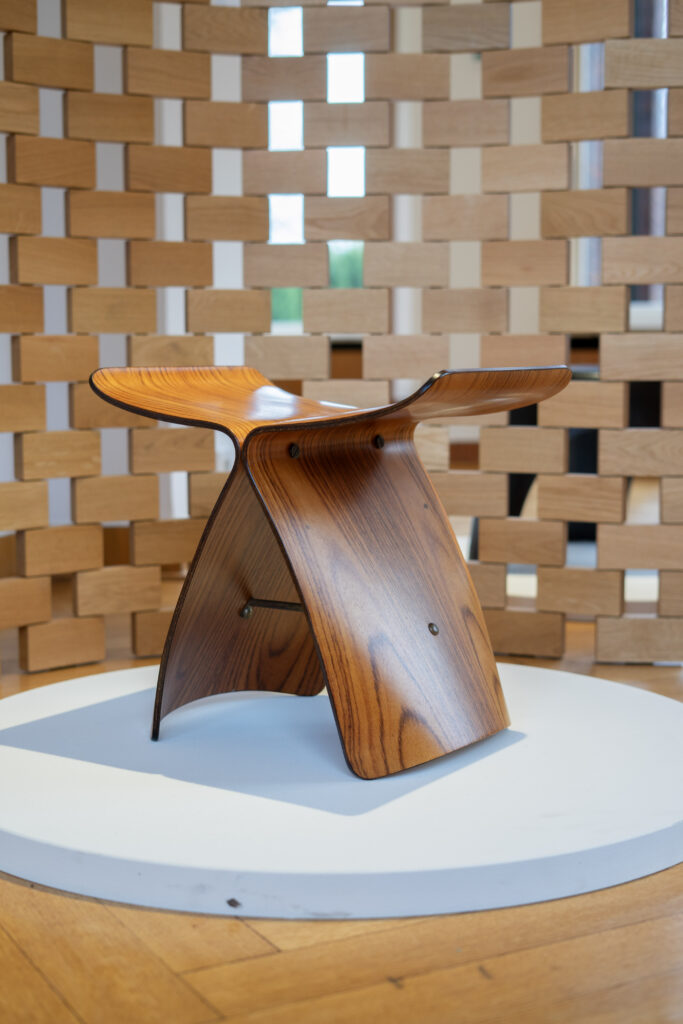
The fact that Charlotte Perriand was already recognized beyond France as an independent and innovative designer at the time is shown by an invitation from Japan: the Japanese Ministry of Trade and Industry invited her in February 1940 to become an advisor for industrial art and to participate in research on the development of export products. The goal was to combine traditional Japanese craftsmanship with modern production techniques. However, Perriand not only contributed theoretically but also practically and already in 1941 realized the exhibition Contribution to the interior equipment of the dwelling. Japan 2061: Selection, Tradition, Creation. This was shown in the Takamashimaya department stores in Tokyo and Osaka. The fascinatingly simple furniture, to which Perriand was inspired by a bamboo sugar tongs, can also be seen in the Kaiser Wilhelm Museum.
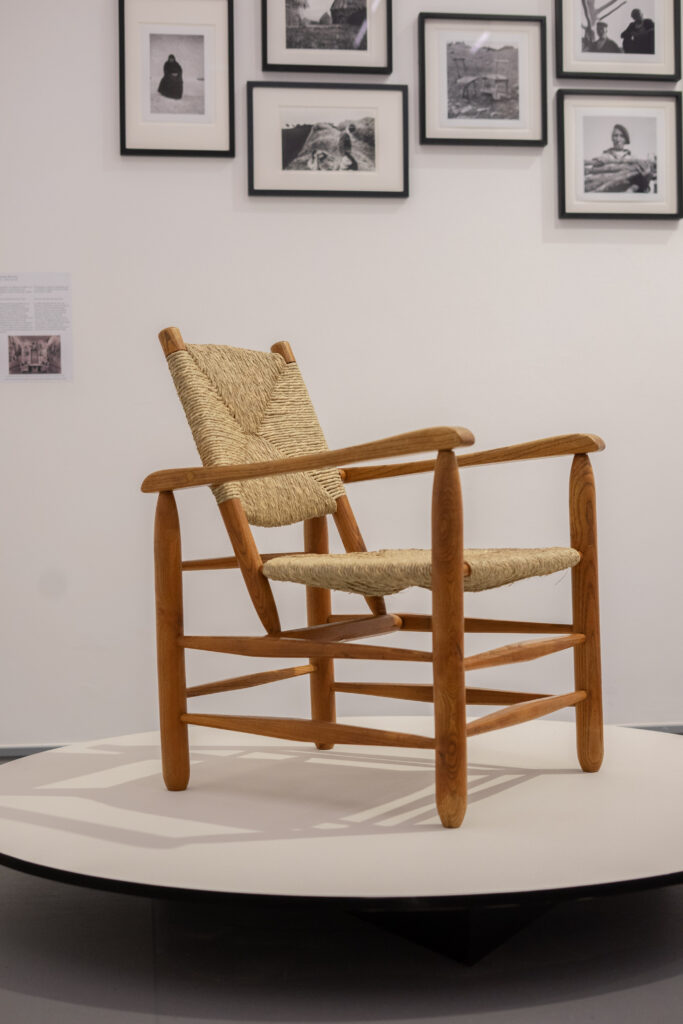
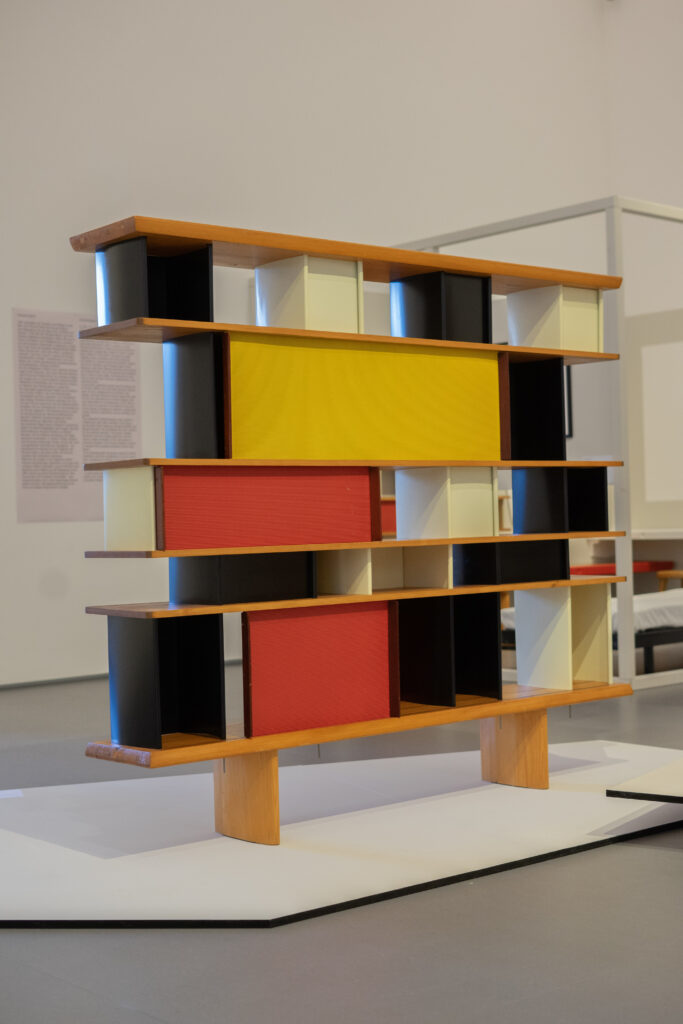
During the reconstruction of France after the Second World War, at the beginning of the 1950s she was commissioned to design living room rooms in the Cité Universitaire She set up shop in Paris. Among other things, she exchanged ideas with the artist Sonia Delaunay and with Jean Prouvé, the great architect, engineer, and designer, and designed with him. Tunisia A bookcase is one of his most famous pieces of furniture. The colorful bookcase, a simple construction of wooden panels and brightly painted industrial metal elements, today achieves six-figure prices at design auctions. It is all the more beautiful to see that it is part of a reconstructed student room in Krefeld and vividly illustrates how Perriand was able to design even small spaces with great mastery.
Conversely, Perriand was also capable of thinking on a large scale. Proof of this is undoubtedly her greatest project. Les Arcs, which she realized together with project developer Roger Godino in Tarantaise from 1967 onwards. This person commissioned the passionate alpine climber to design a ski resort for the province of Savoy. However, the objective was not to create a mundane winter paradise for the bourgeoisie, but rather a holiday resort for everyone. Sensitive to the landscape conditions, Perriand designed flat, horizontally oriented buildings that adapted to the mountains rather than competing with them. In this context, the modular wet room shown in the exhibition was also designed by Perriand in the mid-1970s and could be flown to the construction site and installed immediately. The fact that she found building in the alpine context very enjoyable is also confirmed by the film shown in the exhibition about the project.
Strengthened by impressions from all her creative phases, the journey to the exhibition satellites in the Lange and Ester houses is worthwhile. In particular, the Ester house opens up a new perspective on the designer’s already rich oeuvre: in the rooms of the Mies van der Rohe Villa, for example, a discussion of her encounter with Brazil is explored; this was something she sought during her husband Jacques Martin’s move to Rio de Janeiro in 1961. Martin was a manager at Air France and needed a representative, elegant apartment. Therefore, he commissioned his wife to redesign the rooms, for which she had initially intended to use the furniture she had designed in Japan. Confronted with the specific locations, however, she decided to adapt or expand her designs. Thus, the dining table designed in Japan served as a starting point, but she embellished it with a plate made from local wood, whose shape she developed from the grain of the wood. Her decor was complemented by lamps by Isamu Noguchi, whose cubic light fixtures form a striking contrast to the organic forms of her furniture, demonstrating that Perriand carefully followed the work of her colleagues.
With Charlotte Perriand – The Art of Living Thanks to the close collaboration with the Charlotte Perriand Archive, the Kunstmuseen Krefeld have achieved a real coup, and not just because this is the first comprehensive retrospective of Perriand in Germany. Rather, the exhibition reveals a creator whose work resonates even today and inspires reflection on building and living in the present.
Charlotte Perriand, L'Art d'habiter / The Art of Living, November 2, 2025–March 15, 2026, Kaiser Wilhelm Museum, Haus Esters, Haus Lange.
The exhibition Sindelfingen presents the first retrospective of Mario Schifano in Germany.
 7 min read
World Heritage Site Völklinger Hütte: Spectacular Son-et-Lumière Art
 1 min read
The exhibition "Six Five Four Three Two" featuring works by the New York-based artist Josephine Meckseper at the Heppenheim Art Society.
 9 min read