 9 min read
 9 min read
"In Heppenheim (Bergstraße), on 26 June 2026, extreme maximum temperatures of 38 to 40 degrees Celsius were reached. The region was at the center of a historically early and intense heat wave, during which new junior records were set in large parts of Hesse."
As far as the German Weather Service is concerned. As far as the German Weather Service is concerned. In fact, it was an evening like it could hardly have been more summery. While above in the Heppenheim Old Town a brass band musically ushered in the 72nd Bergsträßer Weinmarkt, a popular ten-day folk festival, a somewhat more organized but equally cheerful group of people met in the former premises of a small bakery in Heppenheim Bahnhofstraße to open a new exhibition at the Kunstverein Heppenheim. No one had to worry about the threshold fears here. Everyone who had heard about it was welcome to attend. And instead of a dinner as often the case elsewhere, those who were hungry or thirsty could simply cross the street. Healthy finger food was available in the cooking school of Germany’s best-known Ayurveda chef Volker Mehl.
The art association founded in 2009 in the picturesque small town of Bergstraße with a population of 26,000 members is one of the smallest among the more than 300 registered art associations in Germany. In its first 17 years of existence, however, it has managed to make a name for itself far beyond the region in the urban triangle between Mannheim, Heidelberg, and Darmstadt. It has been nominated several times by the Association of German Art Societies (ADKV) for the award "Art Society of the Year".
Currently, there is an artist there named Josephine Meckseper, a New York native born in Germany, who can be counted among the indisputable leaders of the international art world. Participation in biennales in places like Melbourne, Taipei, Sharjah, Seville, and even twice at the Whitney Biennial in New York, as well as the fact that her works are represented in the collections of the MoMA, Guggenheim, Whitney, and Metropolitan museums and thus virtually all major New York museums, are all important factors. However, important works are also housed, for example, in the collection of the Kunstmuseum Stuttgart and in numerous private collections.
What attracts a globally established artist to the southern Hesse province? To Josephine Meckseper: "The exhibition came about through my artist friend Gregor Hildebrandt. In 2019, I exhibited in his 'Grzegorzki Shows' project space in Berlin – paintings that were painted on Miami-Beach-style bath towels. Uwe Emig, the director of the Heppenheim Art Society, came by the exhibition and invited me to exhibit the works in Heppenheim shortly thereafter. Then my father died, Covid hit, there was a car accident, and many other things came between, and I had to postpone the exhibition several times." Seven years later, it has finally succeeded, and on the evening of the opening it was possible to get the impression that everyone was happy. The team of the art association, the visitors from near and far, and of course the artist herself.
But why does Heppenheim have such an active art association in the first place? Let's just ask the chairman, Dr. Uwe Emig: "The founding happened by chance in 2009: the bakery Zipp closed due to age reasons and the premises were empty. There was no immediate plan to establish a successor bakery. During a meeting, we discussed contemporary art and the idea of founding an art association arose. Founding members were the artist Thomas Zipp, the journalist Bernd Graber, the art historians Mona Hartfiel, Dr. Anke Emig and myself, the dentist Dr. Uwe Emig."
When mentioning the name Thomas Zipp, most art connoisseurs are bound to gasp: this is the Berlin painter, sculptor and musician who died completely unexpectedly on April 3, 2026, and who also held a professorship at the University of the Arts Berlin. This very Thomas Zipp, born in Heppenheim in 1966, whose personality and career were recently celebrated in numerous tributes, was the son of the Heppenheim bakery couple. It was also Zipp who attracted numerous artists from his personal circle to Heppenheim. A wall covered with old invitation cards attests to this. Whether Thilo Heinzmann, Eva & Adele, André Butzer, Gregor Hildebrandt, Pepi Bottrop, Isa Melsheimer or Felix Schramm. Numerous artists from Berlin, New York, Düsseldorf or Frankfurt have already exhibited in Heppenheim. Josephine Meckseper is therefore not such a big exception.
Regarding the choice of the venue, Dr. Uwe Emig said: "The choice was ultimately made by Thomas Zipp himself, since the bakery's rooms were empty, and with this space in an authentic 1960s style with two large showcases, the opportunity arose to create a low-cost and unusual art space." Without the always helpful and understanding parents of Thomas Zipp, the founding of the art association in this form would not have been possible. The authentic flair of the 1960s modernism that still characterizes the rooms of the Heppenheim Art Association is also perfectly suited for the presentation of Josephine Meckseper's works.
Politically-minded concept artistsünstlerin
The New York-based conceptual artist is a politically-minded artist who repeatedly questions the contradictions of the commodity world in her characteristic formal language, against the backdrop of globally operating capitalism, the aesthetics of advertising, and the importance of modernity in architecture and art. The artist holds both German and American citizenship. She was born in 1964 as the daughter of the painter and graphic designer Friedrich Meckseper in Lilienthal near Bremen. She grew up in the northern German artist colony Worpswede.
From 1986 to 1990, she initially studied art at the Hochschule der Künste in Berlin. From 1990 onwards, she continued her education at the renowned California Institute of the Arts (CalArts) in Valencia, Los Angeles, where she studied with Michael Asher, who is known for his institutional-critical approach as well as for his artistic method of creating not primarily objects but of temporarily and subtly altering existing environments by introducing or removing certain elements.
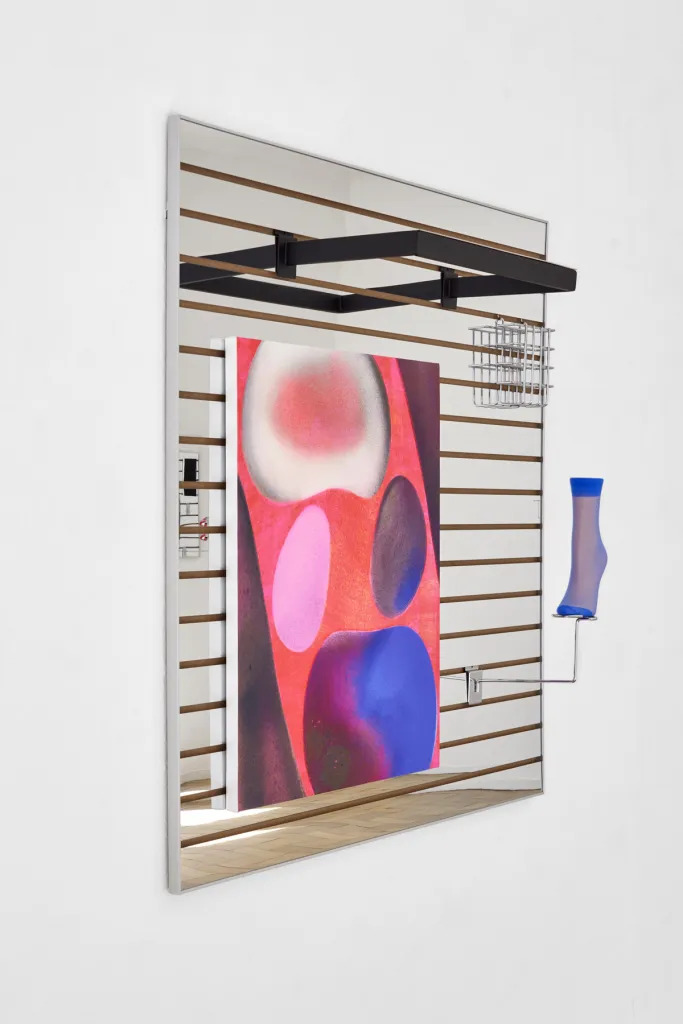
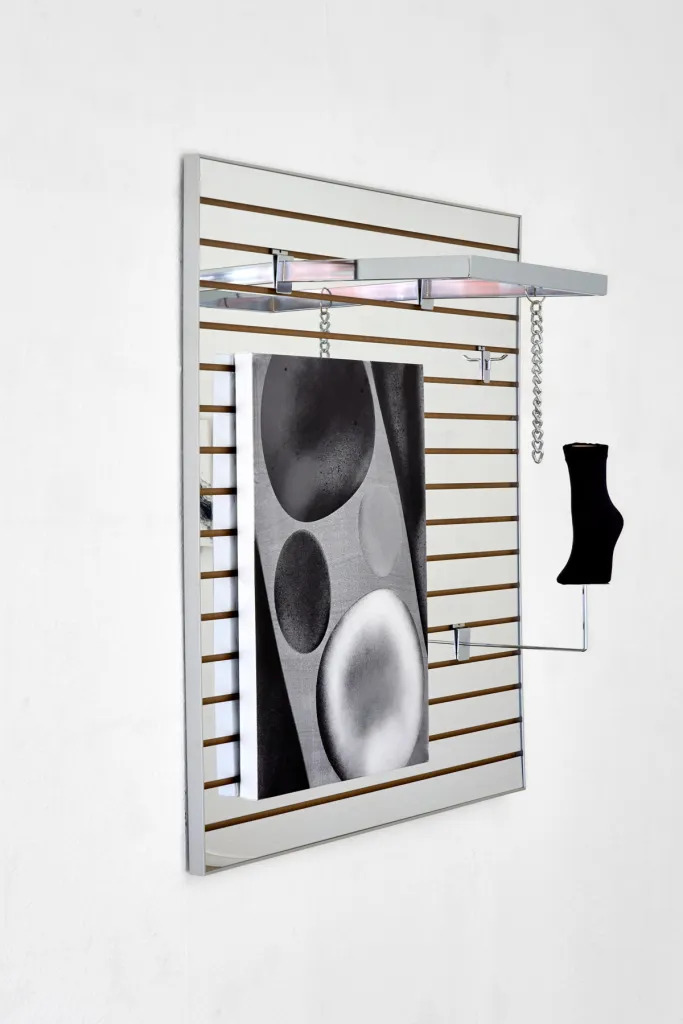
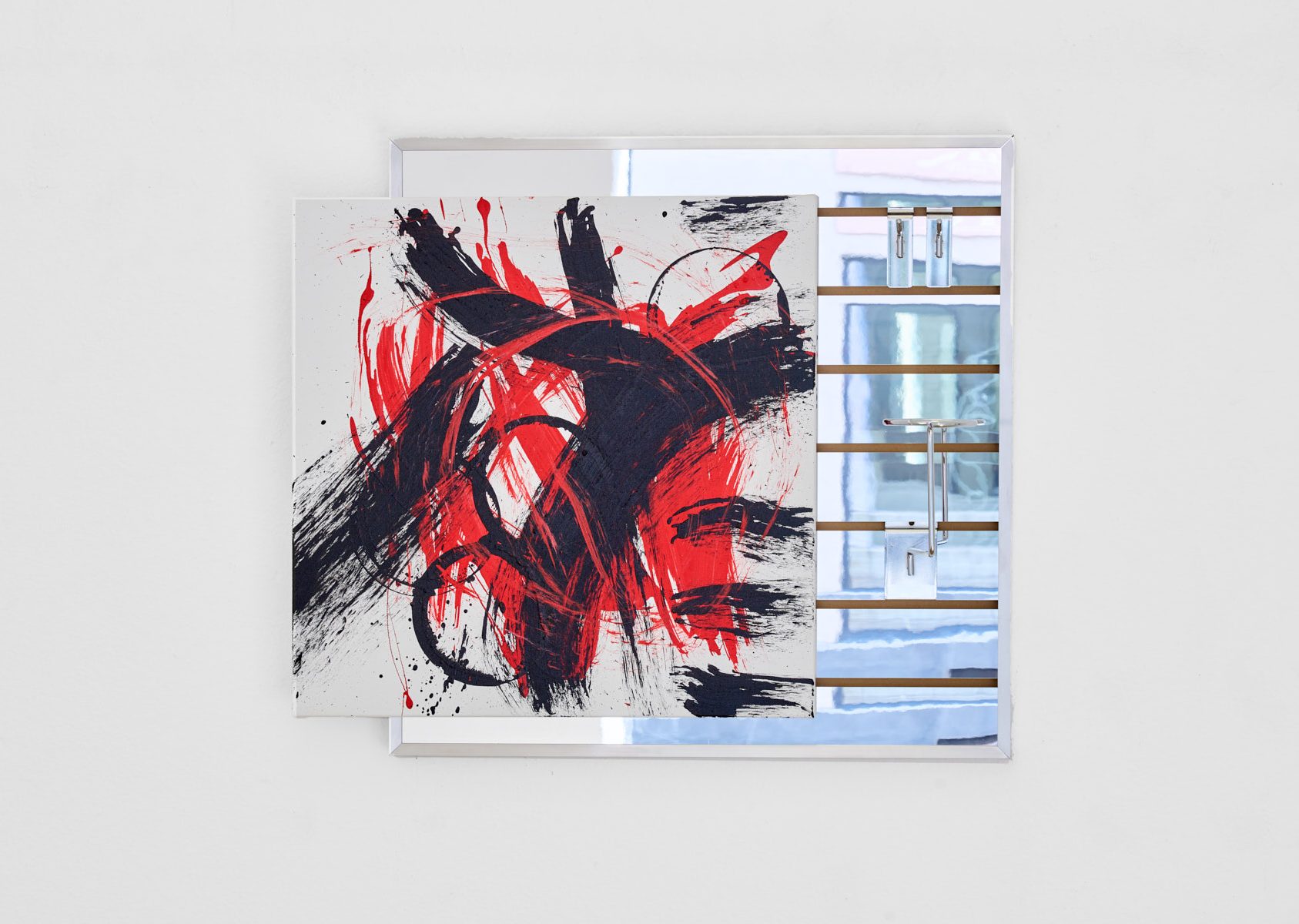
Josephine Meckseper builds on this strategy by adapting elements of merchandise presentation systems for her works and, in a certain sense, infiltrating or contaminating them with new, proprietary content. Thus, various wall objects in Heppenheim can now be seen based on so-called "mirror wall panels". These are rectangular mirrors with horizontally grooved rails for hanging that Meckseper prefers to install in chrome-plated or matte-black coated brackets, wire baskets, metal chains, or other connecting elements.
In this way, in the case of the work "The Ruler" (2024), for example, she attaches a luxurious, semi-transparent women's stocking in bright blue with reinforcements in the cuff and at the heel to a so-called "sock leg", as it is used in storefronts of fashion stores or medical supply stores. The stocking is reflected in one way in the mirror wall panels called "slatwall" in American English, but on the other hand, exactly this blue is reproduced in a small abstract painting that is also part of the display. The work "The Innocent" (2024), which hangs next to it, is based on the same principle. However, since only black, white, and gray shades are used here, a completely different effect results.
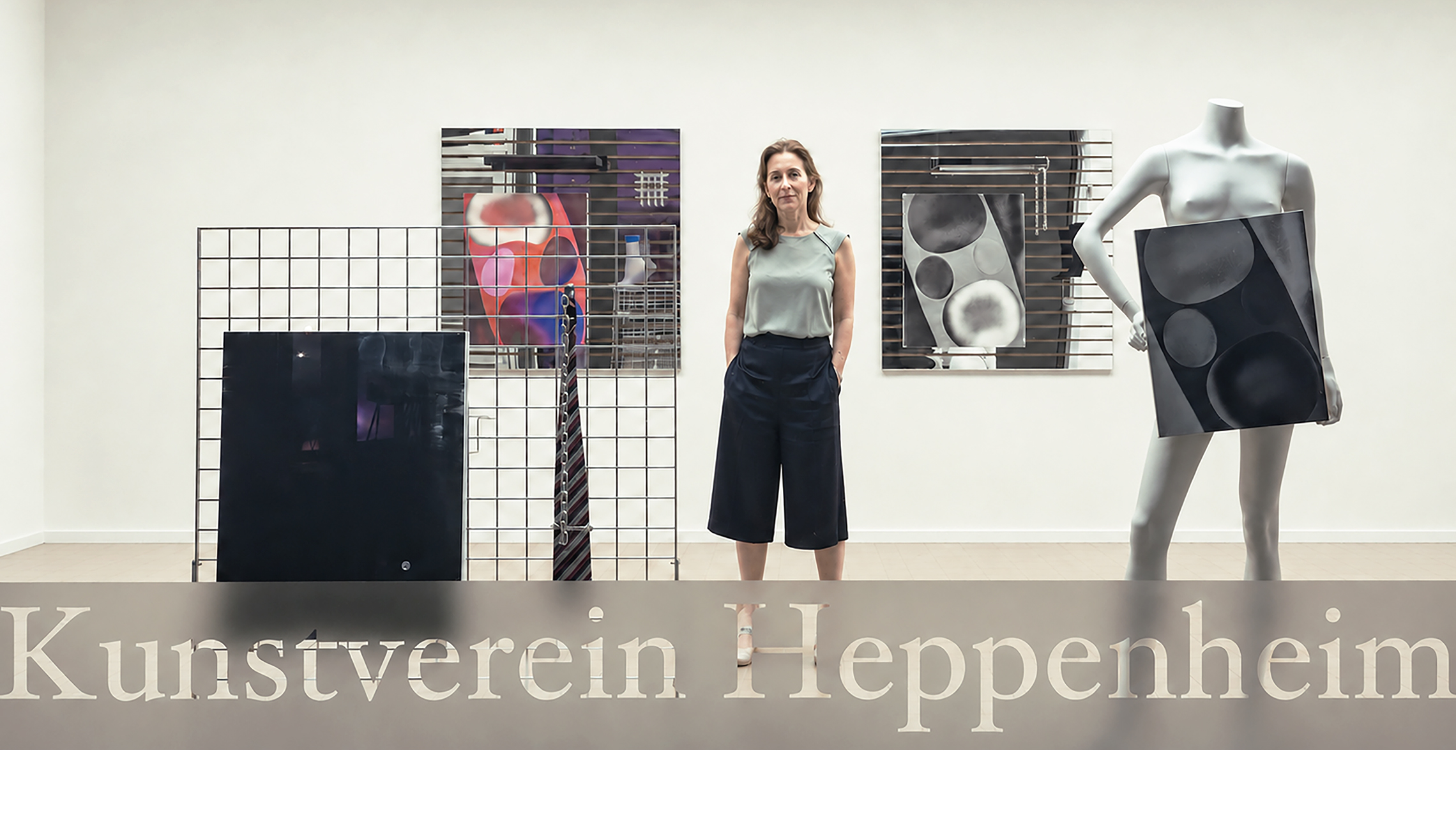
In Heppenheim, Josephine Meckseper of course also plays with the aesthetic qualities of the large storefront found there. She places an eye-catcher there in the form of a headless, undressed and brilliantly white female storefront mannequin, who she has had made to hold a self-contained abstract painting in grayscale tones. A chromed grid stand is then placed to the left of it on two transparent, blue-colored Plexiglas feet. The work from 2010 titled "Untitled (Cobra, Tie)" is completed by a slightly oversized tie in the American national colors, which might appeal to Trump supporters, and also a painting by Meckseper that is adorned with appliqués. The artist describes her approach as follows: "My work deals with our post-industrial era: found materials, overprinted street advertising, shop window displays, testimonies of social interactions – all of which together form an image of a time-bound environment or situation."
And what attracted them to the rooms of the Heppenheim Art Association? Josephine Meckseper again: "The context is perfect for my works. The original idea for the exhibition was to show my large window installation 'Consumer Center' from 2006. For logistical reasons, this could no longer be realized in 2026; furthermore, I wanted to show newer works that incorporate the existing former bakery window." The idea behind my glass showcases and window installations has a European background – Walter Benjamin’s Passagenwerk and Mies van der Rohe’s glass pavilions, as well as the question of how early modernism and the avant-garde developed as aesthetic and political countermovements to Neoclassicism and capitalism. And to consider the street as a political and commercial space and, in this context, to strive in a certain way for a kind of staging of the banal – this is always also what interests me. It is always about considering the importance of the street as a stage of resistance; how, therefore, the shop windows can become points of attack or targets during demonstrations." Whether these connections are conveyed to all passers-by who are heading from the train station to the Heppenheim inner city is not necessarily important to Josephine Meckseper: "In principle, my works are often designed in such a way that they are accessible to everyone and can function on various levels."
But back to the Heppenheim Art Association. Will the Art Association now, after the death of Thomas Zipp, have to find other ways to discover new artists? And how can the decision-makers base their decisions on that? Let’s turn to Dr. Uwe Emig again: "The criteria for selection are very complex and multifaceted and often result from personal observation of the works of art, for example at exhibitions or during visits to galleries and studios. Not all artists come from the network of Thomas Zipp. Since we reach a wider audience with the exhibitions than Heppenheim, promising contacts also arise here again and again, such as with the Frankfurt Städelschule or the Kunstakademie Düsseldorf."
In the past, the Heppenheim Art Society has presented an enormous amount of exhibitions per year, sometimes as many as nine. Whether this can be sustained in the long term remains to be seen. However, next, the Heppenheimers are planning a memorial exhibition for Thomas Zipp, curated by his former students. Alongside Zipp’s own works, the class will of course also display works by his late professor. The opening is scheduled for August 28th.
Josephine Meckseper – Six Five Four Three Two. Until 16.08.2026 at the Kunstverein Heppenheim, 64646 Heppenheim.
The Kunstmuseen Krefeld are dedicating the first retrospective in Germany to Charlotte Perriand’s multifaceted and astonishingly contemporary work.
 7 min read
In the new premises of Plateforme 10 in Lausanne, the Photo Elysée Museum can finally unfold its potential.
 12 min read
Works from the Gunther Jaeger Collection – July 31 to October 25, 2026, Kunsthalle Jesuitenkirche, Aschaffenburg
 2 min read