 9 min read
 9 min read
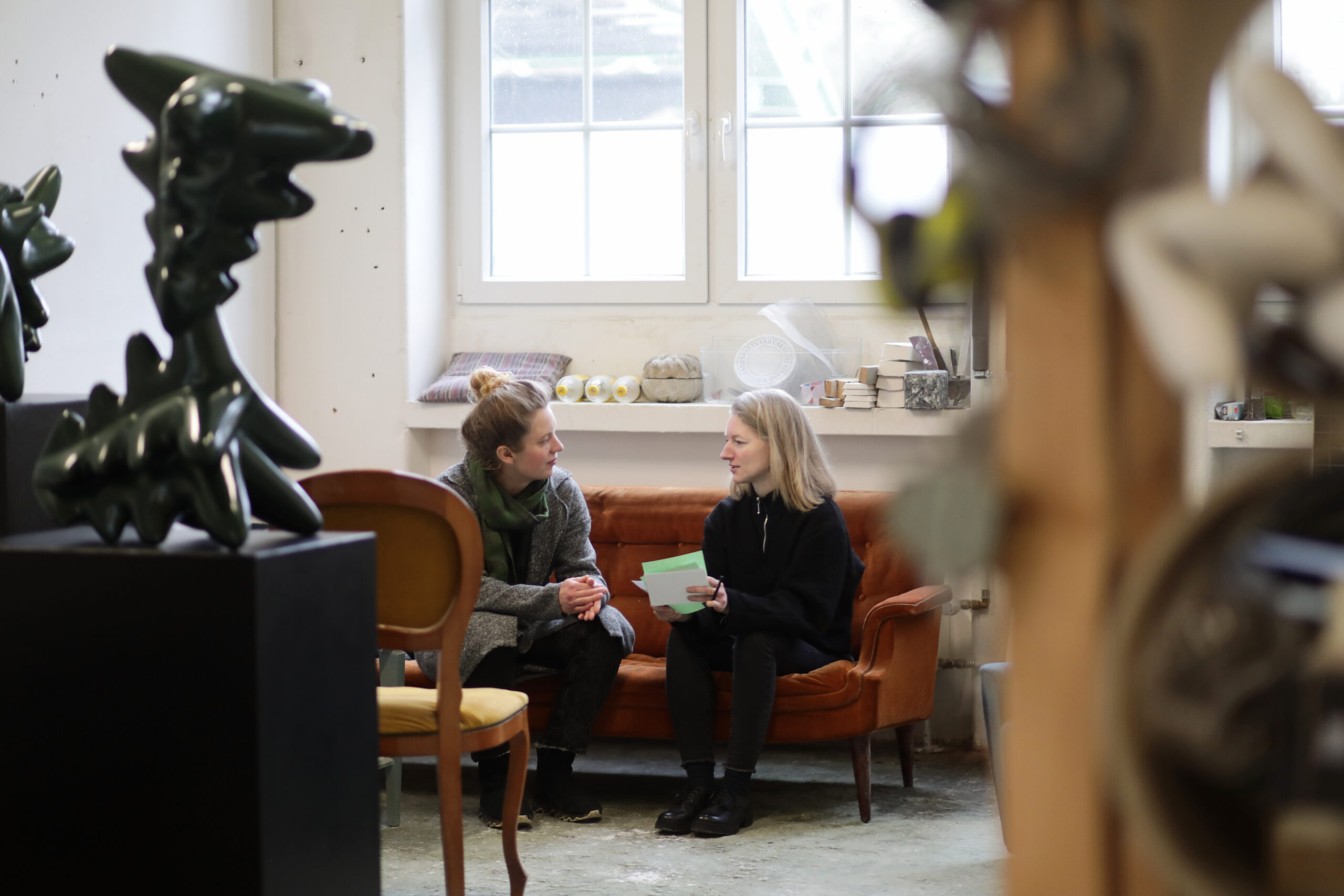
The works of sculptor Jaana Caspary have been capturing my interest for several years now: Caspary creates perspectives based on plastic bodies that go beyond purely artistic perception and reflect living spaces and realities. We met on a drive from Wuppertal to Bielefeld, together on our way to an exhibition of an artist friend. Now Jaana Caspary is showing her work at the Sculpture Park Waldfrieden in Wuppertal an individual exhibition titled there. This exhibition is the occasion for a conversation, for which I accompanied the artist and the photographer Anna Schwartz for a day in Wuppertal. In Casparys studio we discussed her sculptures, drawings, as well as photographic works, and the infrastructural and individual necessities underlying her work as a sculptor. As a result of a walk through the Sculpture Park Waldfrieden We visited their exhibition and discussed the creation, display and experience of sculpture and why working with hands and three-dimensional objects is important for Jaana Caspary.
Jaana Caspary sits on the sofa in her studio near the Wupper River. The hall-like rooms with four-meter-high ceilings are brightly lit: daylight enters through a long row of windows that opens towards the river and becomes visible through the passing gondola train at regular intervals. "Before I discovered this studio, I worked for a year in a studio on the fourth floor that was accessible only via a narrow hallway. Not very suitable for working in the medium of sculpture," notes the sculptor Caspary, who increasingly works with large-scale sculptures, and continues: "That quickly brings you to spatial limitations."
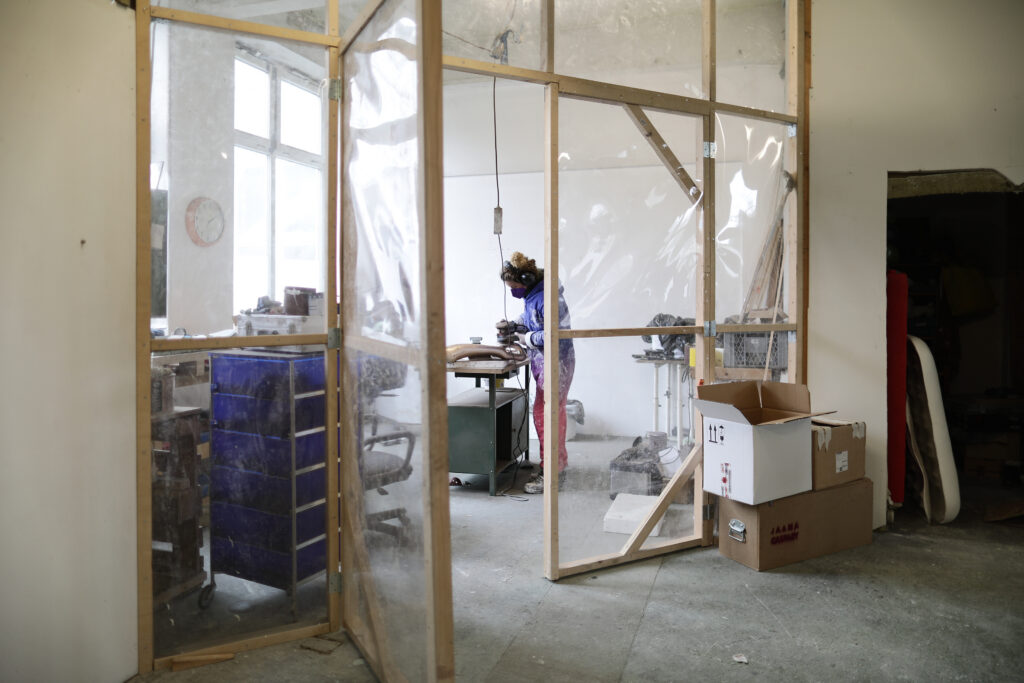
For her current studio, her landlord expanded the entrance door; Caspary herself has divided the rooms into different work areas that also spatially organize her work processes: In one area, for example, she creates forms, explores their effect as objects – here she makes models that are then used for further execution, for example in the foundry. In a separate area, she performs painting or works on smaller bronze sculptures, polishing them. Finally, near the seating area, where we have taken our seats and are talking to each other, she also surrounds herself with the sculptures she has already completed: "It is important to me that there is a space where I can encounter my sculptures, because the perception process is also part of my artistic work. In this context, I am constantly remodeling or storing objects in my storage area when I need more space for a new work."
The space for working is essential for the sculptor. For this reason, she specifically searched for her studio in Wuppertal. Plenty of space, a central location, and lower rents. "I find diversity important," says Jaana Caspary, "but I can't imagine an atelier in larger or more popular cities. I value the exchange between artists and actors in the art field in short and direct ways. And as a sculptor, there are aspects that must be taken into account in my work, such as weight and volume. A sculpture weighing 1.7 tons must first fit through the studio door and from there it can also be moved with a crane. At best, it finds space in a truck; otherwise, I have to calculate with heavy-duty transport. Many organizational factors are involved in working on large-scale projects; a sculpture takes up a certain amount of space, requires new solutions depending on the execution."
How do material and support come together in a wall installation? Does a freestanding sculpture stand on its own, or does it require a special foundation or a stabilizing plate? "For the sculpture," says artist upside-down (2022), which is currently in Sculpture Park Waldfrieden in my exhibition there What was visible and what would remain permanently in the collection after the exhibition was held there was my studio; despite a ceiling height of four meters, it was too small. The sculpture is a total of four meters high, but to assemble the two parts that make it up, I needed a room height of six meters. To build the 1:1 cast model, I went into the backyard of the nearby Gallery Grölle Moved away: There is a large hall where I converted the sculpture into a model between 2020 and 2021. For further casting into bronze, it then went to the foundry."
Different production techniques and molding processes span Jaana Caspary's sculptural work. Often a drawing of a sculpture precedes a molded form in ceramics or clay, as well as molds in acrylic, casting resin or plaster. "In modeling, I consider what material the sculpture will be made of," notes the artist, "but much of it also arises during the process. The bronze Swirl (2023), for example, which is located in the outdoor area of the Sculpture Parks Waldfrieden Before seeing it in the lower exhibition hall, I initially wanted to patinate it green. However, in the production process I decided to keep its polished, shimmering surface."
After visiting her studio, we drive to the sculpture park, sit under the open sky on a bench in front of this bronze statue, and look through at the exhibition hall that stands in the middle of the forest. "The stones for the statue were brought from the nearby quarries," she says. Rotation (2023), white opal, and Bubbles (2022), the black marble Nero Marquina with fine, light-colored graining, are both from Italy, from the Carrara workshops. In these works, I have collaborated with stone sculptors," reports Caspary. "From the stone block to the fine details, until the surface is taut and smooth." It is a subtle language of pictorial aesthetics that I follow in Jaana Caspary's words, and that is realized in the face of her sculptures – their sometimes surreal forms and the precisely selected materials. In doing so, Caspary repeats and doubles traditional forms from everyday use, leading from alienation processes of the object into abstract aesthetic worlds. "The shape of the basin, like the wall relief made of plaster Oktogon (2021) is one such form that I actively seek out. It is an example of forms that already have a sculptural quality in their everydayness for me. I develop these forms in my artistic processes – from the negative form to the positive –, transforming found objects, as I call them, also by reproducing them into independent sculptures. In doing so, Caspary subjectifies the objects that are used as models into a material deconstruction: By reproducing or even quantitatively replicating and reassembling forms, the artist frees them from their usability and narrative. Jaana Caspary’s artistic practice acts as a replica of a readymade.
"I didn't consciously choose sculpture – it came one after the other," Jaana Caspary, born in 1988 in Wuppertal, answers my question about what prompted her to become a sculptor. She explains that she has always enjoyed working with her hands.
The summer months of her childhood she spent with her family on an island in Finland: her father, the painter, converted an old sauna there into an atelier, in front of which stood a large table where work was done outdoors. Jaana Caspary’s mother is also an artist, a photographer. With her brother, Caspary walked through the forests there, collecting roots and twigs, grinding the bark and assembling the finds into objects.
During an internship at the Wuppertaler stages In the field of stage sculpture, she then modeled animals in clay, inspired by the workshop supervisor, who had cast them as reliefs. "I noticed that I am good at three-dimensional work," notes Caspary. Based on this, during her school years she completed an extended internship in the studio of sculptor Tony Cragg in Wuppertal, where she subsequently worked occasionally and learned a lot about working with wood and Styrofoam: "Materials, tools, the visual language of the sculptures – that fascinated me all," says Caspary.
What was essential for her work was, not least, her studies in the class of Belgian sculptor Didier Vermeiren at the Art Academy in Düsseldorf and the discussion she initiated with him about the relationships between sculpture and the base, or with the volume of the pedestal and space: "In doing so, I remained," says Caspary, and continues: "When creating a sculpture, I always think about its presentation, its connection to the human body and the surrounding space. Sometimes I make the base in the same or similar material as the sculpture itself; sometimes I design a base sculpture so that it rests on the ground entirely without a pedestal: depending on what the sculpture – even beyond its own limitations – needs."
In her current exhibition at the Skulpturenpark Waldfrieden, Jaana Caspary is showing for the first time drawings alongside her sculptural work. "I have always drawn a lot, primarily sketches, but three to four years ago I resumed drawing as such." Also in Paris, where she spent a scholarship year in 2016 at the Cité Internationale des Arts Having completed it, she drew a lot – sometimes because the location was less suitable for her sculptural work.
Drawing as a medium has various functions for the artist: On the one hand, she develops forms for her sculptural work through drawing. But aspects of the sculptural process also transfer over when Caspary models with a pen on a sheet of paper, entering into sculptural depths and heights and creating bodily spaces: for example, intertwined strings, ropes braided in coarse meshes, or a mass of accumulated fabric that Caspary has produced by moving in circles and which in turn makes them appear three-dimensional, almost floating on the sheet. "That is why I call them sculptor's drawings," says the artist.
Her engagement with the genesis of pictorial forms is multifaceted, for example in the form of photographic works or photo collages, in which she either photographs found (organic) objects or extracts and reassembles product forms that have already been photographed – with the question of how such a form might also function as a body in space.
Showing art by other artists who inspire Jaana Caspary is important to her. Starting with a small exhibition space in Wuppertal-Arrenberg, which Caspary maintained, the Gallery Grölle They created a joint exhibition format in 2016: Im Room2INTERVENTIONS For several years now, Caspary has been presenting works by artists from Künster:in order to create trans-city meeting spaces – for example with artists from Berlin and Bielefeld. One of her special initiatives is the 2018 foundation of the Sculpture project Hardt, With which she brought plastic works into the public space of Wuppertal as curator and artist: "Sculpture is a three-dimensional body that can be perceived from different perspectives in space, also in the outdoor space, in the open air. That was my intention when I created this." Sculpture project Hardt in Botanical Garden Wuppertal I began to experience sculpture in nature, interacting with it, with trees and plants. Sculpture does not necessarily have to be exhibited in a museum. I see it as a great benefit for its reception that sculptures can reach people in public spaces."
Jaana Caspara's exhibition there It can be seen at the Waldfrieden Sculpture Park in Wuppertal until August 6, 2023.
Photos in the studio: Anna Schwartz, Wuppertal, annaschwartz.de
Photos of the sculptures: Michael Richter, Wuppertal
The Kunstmuseen Krefeld are dedicating the first retrospective in Germany to Charlotte Perriand’s multifaceted and astonishingly contemporary work.
 7 min read
World Heritage Site Völklinger Hütte: Spectacular Son-et-Lumière Art
 1 min read
Tierdarstellungen in der Kunst. Heidi Horten Collection, 27. März - 30. August 2026.
 6 min read