 8 min read
 8 min read
At the end of one of the longest spatial flights, a small-format image hangs on a wall in the exhibition space: it shows the back of a painting, the stretcher frame with its supports, the stretched canvas, and the rear view of two figures who are working on installing this image onto the white wall. The packaging barely protrudes into the space of the painting "Unpacking", which Tim Eitel painted in oil on canvas in 2020 and placed in a quiet yet central location in the Kunsthalle Rostock. It is one of 54 works that the artist presents there in his solo exhibition. And it shows that art is something made and that images only gain form in the context of display, reception, and classification.
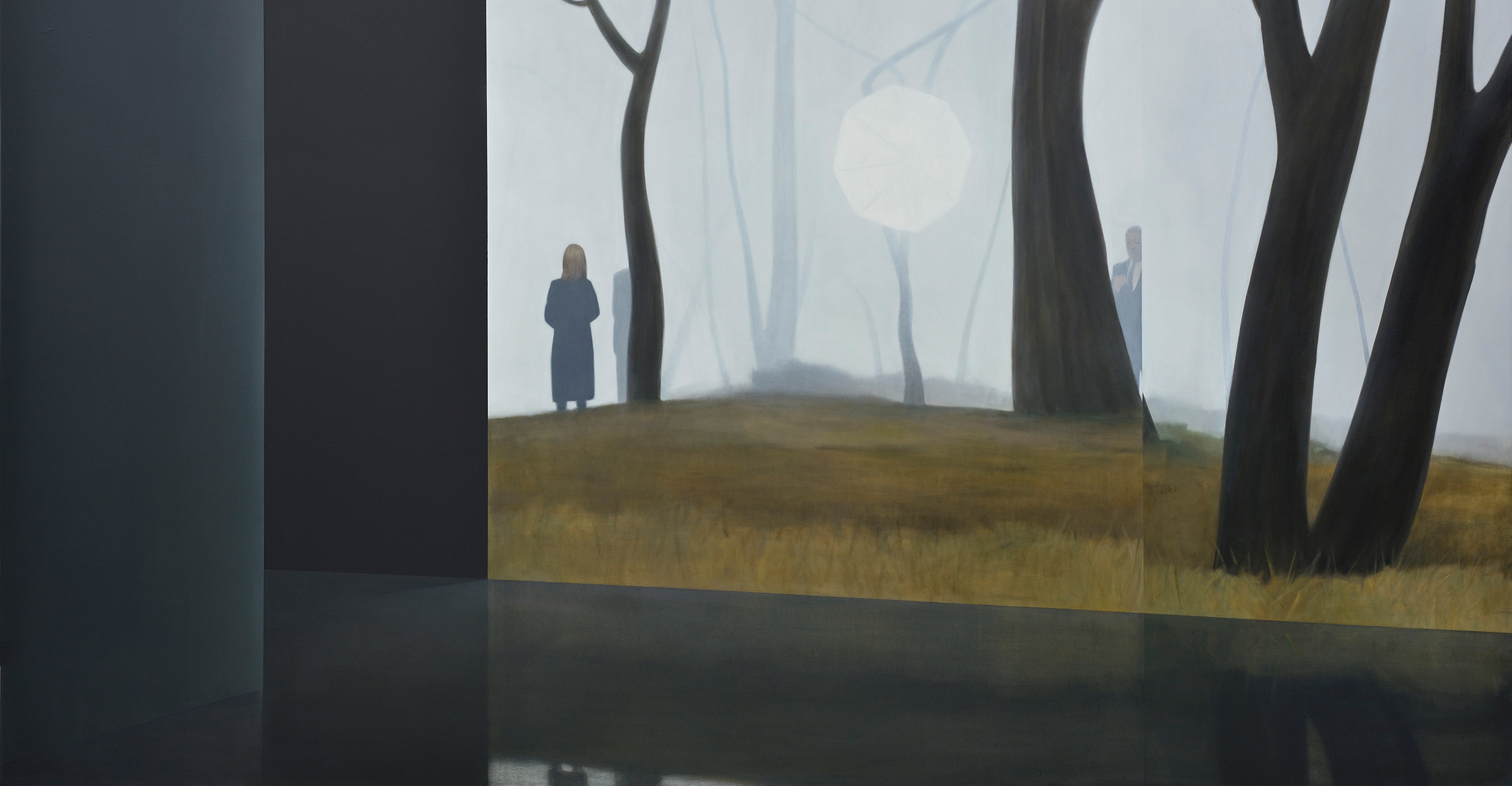
Tim Eitel, born in 1971 in Leonberg, studied painting at Arno Rink at the University of Art and Design in Leipzig and lives in Paris and Berlin. In the early 2000s, he began using his museum paintings, in which he brought together the architectures of museum institutions as well as the works of art and their viewers on display therein, to create paintings. The relationships between museum visitors, the paintings, and the place itself are a subject that Eitel also addresses in his more recent and new paintings, some of which can be seen at the Rostok Art Hall. However, in these paintings and watercolors, presented there for the first time, the artist focuses much more directly on the perception of images: on possible, invisible, hidden, changing, or lingering images. On people who have left behind a (symbolic) imprint. On images that appear before the inner eye, as he says.
"When I started painting the first museum images, I photographed a lot in museums. While looking at the images, I discovered that there are certain gestures and postures that appear again and again and are relatively universal. Gestures and poses are a response, a reaction to space – like a conversation between the space and the person who performs them," tells me Tim Eitel at the Sculpture Garden of the Kunsthalle Rostock, after we have visited his exhibition.
For example, the painting "View into a Room (3 Figures in 2 Moments)" (2019) shows three figures in a museum-like architecture filling the space with their respective perceptions: One figure photographs with a mobile phone an invisible situation, a second turns their gaze in the same direction, but the common point of reference that becomes the object of contemplation within the image remains hidden behind a (spatial) edge. A third figure leads her eye pair through a glass facade into a flat landscape, guiding the gaze around.
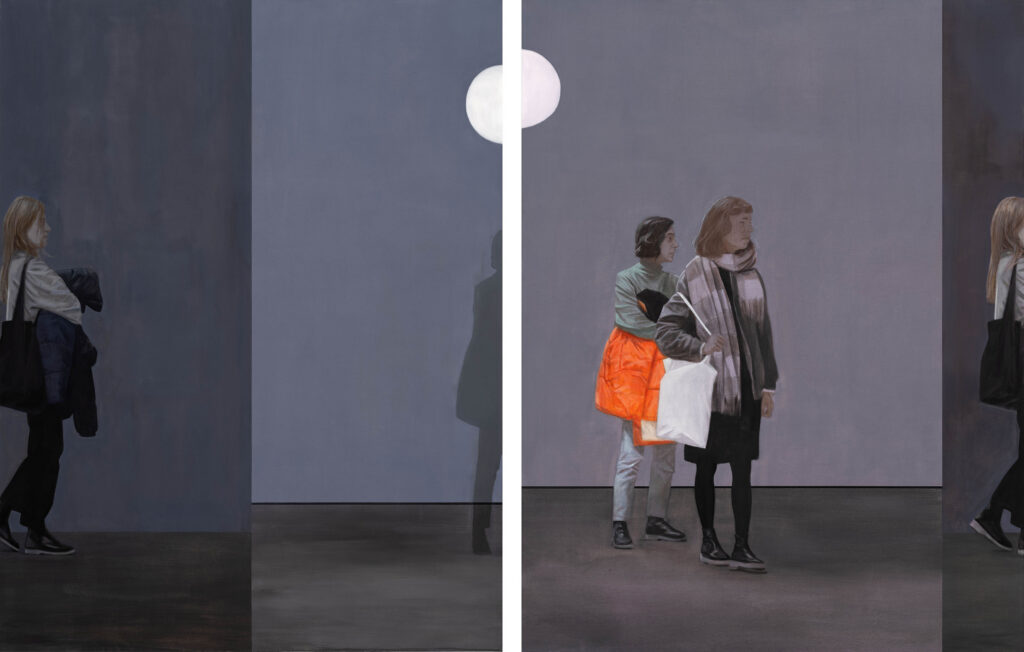
The large-scale diptych "Loop (3 Painters and a Split Moon)" (2024) goes one step further, as the placement of the individual image elements is variable. Eitel's hanging in the Kunsthalle shows a figure on the left panel that enters the image and whose outline is moved out of the field of view in the second painting, which is positioned right-aligned with only a narrow gap between the edges of the panels. Through the variable arrangement of the canvases, their readability becomes fluid, becoming a claim in space: What happens when the boundaries of the image surface are overcome and the figures become people? Narrative lines that transport the diptych that revolves in the mind could thus be, but also (entirely) different.
The act of spatial reference of the viewer’s body to the visual becomes increasingly present in Tim Eitel’s painting, evoked by the choice of small, medium and large formats, by creating distance and closeness. While approaching a small format to capture the details of a facial expression in sunlight or the folds and shadows of a jacket, in a large format painting the only hinted figure is already recognizable from a distance, emerging from a monochromatic surface in a shadowy or reflective manner. In some paintings the image becomes the object within the image; in other places a single gaze among the depicted figures captures my eye in the visual field of the painting.
Tim Eitel works according to photographic templates, but the essence, as he explains, is usually not included in a specific photo. The basis is his image archive, from which he searches for photographic images, prints them in color, stacks them, and sorts them. "The images that interest me the most are at the top. The images that always stay at the top are likely processed into a painting. These photographs have no artistic pretensions at all; I see them as notes with which I work in a collage principle: I extract elements from selected photographic images, which I then transfer in a very free manner into my painting. The painting process itself, however, gives entirely different impulses."
It is a search and finding of fragments that condense over a reductionist process in his painting and combine with an inner reservoir of images to create a new image. In the spectrum of his paintings, individual elements such as clothing items, shoes, or bags are repeated. Shapes such as circles, rectangles, or surfaces allow for the internal organization of the images as well as a shift in the flow of events from image to image, resulting in associative chains, overlaps, and cross-references in the sum of the exhibits. Scenes such as those of a couple walking through an exhibition space find a repetitive echo within an watercolor: the couple is repeated in its movement, doubled, and motion is inscribed into the image. And also multi-part series such as the three-part portrait "La Coupe" (2021), painted on a wooden background, which depicts a bust of a man whose beard is being trimmed, make it clear through the panels shown in sequence that Tim Eitel's paintings draw a connection between one another and the course of things – accompanied by the question of how one positions oneself in relation to something or a situation. "My older paintings have an almost sociological approach from today's perspective: Through the clothing and poses of the figures they are very much rooted in the era of the 1990s. My work today is no longer about the present as the present, but about a present as a pictorial situation – about states."
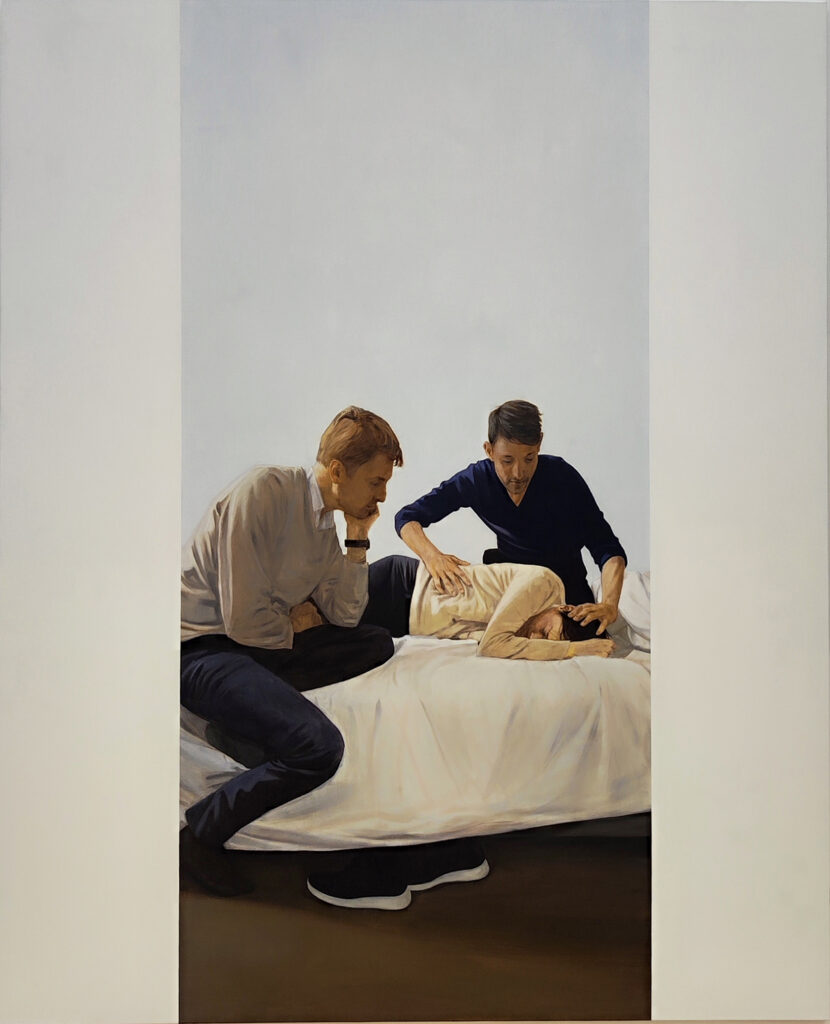
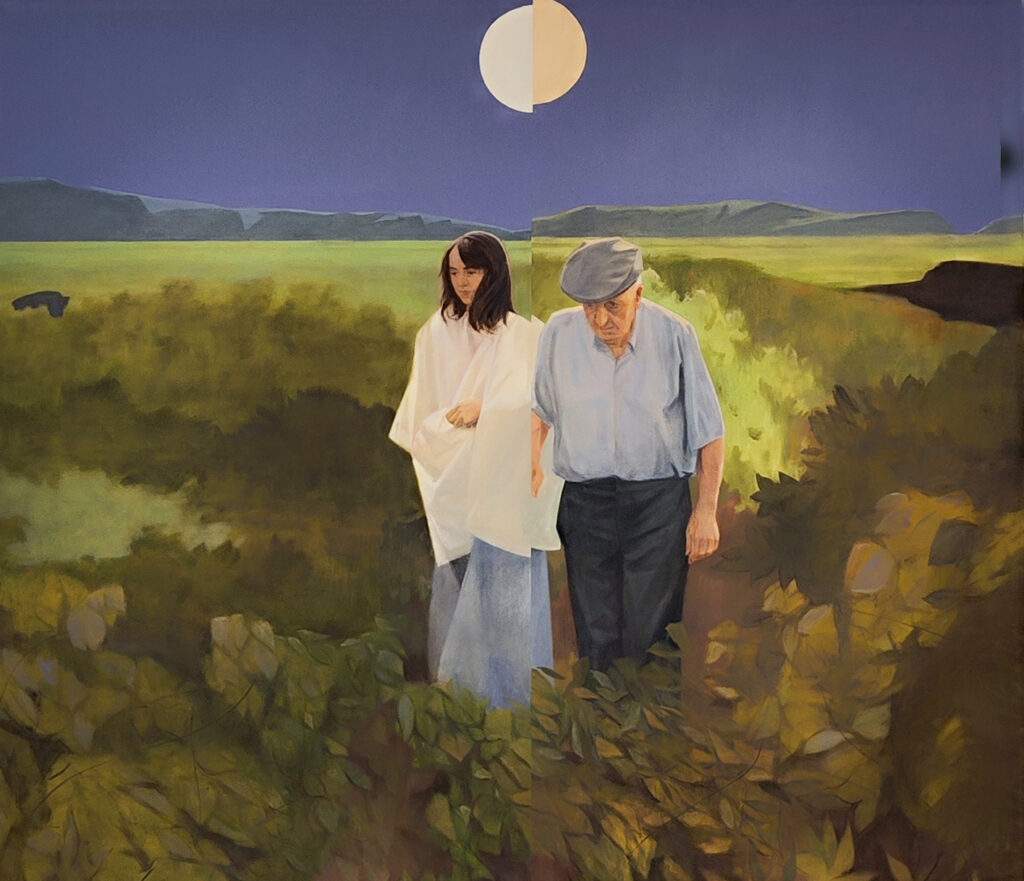
Many of the paintings on display in the Rostock Kunsthalle show his wife Sophie, who passed away two years ago, in various situations. With the exhibition "Proposals for Imitations 2015–2024" and the accompanying catalogue, Tim Eitel makes a clear reference to her death for the first time. Following already known paintings such as "La Séance" (2021), featuring a scene of healing bestowal, there are images of friendly connection and comfort, as well as those through which a cut edge runs through the painting, as if the tangible time is partially distorted or an invisible rupture is being enacted within it. Individual elements of these paintings thus appear as if the image has been torn apart and then reassembled slightly. Sometimes a grey veil flows into the paint and over the motif, as if that passage belongs to another time plane in the same space. This displacement is accompanied by a sonorous, silent sound surrounding the paintings. A sense of lingering effect, as manifested in the painting "Nachbild" (2016–2022), in which Sophie walks through a French wine-growing landscape alongside her great-uncle, where worlds are now merging together. Whether he will continue to paint in this image remains open to Eitel.
About two years ago, Tim Eitel made the transition from oil paint to tempera. The brushstrokes of the painting process remain more visible, but at the same time the paint dries more evenly, forming a consistent layer – an effect similar to a skin that layers over the painting ground. He has been painting some of his works on wood for a long time, which emphasizes the physical presence of the people portrayed. In contrast, the watercolors, which often appear like preliminary or intermediate studies, make the gestural approach more visible. Eitel has expanded his technical spectrum of images.
His paintings have incorporated a certain existentialism regarding the ways in which memory functions and the question of how time can be represented; this existentialism focuses on the value of interaction: in the contemplation of art, the encounter in shared public spaces, the shared seeing, experiencing, questioning, and discovery. His paintings thus appear as vignettes, similar to sketch-like images in literature that refer to interpersonal relationships or events in Tim Eitel’s depictions.
Regarding the beginnings of his painting, at the end of our conversation he notes: "As a teenager, I had a flash of Francis Bacon when I saw a retrospective of his work in the State Gallery in Stuttgart in 1985. That was the first time I had the idea that I could paint myself." Since 2015, he has been teaching painting at the Beaux-Arts de Paris. "My students also paint from photographs, but they don't print anything; instead, they stand there and paint the image on their smartphones. I think that in an era of new technologies, there is space for a different kind of creativity.". How My students see it, and it also influences me."
World Heritage Site Völklinger Hütte: Spectacular Son-et-Lumière Art
 1 min read
The Kunstmuseen Krefeld are dedicating the first retrospective in Germany to Charlotte Perriand’s multifaceted and astonishingly contemporary work.
 7 min read
The exhibition "Six Five Four Three Two" featuring works by the New York-based artist Josephine Meckseper at the Heppenheim Art Society.
 9 min read