 8 min read
 8 min read
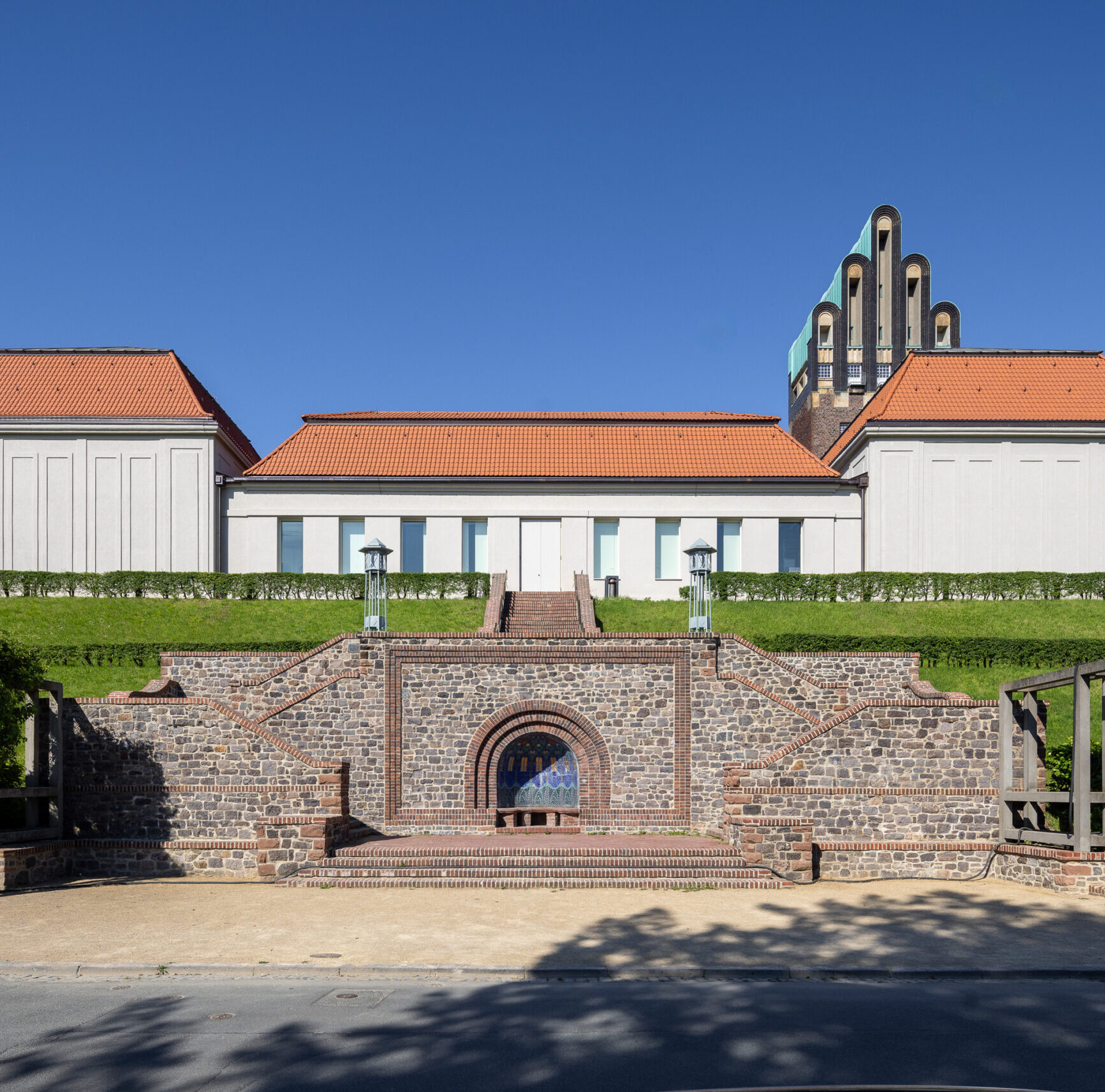
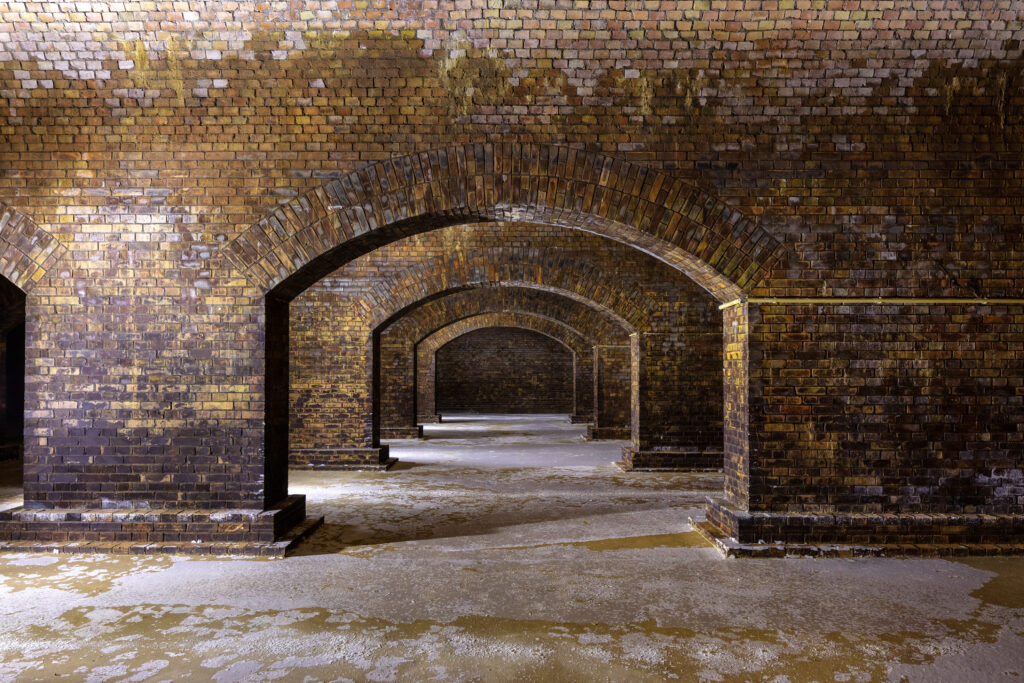
For twelve years, the exhibition building on Darmstädter Mathildenhöhe was closed for renovation. With the Wedding Tower, the symbol of Darmstadt, Joseph Maria Olbrich built it in 1908: on a water reservoir that had been supplying the city since 1880. Two not entirely identical pavilions made of plastered steel concrete and a connecting structure on the east side originally lay around an open courtyard: a modern, sober building for its time. This rose garden was closed during the post-war period and added to the building as Hall 4; a row of windows were added to the east in the 1970s, and the water reservoir remained operational until 1994. The office Schneider + Schumacher has now set up a café in the front area, reopened the windows on the east side and reduced the primary energy requirement by two-thirds with a new concept that uses the water reservoir for heating and cooling.
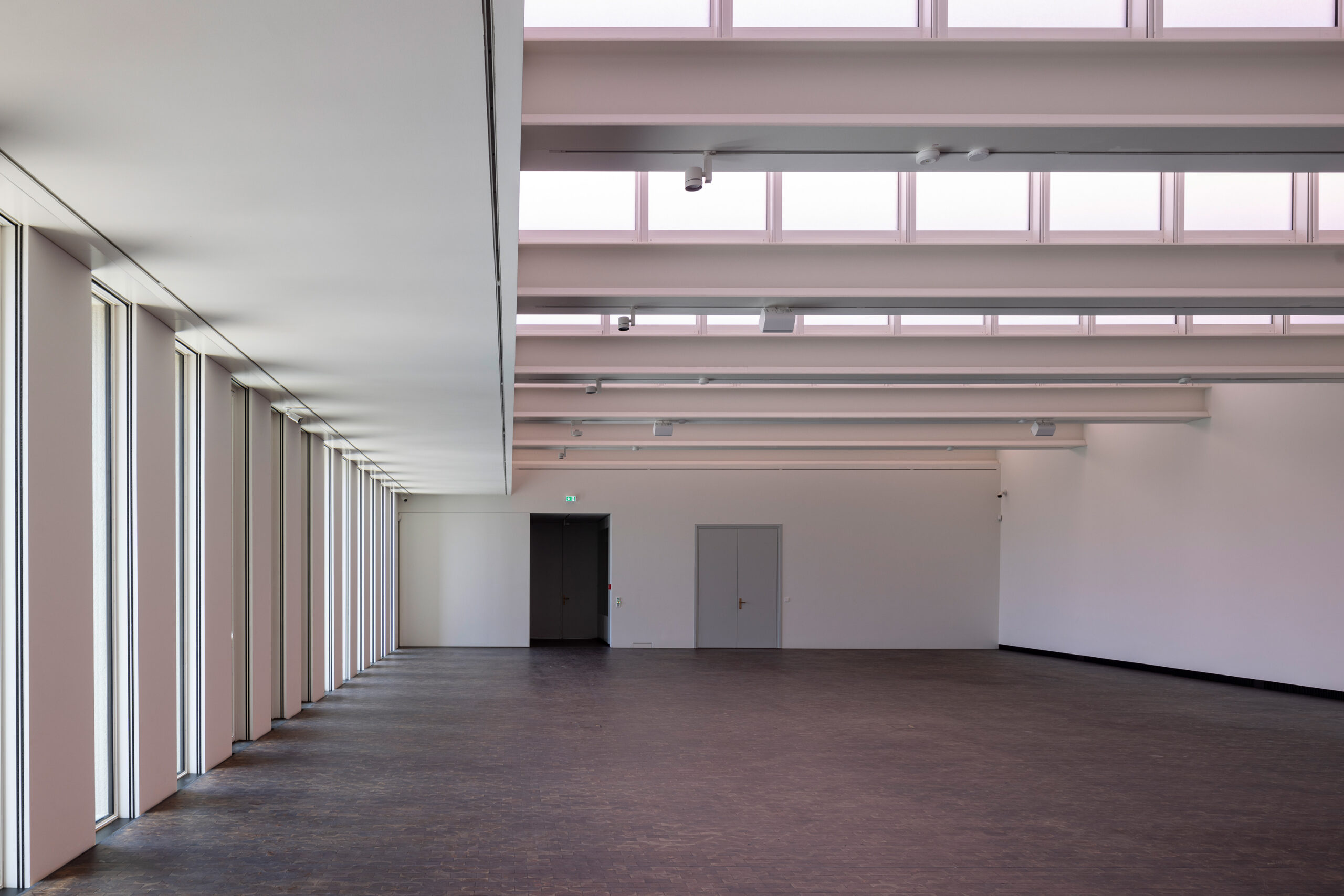
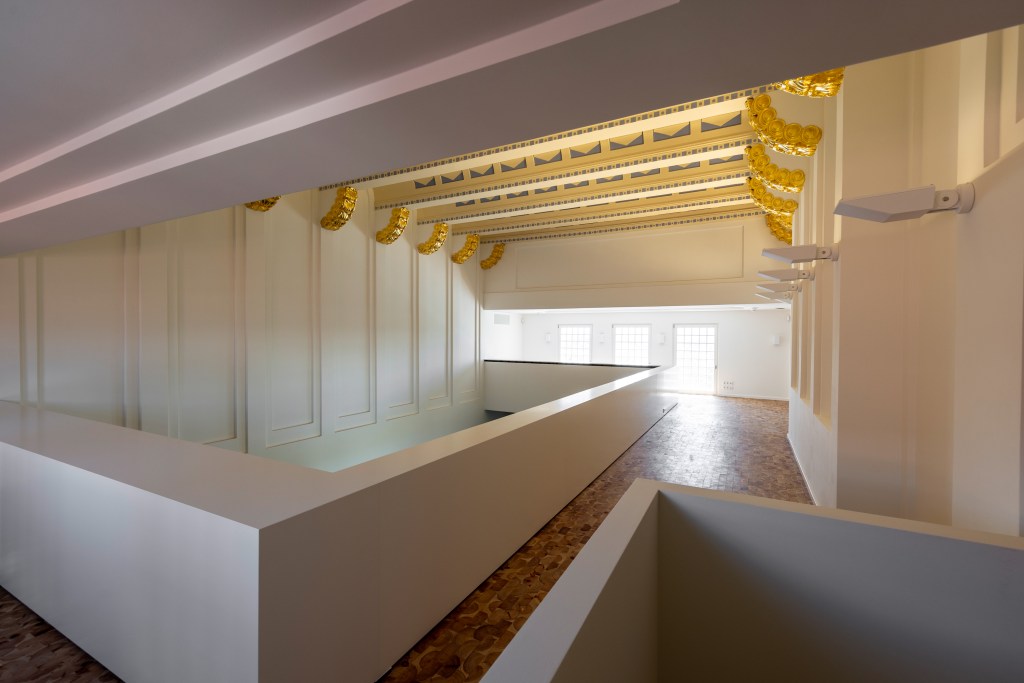
The exhibition building has seen some groundbreaking exhibitions in recent times: among others on Christian Boltanski; Serious Games by Harun Farocki and Antje Ehmann; or most recently for the 100th anniversary of John Cage. For the reopening, the Mathildenhöhe Institute decided to draw on its own collections from the municipal art collection because, as the deputy director Sandra Bornemann-Quecke says, it was not quite clear until recently how long the renovation would take. The collection consists of around 30,000 works and is managed by the Mathildenhöhe Institute as part of public art. It was last on display 40 years ago. The opening was also a milestone because three years ago the Mathildenhöhe became part of the UNESCO World Heritage List.
The collection of a city with around 150,000 inhabitants is not necessarily of regional interest. But Darmstadt is no ordinary city. The Mathildenhöhe: that is the artists' colony, one of the centers of Jugendstil and Art Nouveau in the 20th century. Arts and Crafts-A movement that has dedicated itself to establishing its own museum, right next door, also under the auspices of the Mathildenhöhe Institute. Peter Behrens became an architect here with his own residence. But there was also Darmstadt talks. Their first, in 1950, was accompanied by an exhibition on Humanity in our time, became a landmark for the visual arts of the post-war era due to the dispute between Willi Baumeister and the art historian Hans Sedlmayr. The decisive role was played by Darmstadt holiday courses for new music at Schloss Kranichstein. On Mathildenhöhe, in close proximity to the museum and exhibition building, the Institute for New Music and Music Education (INMM) and the German Academy for Language and Literature are located; the latter has been awarding the highest German literary prize, the Georg Büchner Prize, since 1923.
4 – 3 – 2 – 1, The exhibition title, "The Countdown to the Reopening", also refers to the four halls of the exhibition building and the districts located in the four cardinal directions. This is particularly evident when the view from the east window falls on Rosenhöhe, which is also the subject of a corresponding exhibition section. Street names on the ground and enlarged city plan sections on the walls form the topography. The exhibition offers an excellent opportunity to get to know the city of Darmstadt, even for people from Darmstadt themselves who have long awaited the reopening. This includes popular-historical aspects such as the dialect piece and excursion spot Datterich. However, the topographical arrangement also means that the usual time frames of the stylistic periods and art movements are slightly disrupted. Romantic views of Schloss Kranichstein are juxtaposed with the holiday courses.
At the same time, the artist colony itself is already present at the beginning, in the person of publisher Alexander Koch, who in 1989, with a thought paper, inspired Grand Duke Ernst Ludwig to establish it and who contributed greatly to its success with his publications. What can be seen in the original are a wing designed by Patriz Huber and a bronze figure of the dancer Loïe Fuller by Bernhard Hoetger from Koch’s possession. From there, a line leads to a girls’ and dance school founded in 1911 by Isadora Duncan’s sister, Elizabeth, which only existed until the First World War, and to a performance by Annegret Soltau in the 1980s in the Felsenmeer, photographed in 40 picture tiles by Baldur Greiner, about 20 kilometers south.

The history of the artists' colony also ends with the First World War. But already in 1915, the Artists' Association begins. The attic about the author Kasimir Edschmid, the painter Carl Gunschmann and the SPD politician Carlo Mierendorff of the Darmstadt Expressionism. And the history of the Darmstadt secession: for the magazine The Tribunal Mierendorff managed to win over artists such as Max Beckmann, Karl Schmidt-Rottluff and Ludwig Meidner. Meidner became a member of the Sezession and exhibited in Darmstadt. During the Nazi era, as a Jewish artist, he emigrated to London with his wife Else. Without her, he spent his last years in Darmstadt, where he also preserved his legacy. His works, a large, painted portrait of the writer Max Hermann-Neisse, a small one drawn by Jakob von Hoddis, and the glances of Else at Ludwig and vice versa, form a first highlight of the exhibition.
In the second hall, located on the east side, the post-war history comes to the fore. First of all, because the Werkkunstschule was established here in 1950 right next to the exhibition building instead of a destroyed group of rental houses; but above all because of the New Artists Colony. After Darmstadt had had to relinquish its function as the capital, most recently of the People's State of Hesse, Prince Ludwig, the younger son of the founder of the Artists' Colony, wanted to recapture the former importance as an art city. The seven studio houses were home to, among others, the writers Karl Krolow and Gabriele Wohmann, the theater director Gustav Rudolf Sellner, the theater critic Georg Hensel, the composer Hans Ulrich Engelmann, son of a Holocaust victim and already a participant in the first summer courses in 1946, and the sculptor Wilhelm Loth. Krolow and Wohmann are captured in notable, large-format portraits by Eberhard Schlotter, while Engelmann was painted by Karl-Heinz Schnabel. Engelmann's wife Rosemarie, nicknamed Roma, was a quirky artist who organized an exhibition of children's drawings from all over the world at Mathildenhöhe in 1952, taught in Reykjavik and is represented in the exhibition with an impressive batik wall tapestry.

Portraits are as numerous as landscapes and city views; after all, it is always personalities that shape an art city. Documentary complements the art collections. Interdisciplinary connections are already evident in the first room, where literature, music, dance, and fine art come together. With the New Artists’ Colony, they become the principle. Schnabel also portrayed the photographer Pit Ludwig, who in turn recorded Pierre Boulez, Bruno Maderna, and the flutists Severino Gazzelloni during the Darmstädter Ferienkurse. The paths crossed at the New Sezession, which was founded again under that name in 1945. Wilhelm Loth, president from 1953 onwards, initiated the first Darmstädter Gespräch. Baumeister thanked with the exhibited painting Victory of the blue middle. Later chairmen were Eberhard Schlotter, Carl Gunschmann and Pit Ludwig. But also Wolfram Steinecke, the founder of the holiday courses, was a member of the secession.
Darmstadt is not an island. The development of art in various eras, in the city and beyond, is reflected in the remaining two halls on the north and west sides. Ernst Vogel, a member of the Sezession since 1919, found his own forms starting from Baumeister. In Stuttgart, at Baumeister’s own studio, Charlotte Prinz studied, who in 1993 donated her studio to the city with the stipulation of establishing a scholarship for academy graduates. The diaries of the Korean artist Ankabuta and a large-format work by Genaro Strobel on the Messel Pit are exhibited in a separate mixed form of photography and woodcut.

The many works by female artists deserve attention, starting with Hermione von Preuschen, who studied in Karlsruhe as early as 1869 at the age of 15. At the same time, Luise Büchner, the writer’s sister, and Grand Duchess Alice, daughter of Queen Victoria, founded an association and a school to train women in the arts, which also offered drawing lessons from 1875 onwards. The municipal collection also includes the largest collection of works by Arnold Böcklin, a foundation of collector Maximilian von Heyl. It is permanently exhibited in the Landesmuseum Darmstadt, both are represented in the exhibition with one work each. In 1963 Laura (Polly) Williams, the sister of the Fluxus artist Emmett Williams, founded the gallery Ordo with the artist Etzel Klomsdorff. In the end, the audience in Darmstadt was lacking; the gallery had to close after a year. But the city remains the beneficiary.
In the last hall, located towards the west and facing the city center, two themes dominate: the destruction of Darmstadt during the Second World War and the art prize of the city of Darmstadt. In a single bombing night in September 1944, the city was destroyed to 80 percent; only ruins remained of the inner city. More than 11,000 people lost their lives. Several artists have painted the destroyed city, among them Karl Deppert, whose son provides information about it in a video. The city has been awarding the art prize since 1955. Since 1995, it is named after the initiator and – with Helmuth Lortz – first laureate Wilhelm-Loth Prize. Approximately one third of the award winners present the exhibition; the most recent were Harun Farocki, Gregor Schneider and in 2018 Olaf Nicolai. Finally, a video by Mila Hundertmark can be seen as the last acquisition of the municipal collection; the video has the ironic title: What could be called the absolute reality. An inner-city street becomes a photographic expression. A tongue drills a hole through the paper, a lipstick-colored mouth gradually devours the entire image.
Museums are increasingly resorting to their own collections in the face of the horrendously high insurance premiums for loaned works and tight budgets. And at least locally, this usually attracts great interest. Darmstadt is not Munich or Berlin, but it has an interesting history and the collection accordingly has plenty to offer.
The Kunstmuseen Krefeld are dedicating the first retrospective in Germany to Charlotte Perriand’s multifaceted and astonishingly contemporary work.
 7 min read
In the new premises of Plateforme 10 in Lausanne, the Photo Elysée Museum can finally unfold its potential.
 12 min read
World Heritage Site Völklinger Hütte: Spectacular Son-et-Lumière Art
 1 min read