 7 min read
 7 min read
In short: The exhibition "Chargesheimer The Great" at the Julian Sander Gallery in Cologne contains something very personal. This is due, at first glance, to the fact that the exhibited works seem almost casually arranged in the gallery spaces. A photographic portrait of Louis Armstrong (1961), developed in strong black-and-white contrasts, flanks a group of people with a bouquet of flowers in the entrance area, from where my eye pair falls on an internally rotating kinetic object. Next to a piano, photographic portraits in close-up view of Chet Baker (1961), Jean Paul Belmondo (1956) and Konrad Adenauer (1956) hang in a row, as they belonged to the inner circle of acquaintances. The main wall of the room presents light graphics and chemical diagrams of the artist, which were created entirely without a camera and which allow the discovery of the painterly compositions and crystallizations of chemicals on photographic paper. One of them shines brightly on a glass support, is equipped with a softly glowing light panel to deepen the cosmic dimension of the image. In this silence of the situation, while the rotating motors of the so-called "Meditations Mill" (1968) sound in the background in a uniform manner, it is somewhat as if the gallery visitors, including me, were waiting for a gathering – which subsequently unfolds in a series of socially reportage-like photographs about which I had previously only known Chargesheimers work.
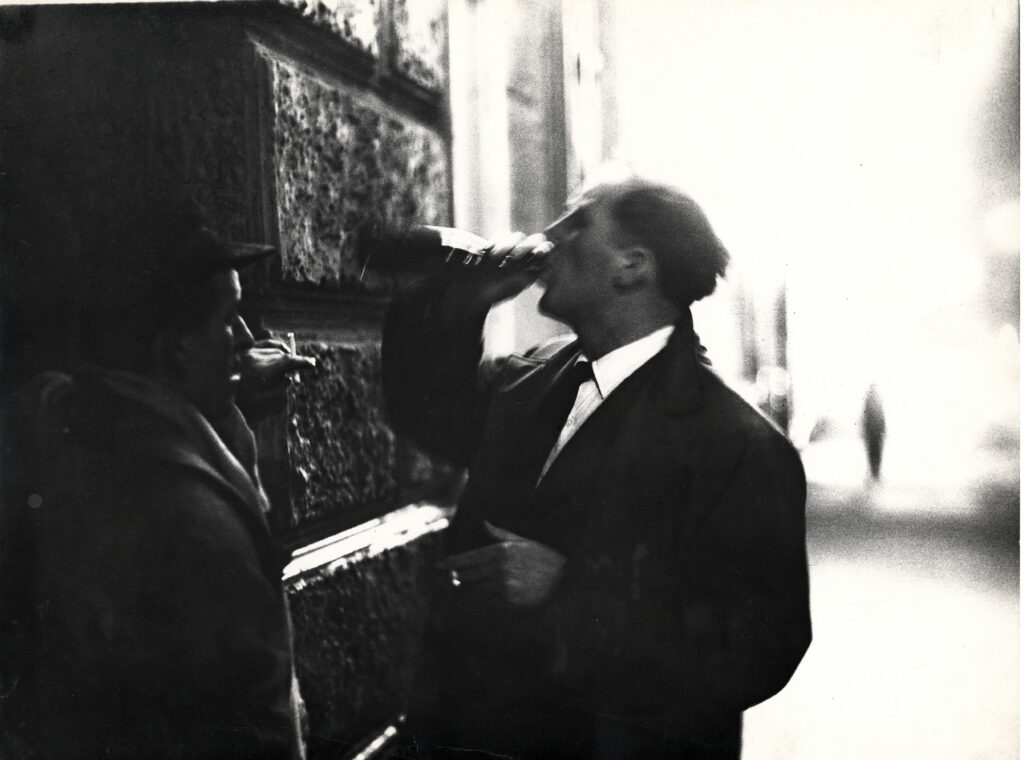
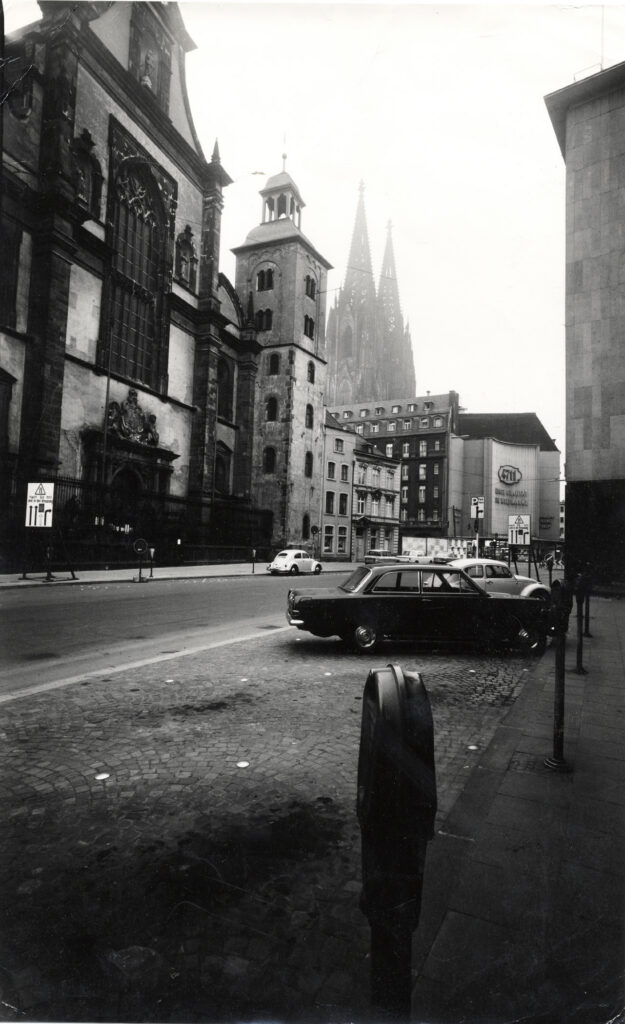
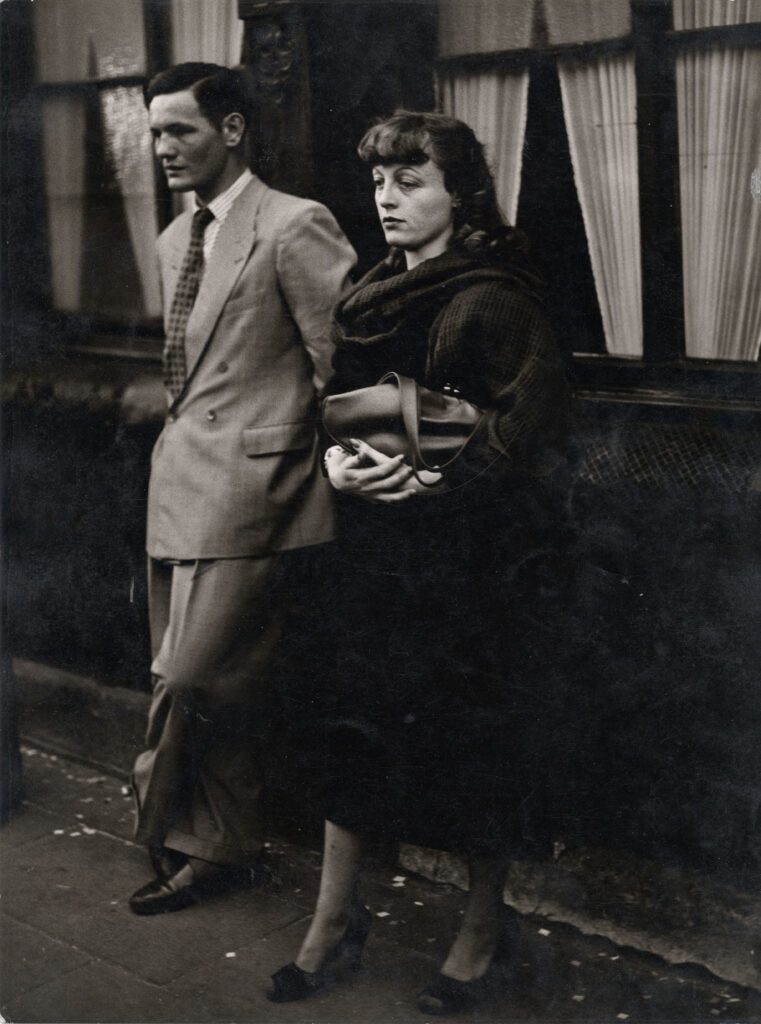
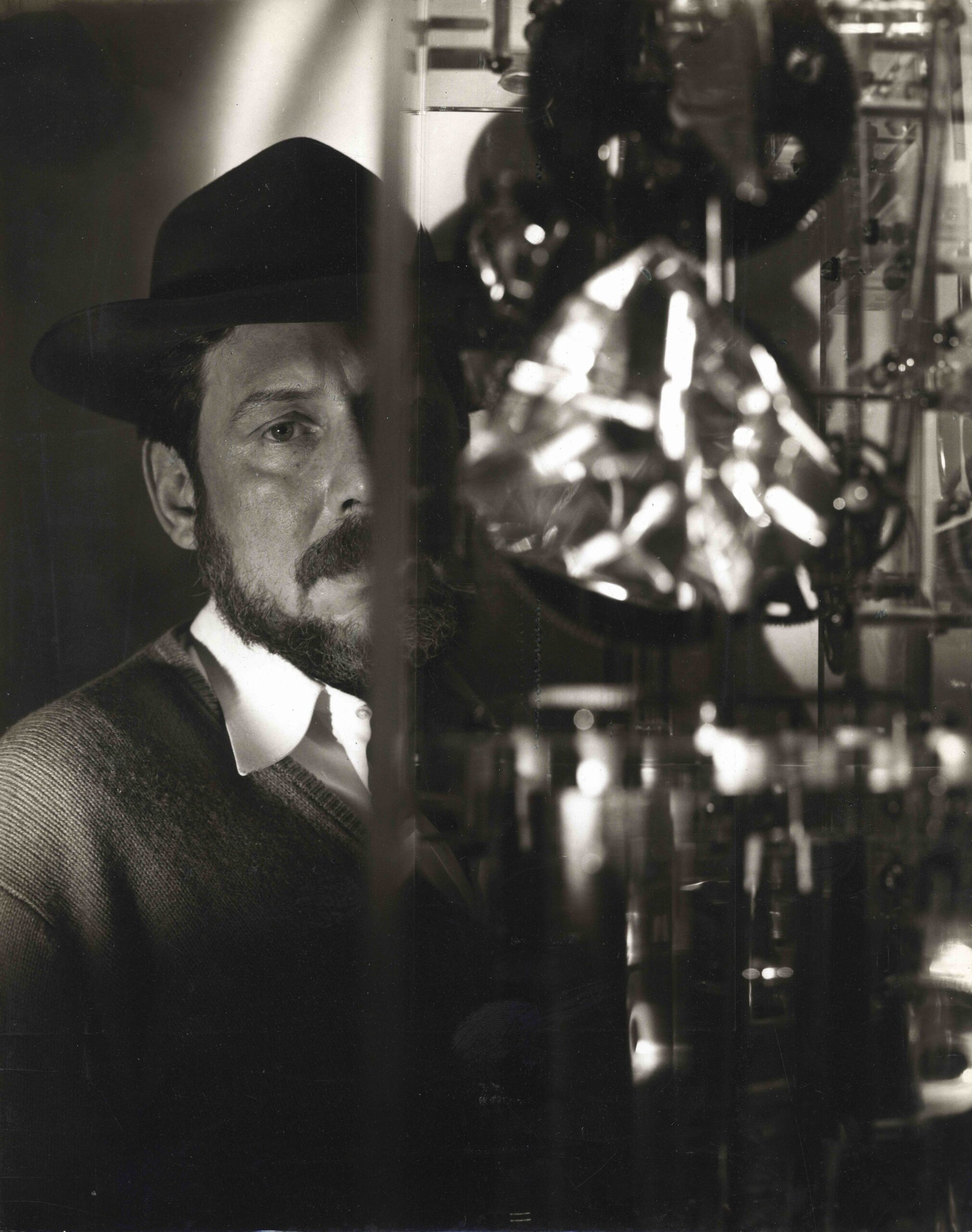
Born in Cologne in 1924 as Karl Heinz Hargesheimer, Chargesheimer led a multifaceted artistic life as a photographer, set designer, director, actor, sculptor, painter, and light artist. The gallery Julian Sander is committed to presenting this multifaceted artist; this may have been a desire for his father Gerd Sander as well, whose personal archives gave rise to the works shown here. It is the interested eyes of the photographer and aspiring art dealer Gerhard Sander, with their friendly and appreciative gaze, that peek out behind one of his kinetic objects when Chargesheimer took the portrait in 1966/68. The photographic image hangs in the exhibition space on the narrow surface of a wall projection that is only as wide as the image itself. It marks the transition to Chargesheimer’s socially documentary photographic oeuvre, with which he became known in Cologne and beyond. Consequently, such black-and-white photographs can be seen in a series hung at eye level in the gallery, which are sometimes known from Chargesheimer’s publications and depict the old Cologne of the 1950s: drinking and dancing couples, people dressed up and sipping drinks, gypsies at Carnival, beer foam on the glass, a Cologne illuminated by light bulbs at night, a situational portrait of Heinrich Böll at a bricked-in house balcony while drinking, followed by street scenes with pubs from the Cologne of 1970. The framed photographic prints, as well as some very early light graphics from the years 1949 and 1950, bear witness to this through notes that are visible through the back of the image or through the patina on the surface of the image, indicating that these images have a longer history – having been passed on from hand to hand, presumably through the exchange of knowledge about art and photography.
After studying graphic design and photography at the Cologne art schools, Chargesheimer worked initially as a stage photographer in the late 1940s, documenting the ruins of post-war Cologne and in the 1950s moved on to advertising photography in Düsseldorf, where he taught photography at the "Bild und Klang Schule" (BiKla). Against this background, his numerous publications of photo books from 1957 to 1970 can be seen, including "Cologne intime" (1957), "Unter Krahnenbäumen" (1958), "Im Ruhrgebiet" (1958) or "Menschen am Rhein" (1960) – the last three accompanied by words by Heinrich Böll, who sought to convey the value systems of a time that was no longer graspable, clothing these photographic genre perspectives in language. Chargesheimer photographed people in their everyday surroundings in Cologne, such as on "UKB" (Unter Krahnenbäumen), one of the oldest streets in the city: "the children and the elderly, the lovers and the lonely."1
He moved to the mines in the nearby Ruhr region, photographed coal in Gelsenkirchen or steel in Essen. A "wanderer"2, As Karl Pawek described him, who also devoted himself to photographic artistic developments, as shown in his publications "Examples of Modern Plastic Art from the Art Collection of the City of Marl" (1960), "Wuppertal. Bilder. Botschaften. Bemerkungen" (1969) or "Theater, Theater" (1967) with a text by Martin Walser. "[He] is interested in the theater that plays the world and the pictorial values on this world stage," Pawek noted in 1961.3 Thus, in the 1960s, Chargesheimer himself became active as a scenic designer and director at the theater, working in places such as Cologne, Hamburg, Kassel, and Braunschweig.
"He was one of the most versatile and remarkable German photographers of the 1950s to the late 1960s"4," notes Stefanie Grebe in retrospect in connection with Chargesheimer's Ruhrland photographs and the reevaluation of the significance of his photographic work. In 1968, Chargesheimer received the "Cultural Prize of the German Society for Photography". In 1978, the Museum Ludwig Cologne acquired extensive photographic collections, including Chargesheimer's negative archive, which became part of the Rheinische Bildarchiv Köln5 It counts and, given the multifaceted nature of his work, opens up and suggests much room for further research.
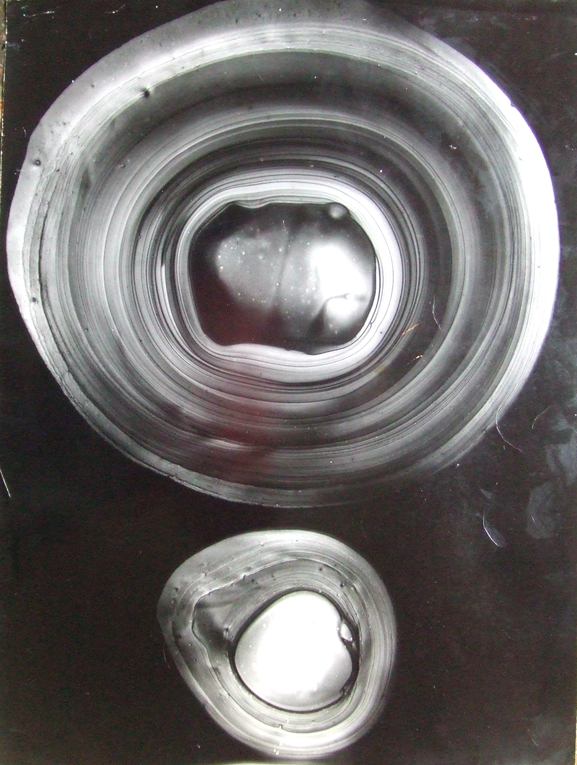
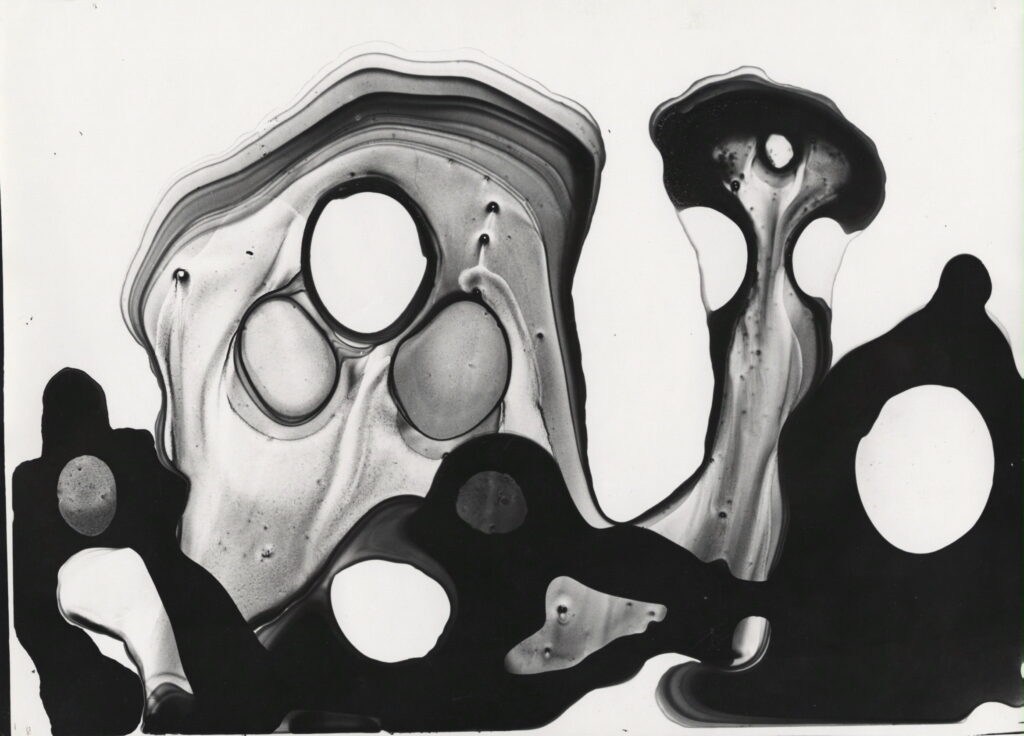
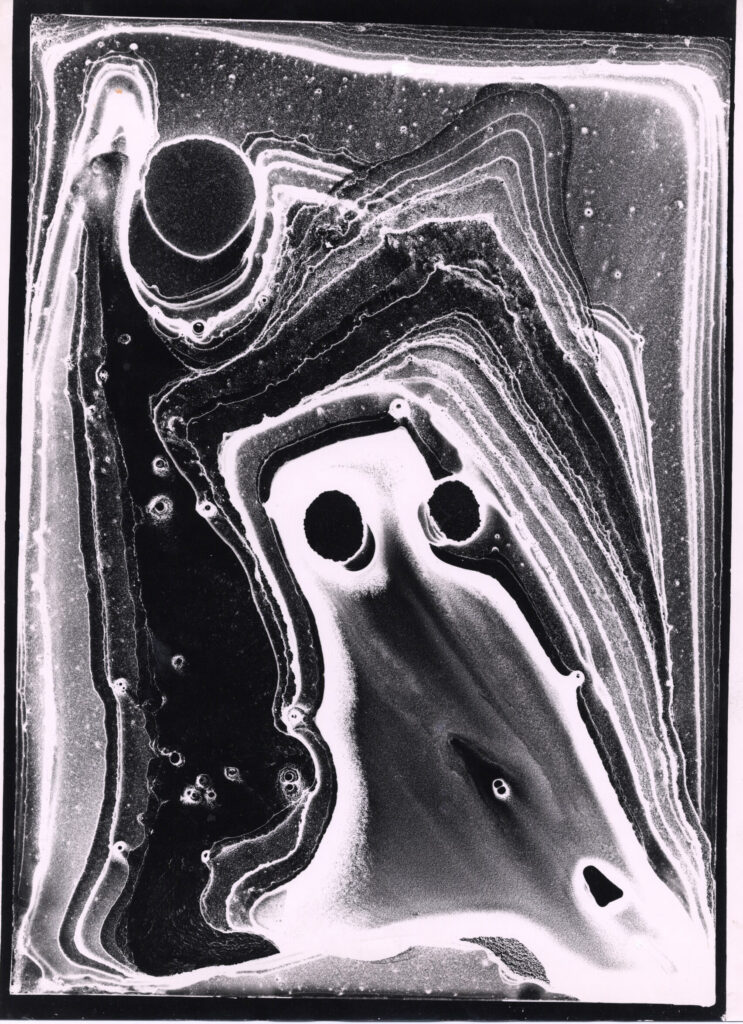
The Julian Sander Gallery has been focusing for several years on highlighting the versatility of Chargesheimer's work. For example, at the Paris Photo 2018 fair, the gallery published a newspaper with the provocative title "Chargesheimer Not A Photographer"."6 The exhibition, which seeks to trace the character of an artist interested in multimedia, is now also on display in the current exhibition. An interview conducted between Gerd and Julian Sander about the artist’s photographic work provides insight into how Chargesheimer approached the technique of lightgraphy, informed by anecdotes from their collaboration, friendship, and enthusiasm for the medium of photography in a Cologne they experienced together in the 1950s and 1960s. The newspaper places another focus on Chargesheimer’s kinetic objects, which he created in the 1960s under the title "Meditations Mills" – such as the object on display in the exhibition: a spherical object made of acrylic glass that looks like a glass planet, in which rotating, reflective steel and acrylic discs move, which in turn form apocalyptic landscapes through external light (or through inserted light) through prismatic reflections. After a presentation in the Soest Art Pavilion in 1969, they were shown in the Wuppertal Von der Heydt Museum in 1970, before being shown in the Cologne Kunstverein in 1971 and Chargesheimer receiving the "Karl Ernst Osthaus Prize" for his objects. A new chapter in his work seemed to be beginning. Already in the same year, at the age of 46, Chargesheimer took his own life.
The more images and facets of Chargesheimer become visible, this exhibition confirms, the more fascinating the confrontation with his work becomes. "From everything that is known about him," Stefanie Grebe concluded in 2014 in the context of his last major institutional exhibition ("Chargesheimer. Die Entdeckung des Ruhrgebiets"), "it can be assumed that he rather developed his own style maniacally and in a frenzy, uninfluenced by others."7
Chargesheimer changed the artistic instruments, composing in a sphere in which faces tell stories and the landscapes created by people report on the personal. He created (photographic) spaces in which "a pure white shines, which leads from an infinite number of intermediate stages to the deepest blackness of night."8 Franz Roh described him in 1961 as one with "unbridled imagination, amazing observational ability and a lust for technical invention."9
The exhibition in the Galerie Julian Sander invites us to lose ourselves in the images and the diversity of Chargesheimer’s work and to let him show us a past world—the one he saw and the one he co-created—as a possibility of representation.
1 Chargesheimer: "Unter Krahnenbäumen. Bilder aus einer Straße", featuring an essay written in German, Heinrich Böll, Greven Verlag, Köln 1958, p.
2 Chargesheimer: "Interim report", Greven Verlag, Cologne 1961, p. V.
3 Ibid., p. VI.
4 Stefanie Grebe: "'And yet I didn't even publish the most difficult photos!' New Photographs of Chargesheimers from the Ruhr Area in 1957", in: "Chargesheimer. Die Entdeckung des Ruhrgebiets", edited by Heinrich Theodor Grütter and Stefanie Grebe, editor-in-chief, Verlag der Buchhandlung Walther König, Cologne 2014, pp. 15–28, here pp. 16.
5 https://www.stadt-koeln.de/leben-in-koeln/kultur/rheinisches-bildarchiv/chargesheimer-karl-heinz-hargesheimer, Last accessed on 8.3.2023.
6 The Feroz Paper, No. 3, "Chargesheimer Not A Photographer", Special Edition Paris Photo 2018, Galerie Julian Sander, Cologne 2018.
7 Grebe in: "Chargesheimer. Die Entdeckung des Ruhrgebiets", 2014, p. 21.
8 Franz Roh in: Chargesheimer: "Zwischenbilanz", 1961, p. XIX.
9 Ibid., p. XXIII.
The Kunstmuseen Krefeld are dedicating the first retrospective in Germany to Charlotte Perriand’s multifaceted and astonishingly contemporary work.
 7 min read
The exhibition "Six Five Four Three Two" featuring works by the New York-based artist Josephine Meckseper at the Heppenheim Art Society.
 9 min read
In the new premises of Plateforme 10 in Lausanne, the Photo Elysée Museum can finally unfold its potential.
 12 min read