 8 min read
 8 min read
"Mrs. Mayr-Stihl has fallen from the clouds," says Katharina Edlinger, the press officer of the Eva Mayr-Stihl Foundation in Waiblingen, at the opening of the exhibitions in the Stihl Gallery and at the Chamber of Commerce. On January 2, 2020, Edlinger opened a letter from the Stuttgart probate court: Renate Reichert had ordered that her estate – according to the Waiblingen newspaper (ZVW) 550,000 euros – be distributed through the contemporary art foundation and the support of young artists. No one knew who this Frau Reichert was, what relationship she had with the Stihl Gallery, or what kind of art she valued.
After intensive deliberations by the municipal council and the foundation, the decision was made in favor of a scholarship for drawing and paper art, which now went to Katrin Ströbel in the first round, and the three junior scholarships were awarded to Khadija El Abyad from Morocco, Valentine Gardiennet from France, and Nele Hendrikje Sandner from Leipzig. All four worked in Waiblingen for a month, and the three younger ones were also supervised by Ströbel, who had already sat on the five-member jury that selected them from over 100 applications.
Ströbel studied in Stuttgart and has lived in Marseille since 2004, as she says, "in an interface with other worlds." She has traveled to various African countries to "reflect on her own work in a context that is not European": Senegal, Nigeria, South Africa, and repeatedly the Maghreb countries, particularly Morocco. In Rabat she met her partner Mohammed Laouli, also an artist. For the last ten years she has been a professor of drawing at Villa Arson in Nice. The fact that a Moroccan woman is now among the young scholarship holders is a coincidence. At Gardiennet, her student in Nice, she refrained from speaking out, she explains. Another coincidence is that Ströbel received a professorship at the Stuttgart Art Academy about two months after she was selected as a scholarship holder.
The Stihl Gallery is the gallery of the city of Waiblingen. But without Eva Mayr-Stihl, the sister of the chainsaw billionaire Hans Peter Stihl, it would not have existed. For many years, the art historian Helmut Herbst, who had already established a historical museum, had been trying to create a municipal gallery, which only came about two decades later, in 2008, like in other cities in the Stuttgart region, precisely because the Eva Mayr-Stihl Foundation financed the construction. Only three percent of the foundation’s portfolio is devoted to art and culture. However, the city of Waiblingen was concerned about ongoing costs: the oval hall, clad on the outside with industrial glass, would have been suitable for plastic works. But Waiblingen decided to focus on works on and off paper. There were no walls in the building at first.
The focus on paper had an impact on the program. It was now possible to score points with major names, from Dürer and Rembrandt to Nolde and Picasso. With this and with popular themes from Wilhelm Busch to Loriot and most recently Ilon Wikland, the illustrator of Astrid Lindgren's children's books, the gallery primarily addressed a local audience. Exhibitions that attracted interest beyond Waiblingen were sometimes created through external influences: Gisela Sprenger-Schoch, the then director of the art school associated with the gallery, curated one of the first exhibitions on the artistic work of John Cage in 2009. Two years later, the Stuttgart Art Academy prepared a summary of the history of lithography for its 250th anniversary celebrations. In 2016, a first overview of the collections of the screen printing pioneer Luitpold Domberger was published; Filderstadt has now dedicated a museum to these collections in the former screen printing workshop in Plattenhardt.
The Paper Art Scholarship now owes its existence to an external stimulus. Katrin Ströbel, who gallery director Anja Gerdemann is right about, is the ideal candidate for this position. Her largest solo exhibition to date showcases works spanning more than fifteen years, which she brings into new contexts through interventions in the space. The cross-shaped wall panels that stand in the room serve not only as support for the hanging. Rather, during her stay in Waiblingen, the artist also drew directly on the walls. Just as on her travels to other countries, she here also deals with her surroundings.


LinksKatrin Ströbel, I come in Peace, 2023. MiddleKatrin Ströbel, bitim-réew, 2009. Postcard from Senegal. RightKatrin Ströbel, Casablanca decalé, 2015. All photos: Joachim E. Röttgers.
"Don't say she's not like that; every girl is like that, every fucking girl", is written in a horizontal row of picture frames, each word framed separately, as if to emphasize it with an exclamation mark. The last frame has been moved slightly to the side to allow the viewer to focus precisely on the gender, actually the skirt of a life-size female figure: with a bra on, carelessly opened boots, a tool belt wrapped around her hips, and in her left hand a chainsaw. This is a motif from the Stihl calendar, which until 2020 fueled the erotic fantasies of the male customers of the Waiblingen-based global corporation. Hans-Peter Stihl introduced the Pinup calendar in this form in 1973, the same year he took over the business. The calendar was discontinued when the Swedish Forest Institute threatened in 2020 not to buy any Stihl products due to the sexist advertising. The model in the photo wears the head of a Tyrannosaurus Rex. The teeth are shown. Title: I come in peace.
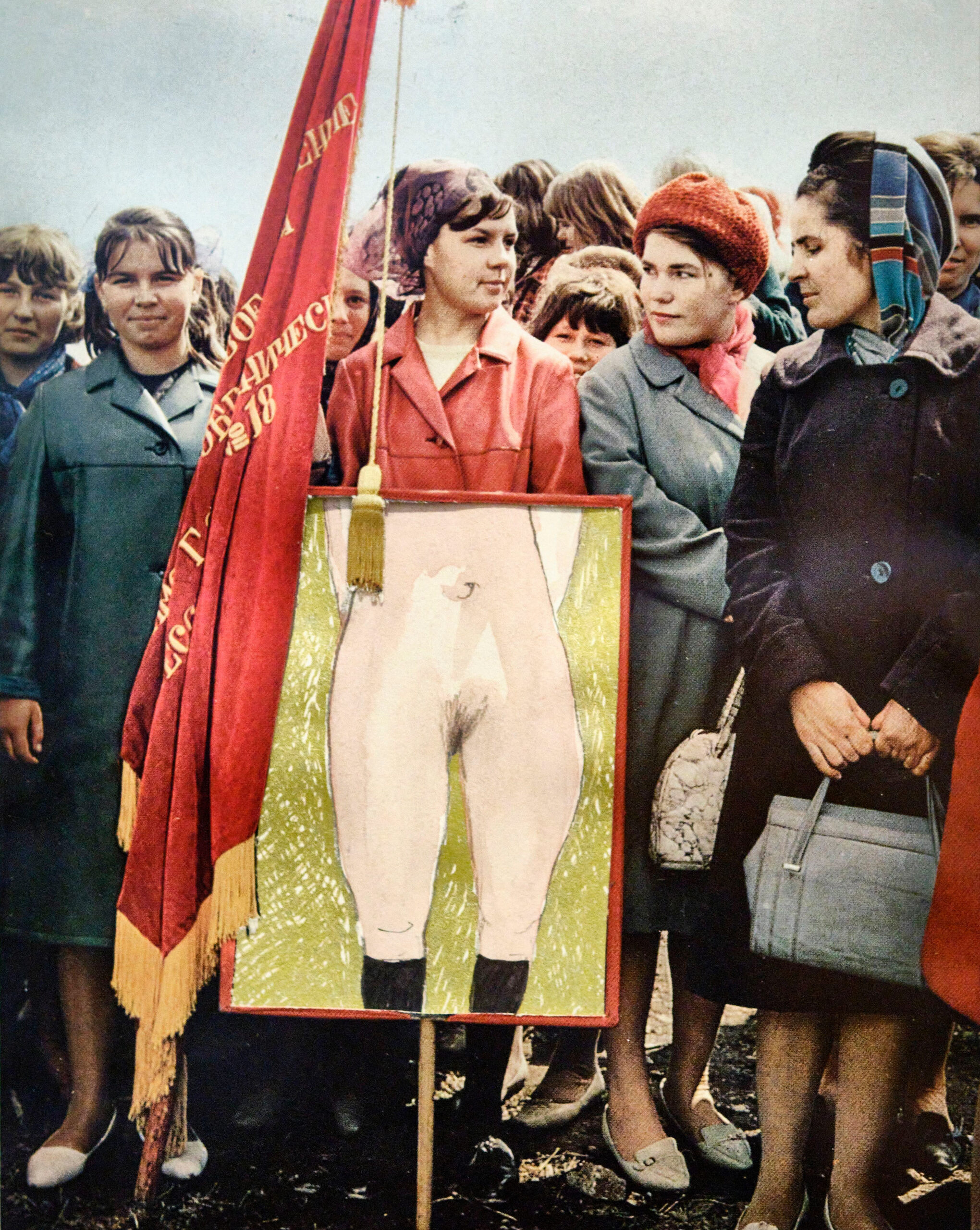
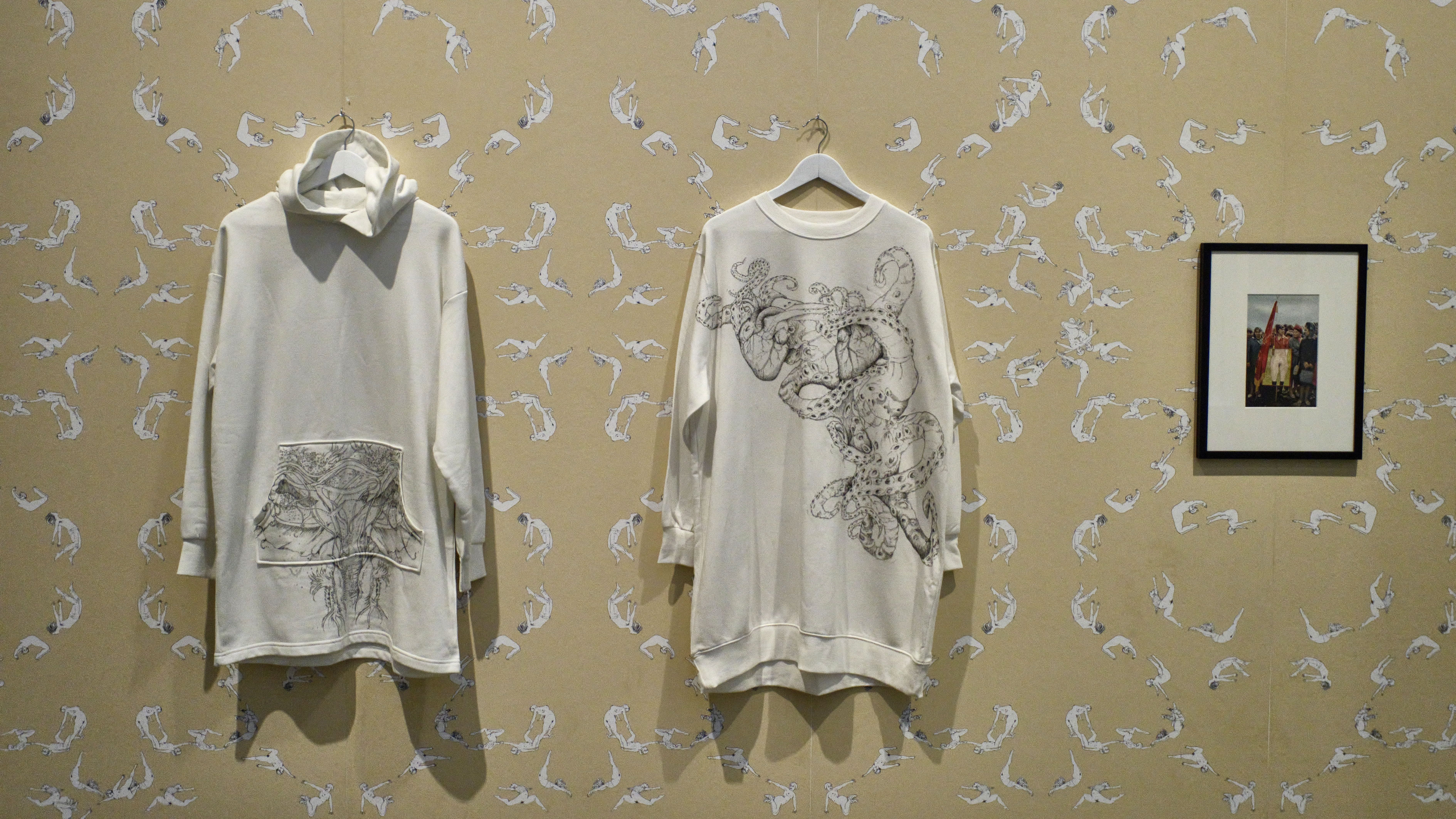
Drawing for Ströbel means more than the production of images. She thinks about the medium of the surface, the relationship between text and image, her own body and gender roles, the visual relations, the geographically and culturally other as well as the postcolonial conditions. Nude female bodies whirl through the space: large on the first wall when one enters the room, as a wallpaper pattern on one of the next ones. An image of a self-confident, uninhibited, testing one’s own limits body feeling: weightless, unattached, but, depending on how it is used, also impermanent. The wallpaper serves as the basis for two named Body Suits, a T-shirt and a hoodie featuring a collage from the series Body Politics The title is taken literally here: In the Siberia of the 1950s, women gather to assemble a red flag with tridents. In the initial image, the central figure has a sign with a portrait of Lenin in front of her. The artist has replaced it with a pink undergarment, thus revealing the bearer.


LinksKatrin Ströbel, I come in Peace, 2023. RightKatrin Ströbel, Casablanca decalé, 2015. All photos: Joachim E. Röttgers.
Ströbel draws in the Barcelona metro. On her first trip to Senegal, she makes postcards and thus reflects on her position as a tourist. The landscape of Casablanca is captured in two large sheets, which can be seen as having been folded into a handy format: she carries her travel impressions with her. In a series of impressive sheets, she explores Arabic script and ornamentation. But the foreigner is not simply different. He is also shaped by the colonial history and postcolonial power relations. From Island of Gorée, Today, a holiday island, the slave ships once set sail. Fans blow air under the many leaves on which a depiction is spread out. The image of the palm trees becomes unstable.
On a three-part folding mirror, the artist applied a white coating and carved the image of an indigenous woman into it. It comes from a book published in 1908/09 by the anthropologist Elisabeth Krämer-Bannow with the incredible title "The Artificially Intelligent Cannibals of the South Sea: Wanderings on Neu-Mecklenburg". The white color and the reflections on the shabby 1950s furniture cause the viewer to think about their own position in relation to such a picture.
Not only does Ströbel reflect on German history from an extraterrestrial perspective, but also on the history of Europe. The 18-part series Inherited Shame He cites newspaper captions from Australian archives that relate to the Nazi era. "Execution carried out by the Einsatzgruppen" is written on one page. On another, there is talk of a protest by the "Aborigines" against the persecution of the Jews in Germany. The accompanying images are missing; the pages are black. The artist refuses the voyeuristic gaze on the atrocities. However, the black can also be interpreted as the dark, evil, or repressed: the unpresentable, to put it in a single word. Black also appears in the current series The confined people Again, as an area that encompasses faces and figures, in relation to the isolation caused by the Corona lockdown.
Two years ago, Ströbel received the Hans-Molfenter Prize from the Stuttgart Art Museum and was exhibited in the Klein collection in Eberdingen-Nussdorf. The exhibition in Waiblingen provides, for the first time, an insight into her entire oeuvre on this scale; it rather anticipates rather than addresses current issues regarding gender roles and the North-South relations shaped by colonial history: in a completely unique way and, where the subject matter allows, with a touch of humor.
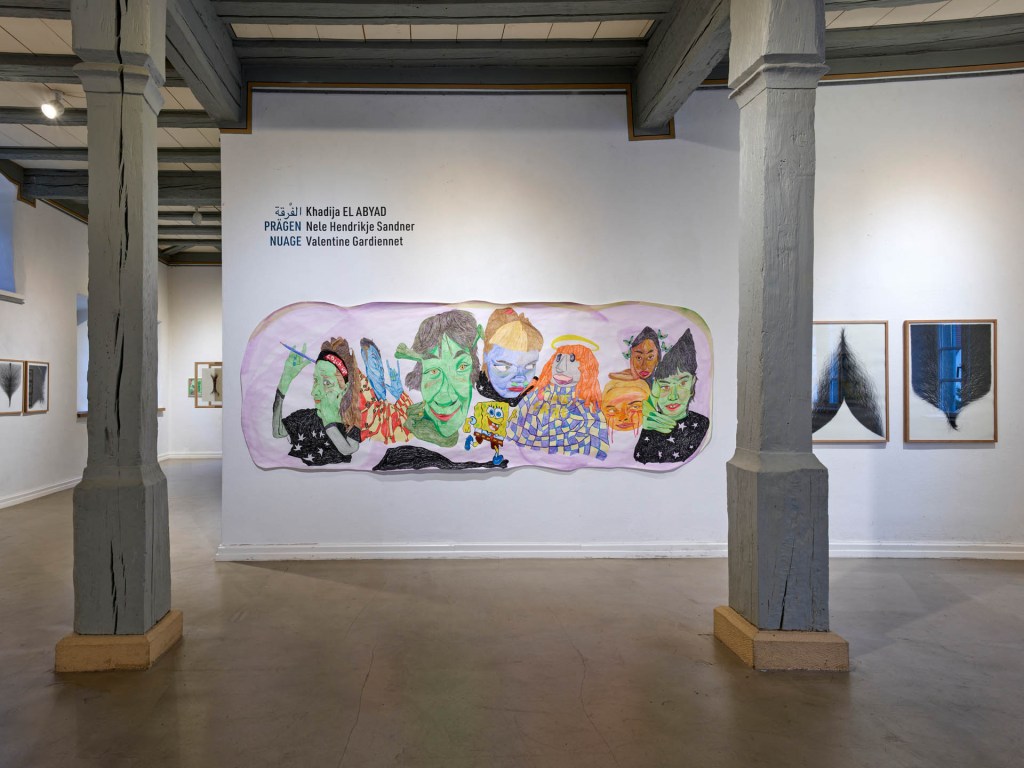

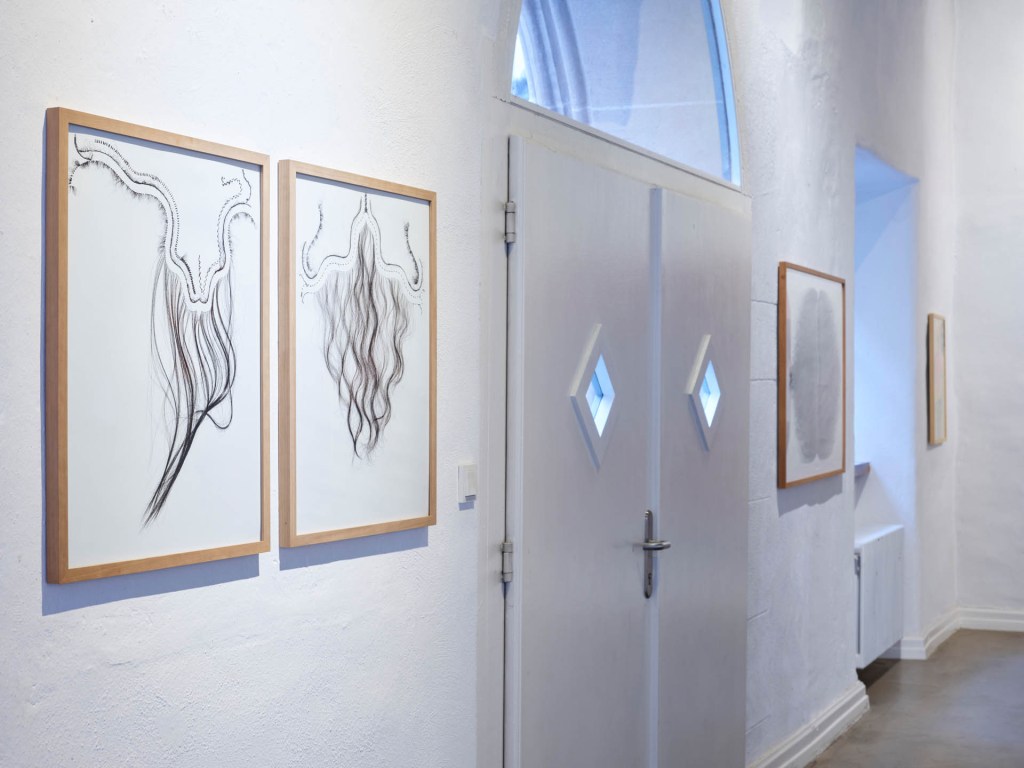
The works of the three young scholarship holders are exhibited at the Kameralamt, where they were created. They could hardly be more different: Gardiennet draws colorful, comic-like figures, often incorporating her own portrait or that of friends. Sandner uses paper herself, which she processes into flat, colorful shapes. El Abyad draws exclusively fine, black lines that strongly resemble hair. She goes so far as to extend this to three-dimensional forms using real hair. In a subtle way, she thus touches on taboos that are not necessarily confined to the Islamic world.
—————————————————————————————–
The exhibitions run until October 8th, https://www.papierkunststipendium.de
The Kunstmuseen Krefeld are dedicating the first retrospective in Germany to Charlotte Perriand’s multifaceted and astonishingly contemporary work.
 7 min read
In the new premises of Plateforme 10 in Lausanne, the Photo Elysée Museum can finally unfold its potential.
 12 min read
Alex Katz at the Tübingen Art Gallery
 8 min read