
 9 min read
 9 min read
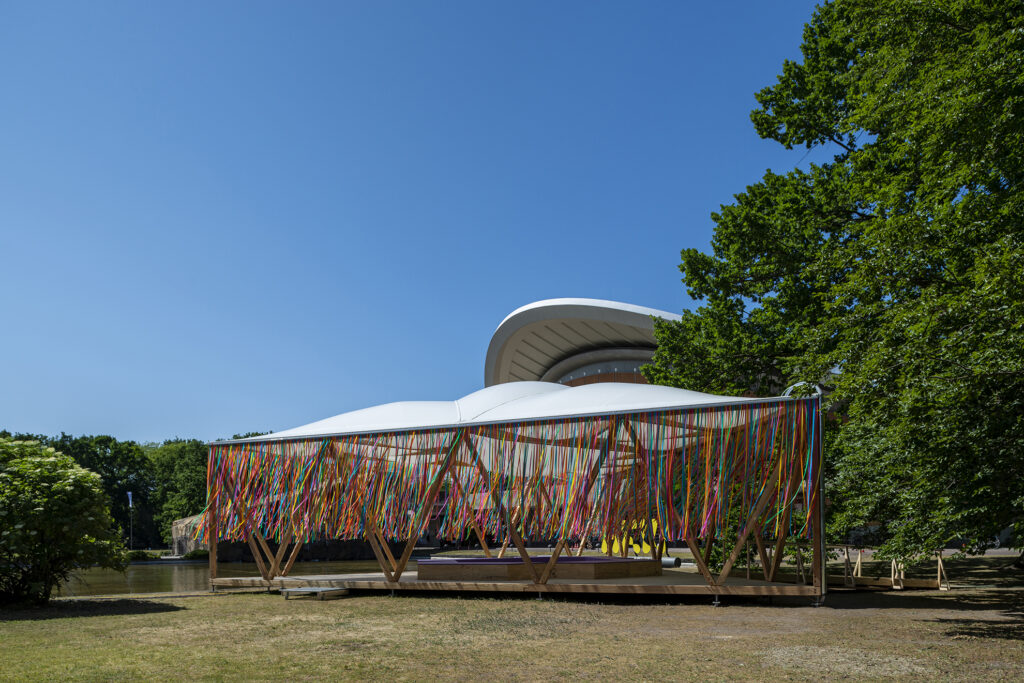
With Bonaventure Soh Bejeng Ndikung at the Haus der Kulturen der Welt (HKW), a new era has begun. The development seems to be taking place in steps of a third of a century: opened in 1957 as a congress hall, the "pregnant oyster", as the Berliners say, was a monument of the Cold War: donated by the Americans at the instigation of Eleanor Dulles, sister of the Berlin-appointed Foreign Minister John Foster Dulles and the CIA director Allen Dulles, in sight of the Brandenburg Gate and the Soviet Memorial, it met here immediately after the opening of Congress for Cultural Freedom: the cultural arm of the CIA, even if this was not yet publicly known at the time. However, the role as a beacon of freedom seemed to be becoming fragile as early as 1980 with the collapse of the roof of the band's rehearsal space. Falling-down new buildings derived its name from it.
32 years after its opening, and even before the fall of the Berlin Wall, the house then made the transition from a bipolar to a multipolar world order. The definition and presentation of the "cultures of the world" at that time were still by no means settled. In the field of literature, the appeal to Goethe helped: Admit it! The poets of the East are greater was the name of a series of events held to mark the opening, based on a quote from West-Eastern Divan. For the fine arts, it was more difficult. At that time, "Western art" from the USA and Europe was the only kind of art accepted. When it came to art from other parts of the world, it was usually meant to be pre-colonial objects from ethnological museums that remained in a seemingly timeless, ethnographic present.
Only two months after the HKW opened in the Centre Pompidou in Paris Magicians of the Earth, The first major exhibition that juxtaposed contemporary art from the USA and Europe with works from Africa, Asia and Latin America, as well as indigenous Australians, Canadians and Oceanians: a breakthrough for the new art of these regions, which was however also controversially discussed. "Non-Western" artists were positioned in terms of title and presentation on the side of nature and emotion in a colonial manner, the criticism went, in contrast to the rationality of "Western" abstraction and conceptual art.
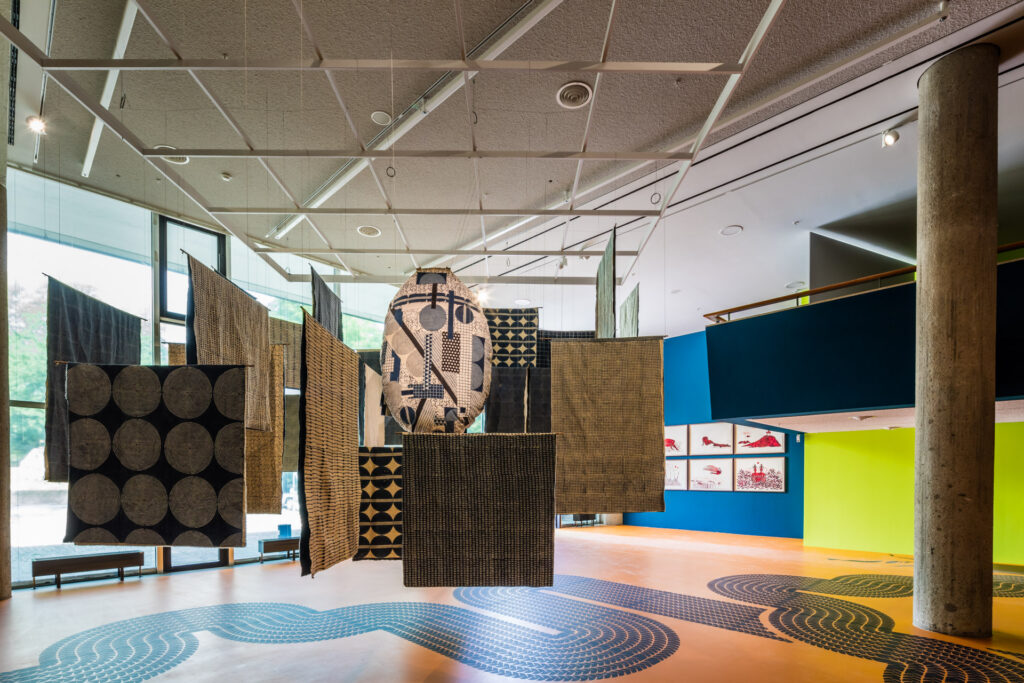
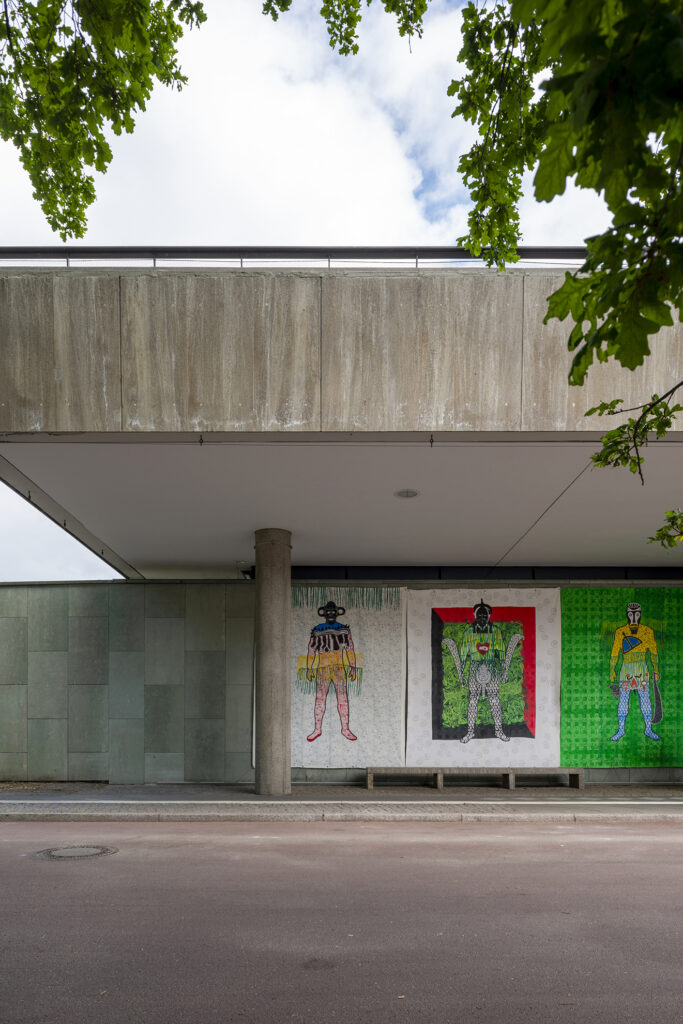
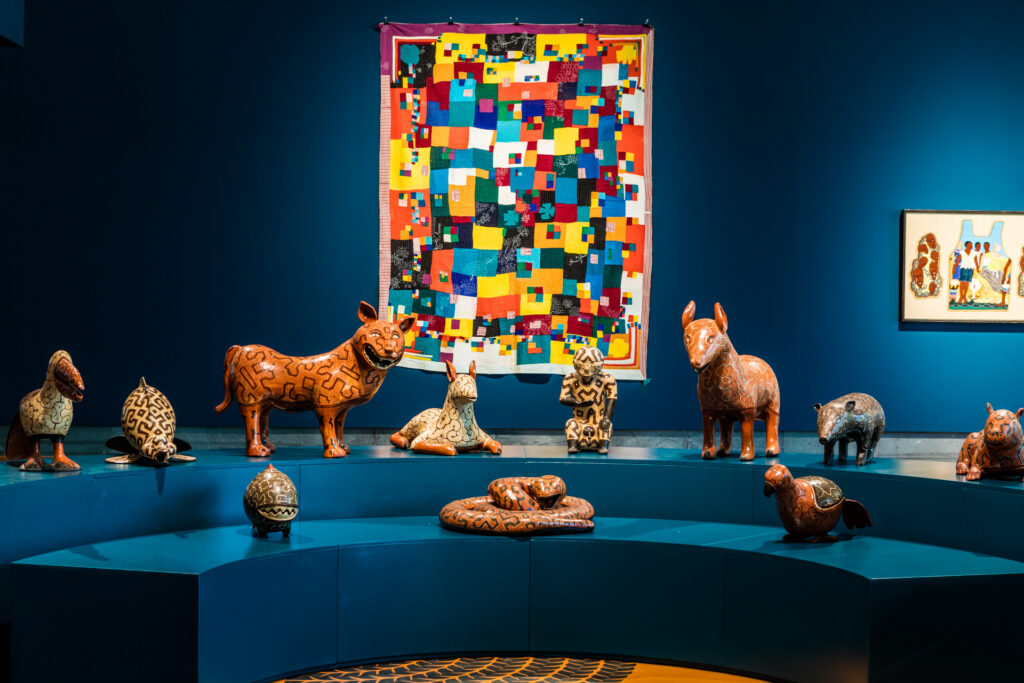
Colorful colors, natural materials and a "spiritual" dimension: At first glance, it seems to be a combination of the two. About Quilombismo, of the first exhibition of the HKW under Ndikung, little has changed. The columns in the foyer are covered with textiles made from henna-dyed wool. Small dragons made of mulberry bark float in the room. Colorful works hang on colorful walls. Many of the works have a ritual dimension. Colors and materials appeal directly to the visitors on an aesthetic level. From the exoticizing perspective, which Magicians of the Earth It seems that self-exotification has become a charge that has been leveled at them.
In the first 34 years of the HKW, the development took a completely different direction. Ndikung's predecessors came exclusively from the world of the Goethe Institutes. Initially, they still played a less dominant role. It was Alfons Hug, who was area manager for the visual arts from 1994 to 1998, who coined the term "other moderns". The already much-acclaimed exhibition China Avantgarde had set the direction in 1993. Art from the "Third World", which had previously been referred to as the Others Unlike Western modernism, which was considered modern: Okwui Enwezor also argued in this very sense, whose groundbreaking exhibition The Short Century the HKW has produced.
At the same time, the establishment of biennials worldwide ushered in a globalization of contemporary art that eventually seemed destined to eliminate the need for separate presentation of "non-Western" art in its own space. Bernd Scherer, Ndikung's predecessor, increasingly turned to fundamental themes such as the Anthropocene or even concrete Berlin-related problems such as the Housing issue.
However, in recent years it has become increasingly clear that people from the formerly colonized and colonizing countries do not stand on equal footing. The experiences of racism of an increasing number of young Black Germans, the Black Lives Matter movement, and the beginning of the decolonization of German history are all interacting and reinforcing each other. Berlin plays a central role in all of this, not least due to the debates surrounding the Humboldt Forum.
Bonaventure Soh Bejeng Ndikung has a completely different background than his predecessors. He studied medical technology and developed pacemakers, and knew little about contemporary art until he came into contact with artists in Düsseldorf and began curating exhibitions about 15 years ago. The basic principle of his project space Savvy Contemporary The goal was to compare two artists from the global South with two from Europe or North America, in order to avoid being labeled "African art" and similar labels. Through his father, who was an anthropologist, he was exposed to the literary and theoretical works of the post-colonial era from an early age: Frantz Fanon, Ngugi wa Thiong'o, the authors of Negritude and many others.
In the opening exhibition at the HKW, Ndikung’s handwriting is clearly recognizable: a title for a tapeworm – About Quilombismo. Of resistance and perseverance. Of flight as an attack. Of alternative democratic-egalitarian political philosophies – which refers to a political concept from post-war Brazil; an exhibition that, to put it briefly, serves more as a backdrop for the opening ceremony, a setting for music, discussions, and lectures, an atmosphere in which visitors can feel comfortable. There are no wall texts. Anyone who wants to know something about the artists and their works will be given a nearly 300-page handbook: colorful letters on tinted paper, difficult to decipher depending on the lighting conditions and dotted with general places, as they are often found in artist’s books. Two examples: "… in her works she draws on mythology to question mechanisms of domination, stereotypical norms, and forms of representation." "The practice of… the artist… moves between drawing, painting, sculpture, and installation." Their works, which often draw on global, current events, engage in dialogue with anthropological narratives and botanical spheres that are closely intertwined with the colonial legacy."
An accompanying reader has been published for the exhibition containing historical and current texts and interviews on the subject. The basic text on "the Quilombo concept" by Beatriz Nascimento, originally published in 1985, traces the term back to the Imbangala, which resisted the Portuguese in 16th-century Angola. The term "Quilombo" is commonly used to refer to the settlements of runaway slaves, in which post-war black Brazilians saw the seeds of a new, non-racist society. There was a newspaper titled Quilombo. Quilombismo became, as Nascimento writes, the key to a new Brazilian identity that included the Black people and enabled them to identify with the country.
"The Imbangala, who dominated Angola," writes Nascimento in her derivation of the term, "were considered a fearful people who lived exclusively from plunder … Unlike other ethnic groups, they did not raise children … They killed them after birth and adopted the young people of defeated tribes. They were Anthropophagi …" This sounds now, however, so clearly like a colonial source that demeans its opponent to justify any kind of violence that one can only wonder why such a description was found in the reader's guide to the exhibition without comment. That the "problematic linguistic forms and habits" are eventually excused in small print does not help, because these are not formulations but the interpretation of historical contexts.
One could dismiss this as a lack of attention to the forty-year-old text, were it not also symptomatic of the exhibition’s orientation, which does not aim to illuminate the historical phenomenon of Quilombismo in post-war Brazil, but to make the concept "in the current flow of time" available for use in the here and now, as Ndikung writes in an article. Whether this works globally remains to be seen. In any case, the exhibition does not adopt a historically critical perspective but invites identification. This resonates strongly with a young, migrant audience: from a cultural-political perspective, a win-win situation. The colors, tones, and materials seem chosen to create a sphere of Others To mark. A safe space for the descendants of colonizers? The HKW, a quilombo?
Three flags of Olu Oguibe flutter defiantly on the roof, with the black, red and gold complemented by a green strip and the letters "D D R", which here stand for "decarbonize, decolonize, repair". If the house wants to address global problems in this sense, it will need to be more than just an enclave in the long run. However, the exhibition is not everything. There is a rich program with literature and music, including Oumou Sangaré, events commemorating the Haitian Revolution of 1803, the coup in Chile in 1973, and a winter festival in Eastern Europe. "Eastern Europe is always what 'We' are not," says the announcement, hardly lacking in topicality: "A place of violence and political crises."
The Kunstmuseen Krefeld are dedicating the first retrospective in Germany to Charlotte Perriand’s multifaceted and astonishingly contemporary work.
 7 min read
In the new premises of Plateforme 10 in Lausanne, the Photo Elysée Museum can finally unfold its potential.
 12 min read
The exhibition "Six Five Four Three Two" featuring works by the New York-based artist Josephine Meckseper at the Heppenheim Art Society.
 9 min read