 11 min read
 11 min read
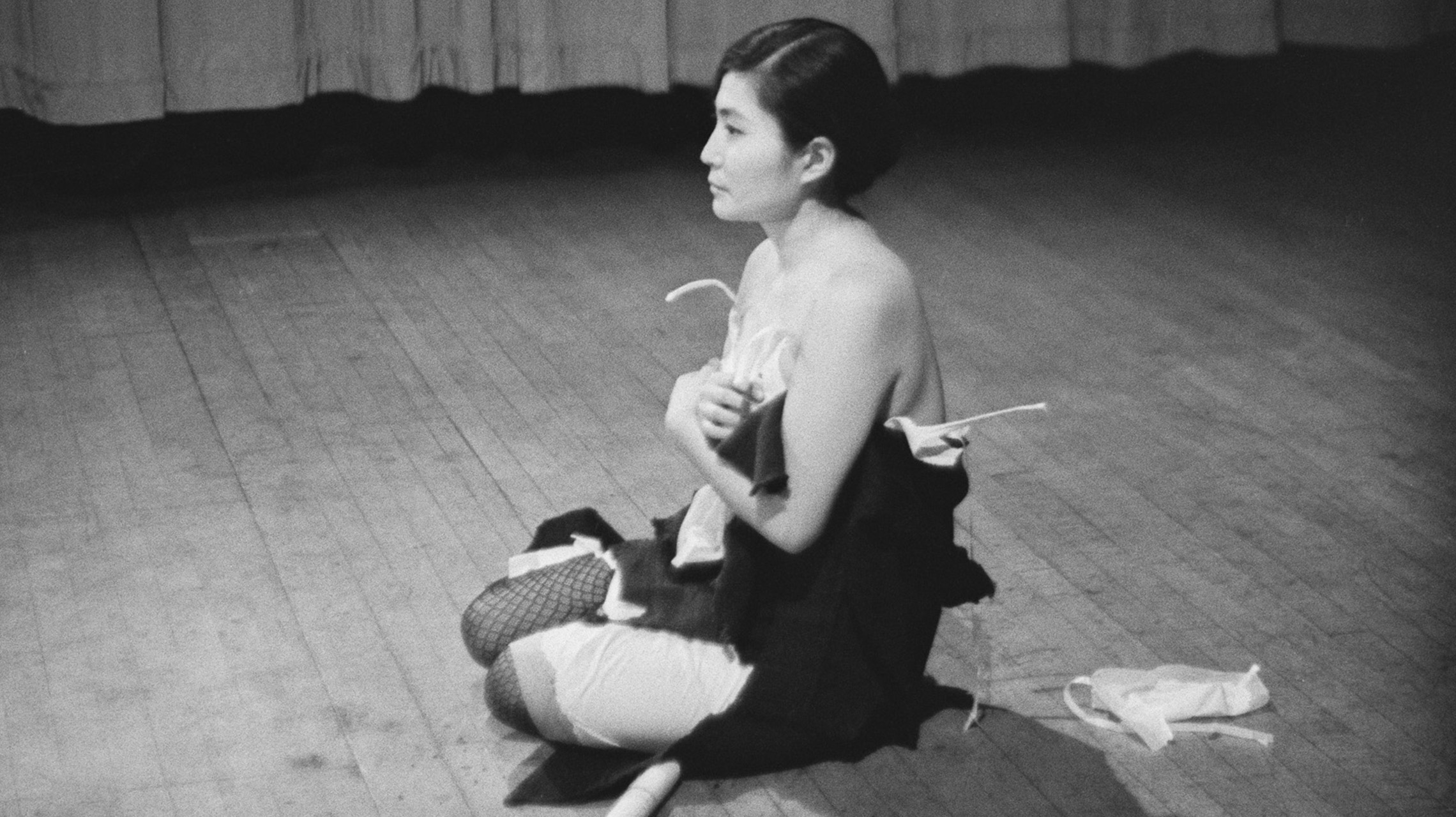
A young woman sits on a stage. Men and women from the audience step forward one after the other and, at their discretion, use scissors to cut the clothes off the woman. Mostly it is men who advance forward with curiosity and sometimes cut large pieces of their clothing. The volunteers from the audience keep the textile scraps and take them home. The crowd is getting restless; someone laughs and occasionally there is applause. The artist’s facial expression remains unchanged. Although she is completely at the will of the audience, she hardly moves. The performance continues and the volunteers are gradually removing more and more bare skin. At some point, the young woman’s top slips off her shoulder, revealing her underwear. However, the audience continues, until the naked woman is only holding fragments of her underwear in her hands. The actress then interrupts the proceedings and thus ends the performance.
The young woman is today's 91-year-old Yoko Ono. Her performance "Cut Piece", filmed in film form, can currently be seen in the Düsseldorf art collection NRW, and has not lost any of its intensity to date. First performed in Kyoto in 1964, the performer repeated "Cut Piece" in 2003 in Paris, on the occasion of the Iraq War. According to her own statement, she performed the performance this time for love and not out of anger as she did in 1964. A rage that was directed against the prevailing image of women at the time, even though the instruction for the performance did not necessarily call for a female performer.
When comparing the atmosphere in the audience in 1964 with that during a reenactment not conducted by Ono herself at the New National Gallery in Berlin in 2023, it is noticeable that the volunteers in 2023 were much more hesitant and sensitive, sometimes cutting out only tiny pieces of the performer's clothing. Men in particular are less likely to venture onto the stage; one cut out a piece from his own clothing and covered the performer with it. The audience seems to be much more aware of the various levels of the performance today. Who is the object here? And is the performer being exposed? Or is the audience publicly exposing itself?
Anyone who knows Ono primarily because of her marriage to Beatle singer John Lennon (1940–1980) or as a peace and environmental activist will be surprised by the current exhibition at K20. Because here, Ono is the focus of attention as a pioneer of performative and participatory art – even though the music, according to the title "YOKO ONO. MUSIC OF THE MIND", is also the subject of in-depth consideration in the chronologically organized exhibition. Yoko Ono was born in 1933 in Tokyo into a wealthy family; she had to flee the city before the Second World War in 1945 and was later allowed to return to Tokyo as the first woman to study philosophy at the Gakushūin University. In 1960 she moved to New York and organized events and concerts with the composer La Monte Young, which would later become part of the New York avant-garde.
Ono held her first solo exhibition in 1961 at the AG Gallery of George Maciunas, the pioneer of the Fluxus movement. Fluxus, from the Latin "to flow", brought together interdisciplinary artists from all cultural fields in search of new provocative performance forms. With a demand adopted by the avant-garde for the fusion of art and life, the post-war artists sought to de-limit traditional art forms. Already anticipated by the founder of modernism, Marcel Duchamp, criticism of the rigid concept of genre, the closed work as such, and of the institutions of art grew increasingly pronounced. Building on the achievements of Futurism, Dadaism, and Surrealism, various new art movements emerged, such as Body Art, Performance, and Fluxus.
The artists suddenly entered the stage themselves, transforming the body into an artistic means of creation and tool of expression. Furthermore, in connection with theater, the fourth wall in art was also breached as an invisible boundary between the stage and the audience, with the role of the receiver changing from passive observation to active participation as a permanent component of the artwork. Although the position of the viewer was always intended in the work, the audience found themselves in an actively participating role for the first time with Allan Kaprow’s "New Yorker Happenings" in the late 1950s.
At Maciunas, Yoko Ono presented her so-called "Instruction Paintings", in which the audience was, for example, invited to enter a canvas lying on the floor. The artist developed these works further and reduced them to written instructions that she presented to the public after her return to Tokyo in 1962. Two years later, her book "Grapefruit" was self-published, a collection of written instructions written between 1953 and 1964 that were intended to encourage readers to take action. These include instructions such as "Listen to a Heartbeat" or "Step in all the puddles in the city".
These instructions seem like poetic scores intended to bring the body and mind into harmony and vibration. In the Düsseldorf retrospective, areas that the audience is asked to activate are marked with yellow markings. In "Bag Piece" (1964), for example, exhibition visitors are asked to put a black bag over their shoulders and meet each other freely without prejudice. Elsewhere, in "Painting to Shake Hands (Painting to Shake Hands)" (1961), volunteers are asked to reach out to a stranger through a wall, and in "Shadow Piece" (1963) they are asked to draw the respective other person's shadow.
In the ongoing reduction, clarity, and sensitivity of Ono’s works, their Japanese roots are reflected alongside their connection to Western modernism. Accordingly, a so-called "Wish Tree" immediately emerges in the entrance hall of the art collection, made of stone ground that Ono has already had installed in various locations. This continues a Japanese tradition in which wishes are written on small slips of paper and hung on trees around Buddhist temples. The placement of the wishes continues until every branch is equipped with a piece of paper. Other examples of incorporating Japanese traditions are Ono’s ritual cutting of her hair as a widow, which she performed after Lennon’s death, or her work titled "Mend Piece" from 1966. In the latter, participants use the ancient Japanese technique of "Kintsugi" to repair broken porcelain. Instead of hiding the cracks as inconspicuously as possible, Kintsugi involves applying a gold-infused lacquer. The cracks are not covered up, but on the contrary, they are emphasized. The history of the respective object is thus preserved. This corresponds to a philosophy that understands cracks and irregularities as an essential part of growth, recognizing beauty in imperfection.
This philosophy permeates Ono's work, which focuses on the seemingly insignificant things and is based on the guiding principle "mind over matter". The community always takes a more important role than the individual, which corresponds to Ono's sometimes collective implementation of written instructions. This is particularly evident in the work "Promise Piece", in which participants break a vase and subsequently promise to repair it together in ten years. This gathering can be traced back to "Ichi-go ichi-e", the understanding of the uniqueness of a meeting. Metaphors of healing and restoration are recurring themes in Ono's work. Traditional techniques such as Kintsugi are also repeatedly used. Not least, Ono taught origami and Japanese calligraphy at one time. With her deeply rooted experience, Ono struck a nerve in the post-war era, as there was already great interest in Zen Buddhism, as can be seen for example in the "Zen 49" movement. It seems that Western modernity and Japanese tradition complement each other perfectly.
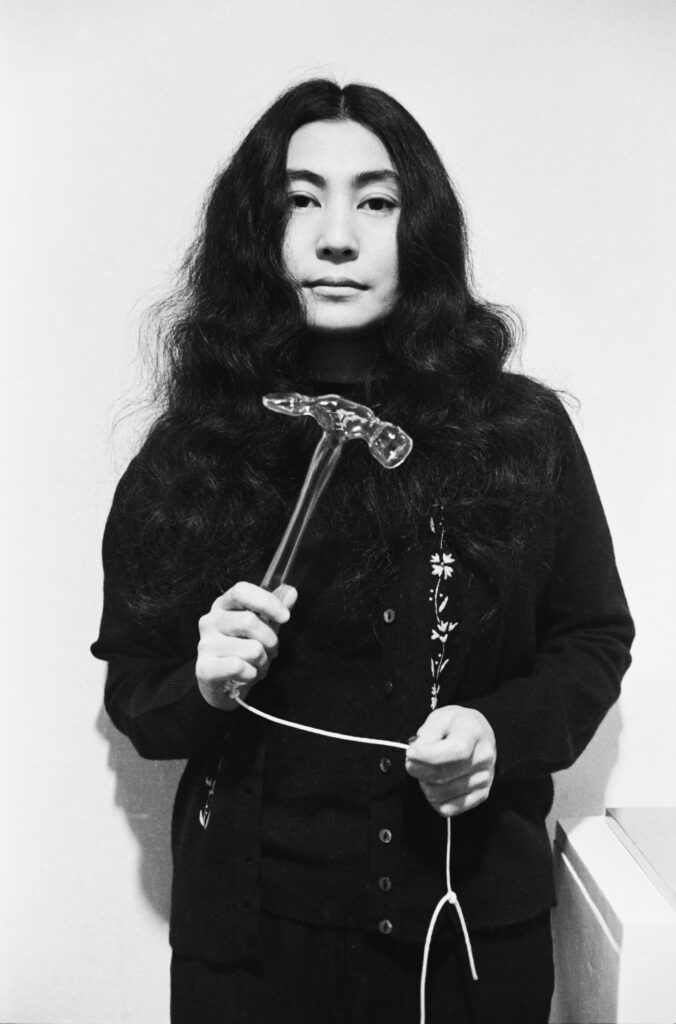
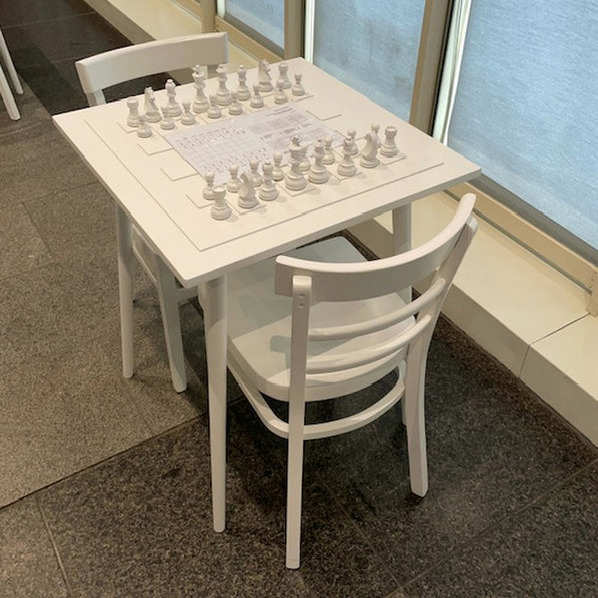
However, the "White Chess Set (White Chess Game)" (1966) with exclusively white pieces appears particularly relevant. It is almost inevitable that the players gradually lose track of their own and the opponent's pieces over the course of the duel. Accordingly, at the end of a game there is neither victory nor defeat. The chess game can be read as a clear appeal for peace. Yoko Ono's anti-war stance permeates her work and also forms the main motif of the performance "Give Piece a Chance" realized together with Lennon. Lennon and Ono met as a result of Ono's move to London in 1966 and in the context of their exhibition at the Indica Gallery. The film "BED PEACE (Bed Peace)" (1969), presented at K20, documents their second so-called "Bed-In" in Montreal after Amsterdam. During the Vietnam War, the couple used this method to send a message of peace without violence, and even received press representatives and other celebrities from their bed.
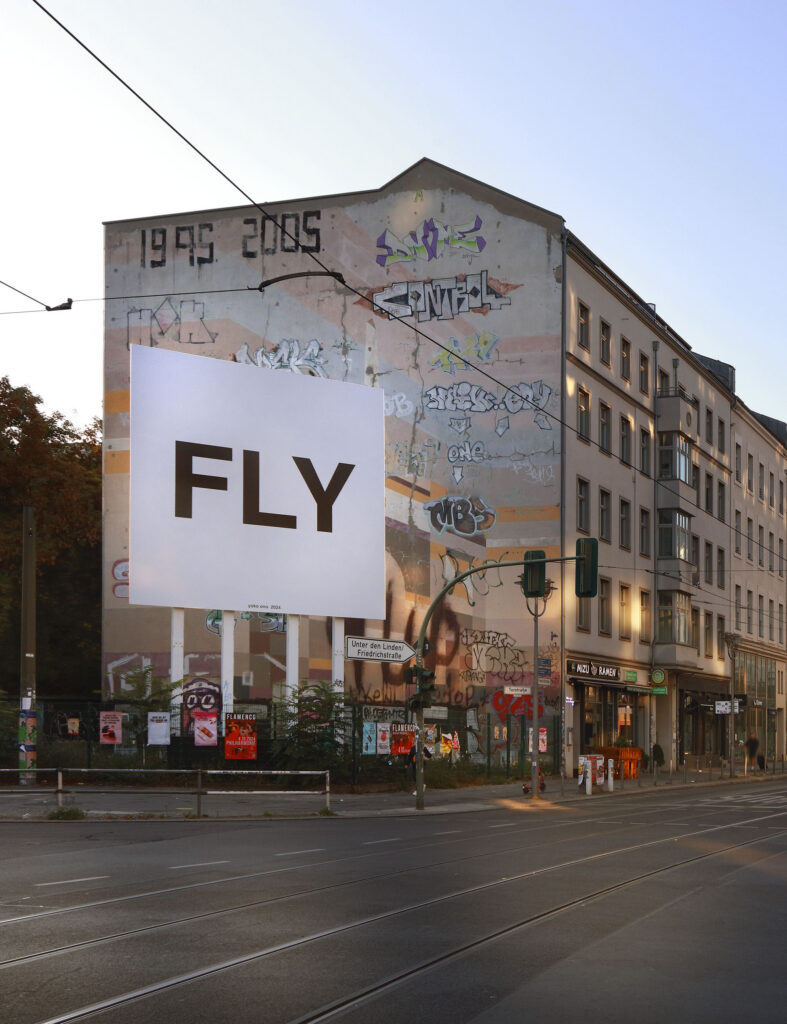
The struggle for world peace was and is, in light of current wars, both then and now, of tragic relevance. In keeping with this, the phrase "PEACE IS POWER" (2017) is displayed in large format on the facade of the Kunstsammlung NRW. In parallel, the Neue Berliner Kunstverein (n.b.k.) has placed an Ono instruction "FLY" on a billboard at the intersection of Friedrichstraße and Torstraße. This is the first of a total of two billboard walls that form, within the framework of the Billboard series of the n.b.k., time-shifted interventions in public space in Berlin. These are intended to serve as a call to liberation and empowerment in close cooperation with the studio Yoko Ono. The second billboard will be displayed in the public space for another six months starting in March 2025.
Yoko Ono has consciously used her media power and the tools of advertising in the past, for example by having Lennon and herself jointly plaster the Times Square with "War is over! – if you want it" as part of her Billboard campaigns. The aspect of participation in Ono’s oeuvre also appears to be no less contemporary. For Ono, art is realized in the imagination; anyone can become an artist in a similar way to Joseph Beuys. However, Ono’s conceptual instructions lose their subtle poetry embedded in the museum space, so the areas marked with the yellow markings feel less playful than didactic rather than participatory. Nevertheless, the visit to the exhibition stimulates the mind and the imagination is boosted significantly by the instructions written down afterwards. One is almost tempted to design one's own instructions or perhaps even to think of the world in a completely new way.
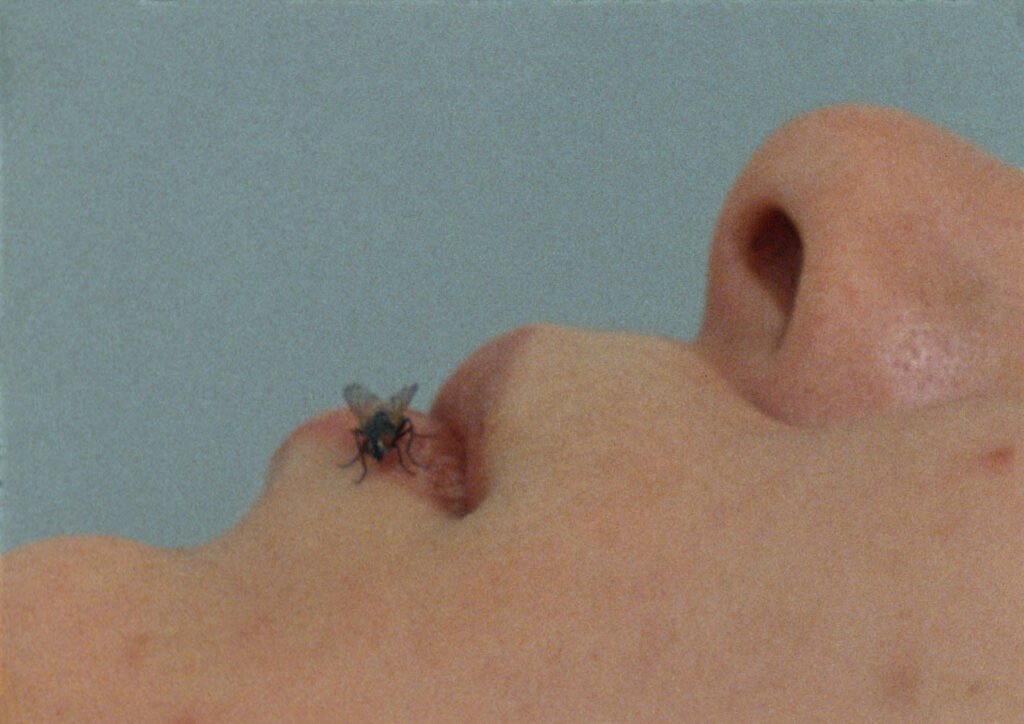
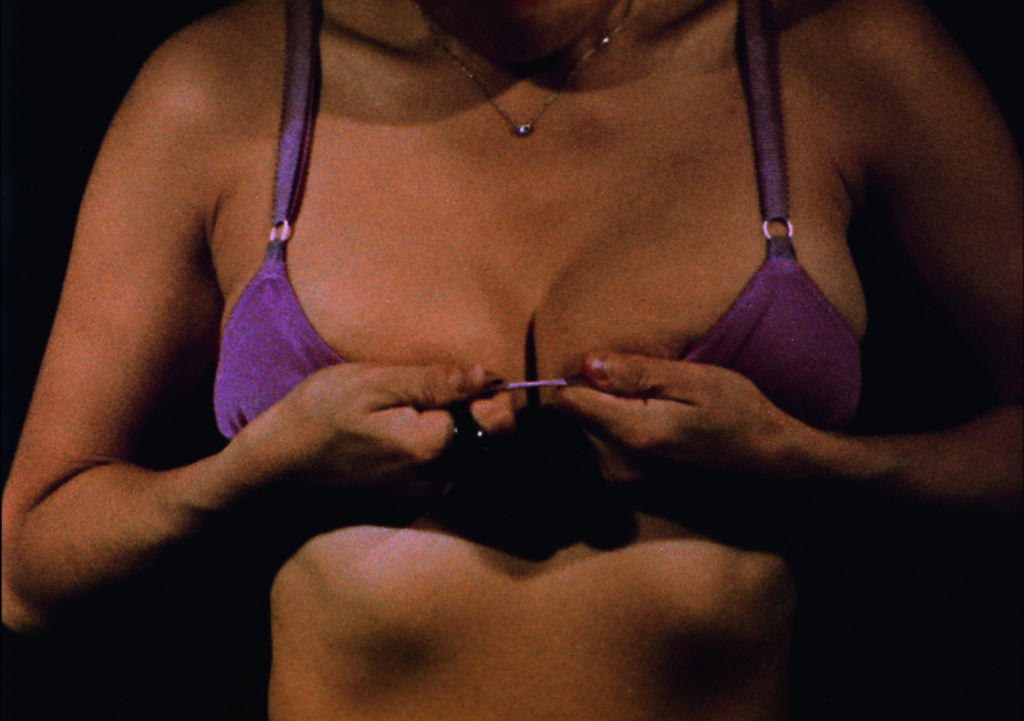
Yoko Ono created conceptual and participatory art in the early 1960s, when there was no theory of performance art. Feminist-themed performances such as "Cut Piece" but also "FLY (FLIEGE[N])" (1970–71), in which a fly wandered over the body of a naked woman, or "Freedom" (1970), in which Ono unsuccessfully tried to free herself from her bra, inspired subsequent generations of performance artists. Marina Abramović's "Rythm 0" from 1974 went one step further based on "Cut Piece".
In the performance, which seemed like a social experiment, there were no limits for the audience; they stripped the artist naked to her bare body or even threatened her with a revolver. In a space without a stage, there was no separation between the performer and the audience; it was a complete dissolution of boundaries, both physically and psychologically. "Rythm 0" would hardly have been conceivable without Ono's performance as a precursor. Together with Carolee Schneemann, Ono set standards in her equally personal, everyday and dematerialized performances that still influence contemporary art today. The retrospective organized in collaboration with the Tate Modern in London will be moved this year from Düsseldorf to the Gropius Bau in Berlin – Yoko Ono seems to finally have earned her deserved place in art history.
"Yoko Ono. Music of the Mind" at the Kunstsammlung NRW, K20, until March 16, 2025. Afterwards, from April 11 to August 31, 2025, the exhibition will be on view at the Gropius Bau in Berlin.
Catalogue: Yoko Ono. Music of the Mind, 304 pages, German, 42 euros.
www.kunstsammlung.de
"Yoko Ono. Fly" at the intersection of Friedrichstraße/Torstraße, Neuer Berliner Kunstverein n.b.k., until February 23, 2025. Second part from March 2025.
www.nbk.org
The Kunstmuseen Krefeld are dedicating the first retrospective in Germany to Charlotte Perriand’s multifaceted and astonishingly contemporary work.
 7 min read
The exhibition "Six Five Four Three Two" featuring works by the New York-based artist Josephine Meckseper at the Heppenheim Art Society.
 9 min read
In the new premises of Plateforme 10 in Lausanne, the Photo Elysée Museum can finally unfold its potential.
 12 min read