 19 min read
 19 min read
As early as autumn 2019, the self-image of Documenta had begun to crack. During an Emil Nolde exhibition at the German Historical Museum (DHM), historians Bernhard Fulda and Julia Friedrich came across the NSDAP membership card of the first Documenta curator, Werner Haftmann. Then, while researching for her doctoral thesis, Vincenza Benedettino discovered that this man had already joined the SA in 1933. At the beginning of the Nazi era, he had been a member of the SA for the magazine Art of the Nation He worked for Expressionism as "German art". In one of his contributions, he wrote in 1934: "The great representative of this agitated and passionate form is Nolde; in him all the mystical and sorrowfully agitated elements of this burning time are once again fully embodied in his own way." So, was he only rehabilitating the art for which he had already taken a stand in National Socialism when he was the curator of the Documenta? In any case, he had once again removed the Jewish artist Rudolf Levy from his list of participants, as Julia Voss discovered in conversation with the sculptor Emy Roeder, one of the few female artists of the first Documenta: apparently to maintain his thesis that there were no significant Jewish contributions to Modernism. Finally, the historian Carlo Gentile uncovered in June 2021, a few days before the opening of the DHM exhibition Documenta. Politics and Art In the Süddeutsche Zeitung, it was reported that Haftmann was also responsible for torture and the murder of Italian partisans.
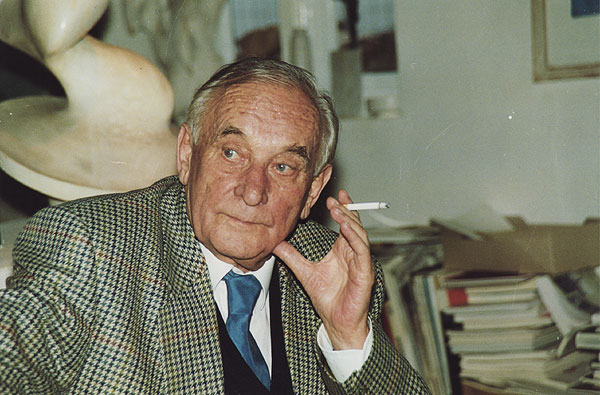
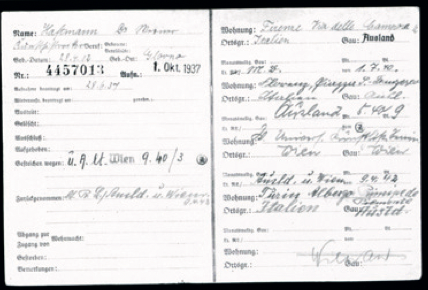
As puzzle pieces, the findings of historians and art historians came together to form a new picture. It is true that the exhibition in Kassel displayed works that could not be shown during the Nazi era. But the Documenta was not a "zero hour". Like the entire German postwar history, it was more closely connected to the horrors of the Nazi era than previously thought. The myth was dispelled.
While the unpleasant aspects in Unschuld’s biography were carefully researched, the same cannot be said about the accusations of sexual assault. Kassel Alliance against Antisemitism Do not say this about the curators of the next Documenta. In January 2022, five days after the end of the exhibition at the DHM, the alliance accused the Indonesian collective Ruangrupa of serving up anti-Semitic prejudices. "The alliance is about denouncing people who view the occupation policy of Israel critically," three weeks later quotes the Hessische/Niedersächsische Allgemeine (HNA), which was the first to publicize the accusations against historian Ulrich Schneider. "The generalized accusation of anti-Semitism is consciously used as a death sentence argument by them." The expert on the Middle East, Werner Ruf, says from his own experience with the alliance: "With this group, you can do and say whatever you want. They simply build their own image of the enemy."
At its core, the allegations revolved around the Palestinian collective invited by Ruangrupa. The Question of Funding: a small group of cultural actors, according to their own statements, which had been founded three years earlier in the Khalil Sakakini Cultural Center in Ramallah. The participants working in various institutions had noticed – hence the name – that in their funding applications they were more likely to follow the criteria of international donors than their own agenda. On their website, they do not represent a particular policy or agenda, but merely pose a series of questions to their own community, including what role the collective could play at Documenta. The Kassel Alliance now accuses the founder of the cultural center, the Christian author and reform educator Khalil Sakakini, who was born in Jerusalem in 1878, of having collaborated with the National Socialists. According to Jens Hanssen, a Middle East historian studying in Toronto who writes in the online magazine Jadaliyya, published by Arab Studies Institute in Washington (excerpted in English) History of the present) He has worked out who Sakakini really was. "Don't believe that Hitler is the Luther of our time!" this man warned his son in 1934 and described National Socialism as "a consequence of crises and catastrophes that will lead all of humanity down the wrong path and leave us all as mere beasts".
Not all those who wrote about the Kassel Alliance bothered to investigate who was behind it, like the HNA did. A media outcry arose, often considering what was initially only a weakly substantiated accusation as proven: that these curators from Southeast Asia had a "antisemitism problem," as a contribution from the weekly newspaper The Time Sufisticatedly formulated. To meet this challenge, the Documenta put on the exhibition titled We Need to Talk An expert discussion series that was scheduled to take place online over three dates in May was cancelled. But in late April, the Central Council of Jews intervened. In a "letter of protest" widely distributed by the German Press Agency (dpa), its president Josef Schuster complained that it had not been sufficiently involved.
The Documenta wanted to discuss "the fundamental right to freedom of art in the face of rising racism and anti-Semitism and increasing Islamophobia", and thus also about racist remarks directed at the Indonesian curators and their guests. Disagreements should "be tolerated and productively discussed". Schuster, on the other hand, did not want to tolerate disagreements but resolutely oppose anti-Semitism. He wondered "why the topic of anti-Palestinian racism has found its way into the program" and could not see any connection. Soon afterwards, a case of vandalism in the group's premises showed that a connection existed. The Question of Funding With hidden threats of murder. At that point, the conversation had already failed. Under the massive pressure of the media debate, some participants had withdrawn. Subsequently, Documenta cancelled the entire series.
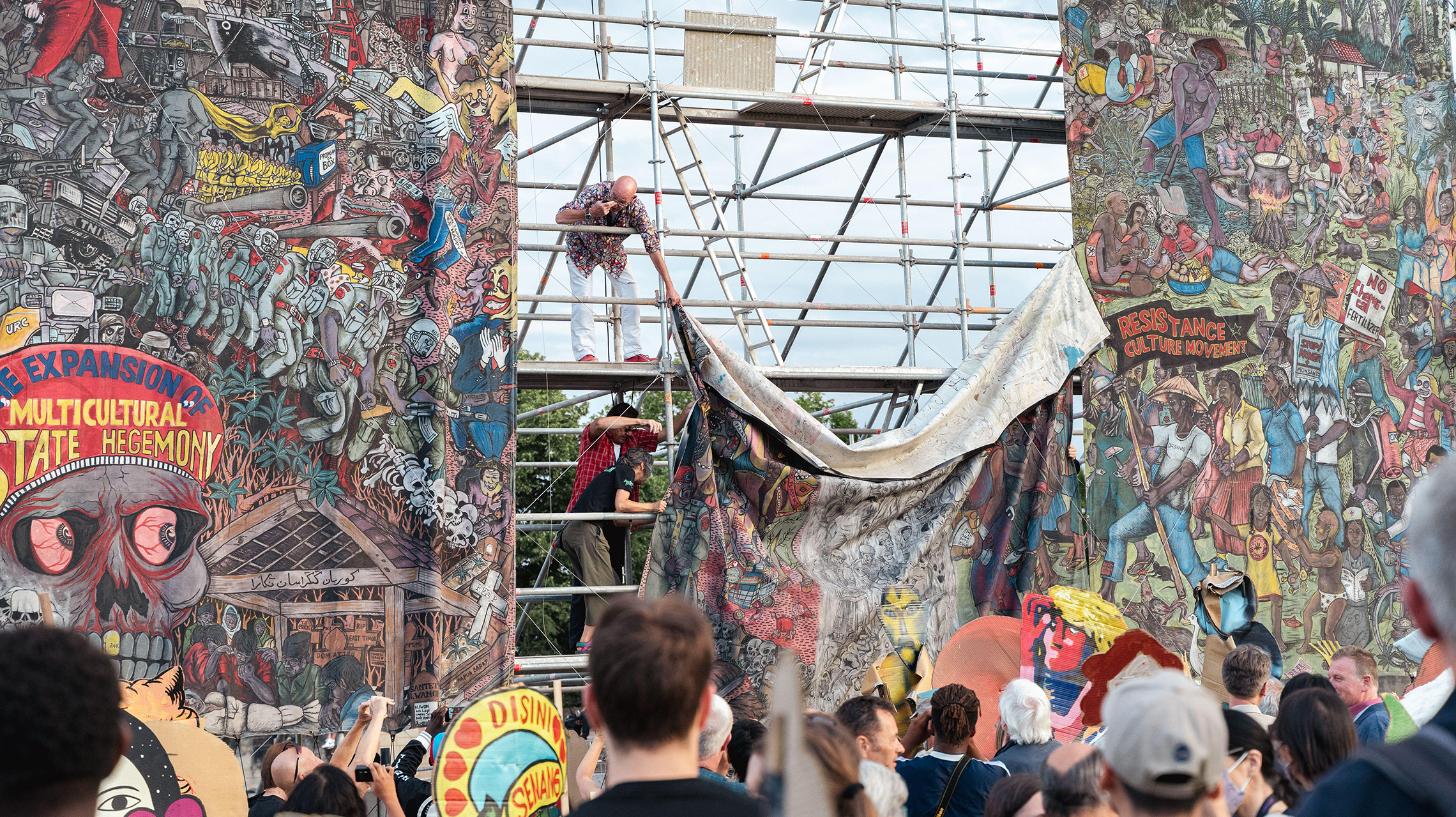
One must review this heated atmosphere of denunciation and suspicion, in which even the attempt to have a clarifying conversation met with heated resistance to understand the uproar surrounding the opening of the Documenta. No one disputed that two of the figures on the twelve-meter-high banner People's Justice The group Taring Padi contains antisemitic stereotypes. But who Taring Padi actually is, why this banner was placed so prominently and what it meant in its original context: such obvious questions were not asked.
The enormous agitational work was created in 2002 after the resignation of dictator Suharto, whose iron fist claimed the lives of more than half a million people. It is a kind of secular Latest judgment With hundreds of figures: On the left are the perpetrators of the Suharto regime, including agents from various intelligence agencies from the CIA to the KGB, and also a figure with the inscription "Mossad" on the helmet. The Star of David on its red scarf does not designate the persecuted Jews as in the Nazi era, but serves as a symbol of the state of Israel, whose intelligence service is certainly responsible for covert killings, torture, and sabotage operations, even if not primarily in Indonesia. Further to the center is the second problematic figure: a man in a suit with a top knot and a cigar in his corner of the mouth, with jagged, protruding teeth and red eyes. An anti-Semitic Jewish stereotype, paradoxically, characterized by SS runes on the hat. On the right side, however, we see the fighters against the Suharto regime, the simple people: in the center is a man wearing a straw hat who is waving a flag that reads "Resistance Culture Movement".
No one bothered to decipher the overall iconography of the banner. There was also little time for it: it was covered up and then hung up. Genocide and Holocaust experts such as Michael Rothberg from the University of California, Los Angeles, or Anthony Dirk Moses from City College of New York nevertheless tried to contextualize the two incriminated figures. As Jeffrey Hadler, a professor of Indonesian Studies at the University of Berkeley who died in 2017, showed, anti-Semitism in Indonesia was an import from the Dutch colonizers and from Germans living there during the Nazi era. But there was only a vanishingly small Jewish minority. The antisemitic stereotypes were rather transferred to the Chinese, who were perceived as foreign instigators. There were also pogroms against the Chinese, but not by Suharto opponents but by Suharto himself. Later – and this is the character of the Mossad agent – these negative images were associated with an anti-Israeli stance due to the Middle East conflict. The teeth and red eyes of the second character, on the other hand, come from the traditional depiction of villains in Javanese shadow puppetry.
Such contextualization, however, did not take place, apart from the comments of far-flung observers like Rothberg and Moses. The banner confirmed what the Kassel Alliance, that is, Jonas Dörge, had said earlier:, Time-Author Thomas E. Schmidt, the Central Council and everyone else who had always known or gradually understood it without being able to prove it yet: Ruangrupa had an antisemitism problem. No excuses helped: The curators and artists had, without even noticing it, violated a taboo. "Now tough consequences must follow," demanded the Jüdische Allgemeine shortly after the opening, "even for Culture Minister Claudia Roth": almost in unison with Bild newspaper, which had already demanded it in a video the day before: "Claudia Roth must resign." Roth backed down. She accused the curators of being rude, citing them before the Bundestag's Culture Committee. "The Central Council of Jews is increasing the pressure on Claudia Roth," the Bild newspaper reported two weeks later. Roth bowed. "She should have been more loud and clear," she quotes. Der Spiegel. Later she threatened Documenta with financial consequences.
Claudia Roth did not resign. But victims had to be brought to justice. Shortly after the opening, Documenta director Sabine Schormann resigned. In November 2023, Ranjit Hoskoté, a member of the search committee, followed suit, and then in solidarity with him the entire search committee. Hoskoté had signed a petition in 2019 against an event organized by the Israeli Consulate General in Mumbai. The poster presented Theodor Herzl and Vinayak Damodar Savarkar, the founders of Zionism and Hindu nationalism, as "Leaders of Nations". In 1948, the Jewish state of Israel was established in the Middle East. The Palestinians were expelled. In the same year, after the end of the British colonial rule, the Indian partition took place into a Muslim North, Pakistan, and the present-day India, which according to rough estimates resulted in one million people being killed. The Hindutva party, which uses a swastika as a symbol, views members of other religions as guests in their own country, which actually belongs to the Hindus. Prime Minister Narendra Modi is said to have played a leading role in the anti-Muslim Gujarat Riots of 2002. The event established a connection between the two movements. In contrast, the group’s petition was directed against the event. BDS India.
BDS means Boycott, Divestment and Sanctions. The movement emerged after the second Intifada, the armed uprising of the Palestinians from 2000 to 2005, as a non-violent alternative to resistance against the occupation. The movement is modeled on the struggle against apartheid in South Africa. The movement is supported by pacifist, feminist, and also Jewish and Christian groups such as the American Friends Service Committee the Quaker organization, arguably the oldest pacifist organization in the Western world. Divestment It means disinvestment. The movement is strong, especially in the USA, also in Canada and Great Britain, and has so far achieved its greatest successes, where it was able to push companies that benefit from mineral resources or cheap labor in the occupied territories, namely mainly in the West Bank, to withdraw. BDS campaigns are also constantly trying to prevent arms deliveries to Israel. Opinions on the boycott of Israeli cultural and educational institutions are divided.
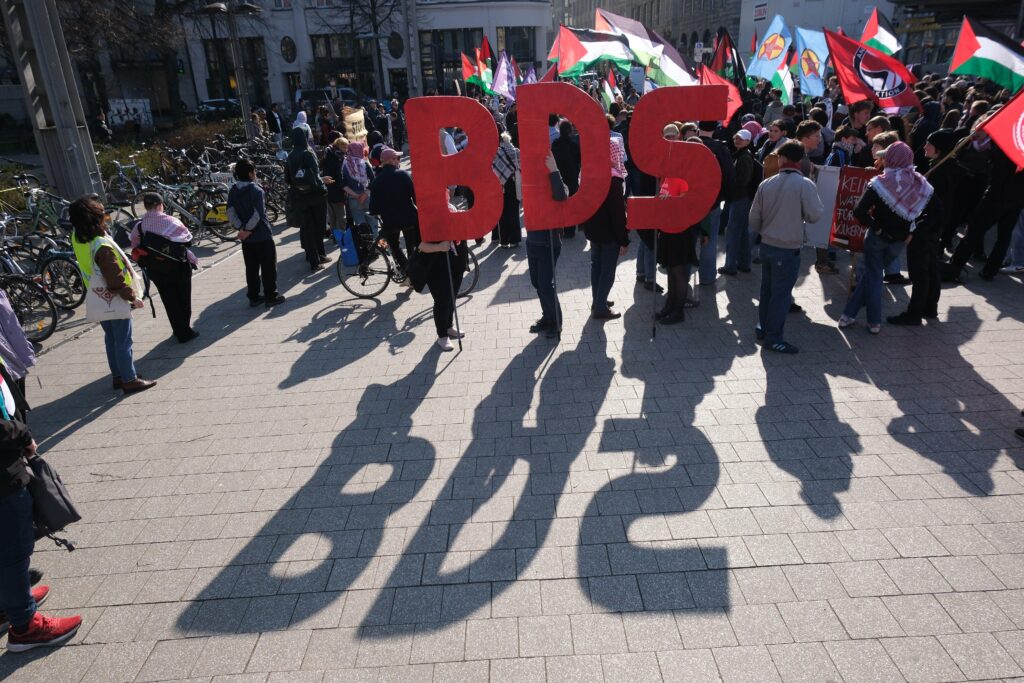
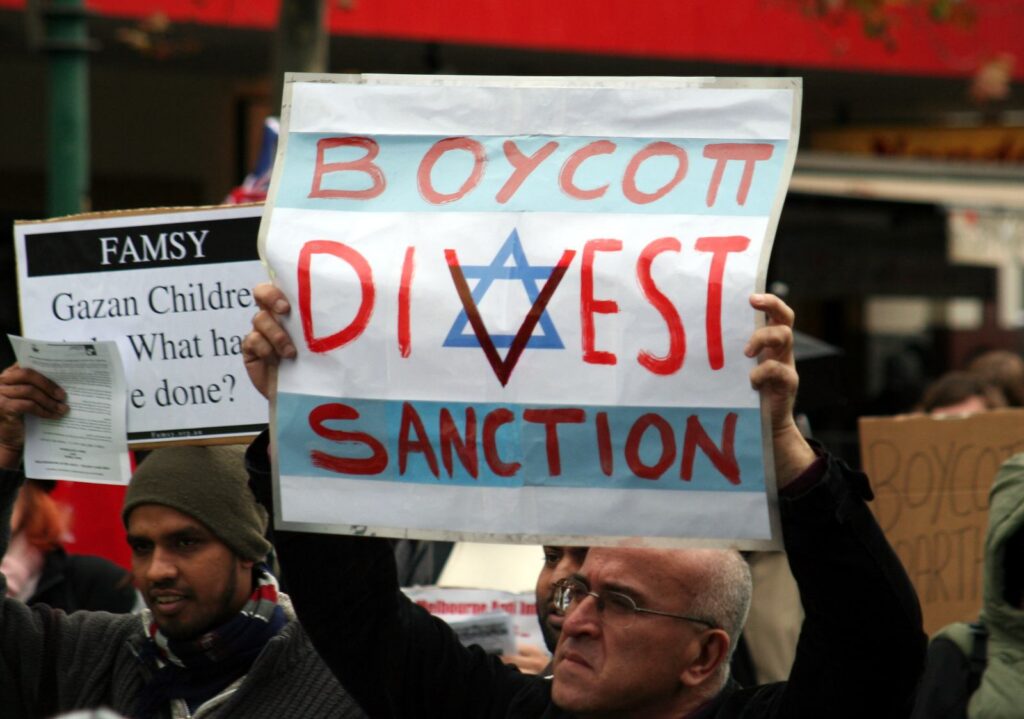
In Germany, however, BDS is equated with boycotting Jewish businesses during the Nazi era, especially since a 2019 Bundestag resolution. "The calls," it says there, "also remind us of the most horrific phase of German history. BDS stickers on Israeli products evoke inevitably associations with the Nazi slogan 'Don't buy from Jews!' and corresponding graffiti on facades and shop windows." The resolution, originally introduced to Parliament by the AfD and slightly modified by almost all parties, is not legally binding, has no legal force, but does have an effect. In practice, anyone even suspected of supporting BDS is subject to antisemitism charges. This means that, according to the resolution and established practice, journalists from public broadcasting stations are removed, cultural institutions are no longer funded, and speakers are once again barred from speaking, not only when they actively support BDS but even when they are already perceived as sympathizers with the movement.
That is why the Israeli architect Eyal Weizman supports it, as he stated in an interview with the English literary magazine Granta underlines, BDS: because Palestinians would be silenced by the Bundestag resolution. The research network founded by Weizman Forensic Architecture, which last year won the Right Livelihood Award, He received the so-called Alternative Nobel Prize and is known in Germany primarily for his research on the NSU murder of Halit Yozgat presented at Documenta 14. Forensic Architecture He works on a case-by-case basis on behalf of victims of human rights violations, including in Israel and Palestine. Weizman also advises the International Court of Justice. He considered the banner of Taring Padi a "terrible stab in the back" to his efforts.
The BDS movement raises the question of what exactly should be understood by antisemitism. There is, however, a non-binding working definition of antisemitism. International Holocaust Remembrance Alliance (IHRA), which would be less controversial, the Bundestag would not have added a sentence in 2017 that, in addition to hatred against Jews and attacks on Jewish institutions, also names attacks on the State of Israel as a criterion. It remains unclear what is meant by "attacks": military violence or also criticism of war crimes, human rights violations and violations of international law, as the International Court of Justice actually accuses Israel of. In practice, this uncertainty often leads to refusals and expulsions, since no one wants to risk being accused of antisemitism. The Israeli sociologist Eva Illouz formulated this after the resignation of the director of the Jewish Museum in Berlin, Peter Schäfer: "One can only express criticism of Israel if one is not suspected of being antisemitic; but if one expresses criticism of Israel, one is inherently suspected of antisemitism." That ends the discussion before it even began."
The IHRA definition has been in place since 2021. Jerusalem Declaration In contrast, Illouz has formulated it. She defines anti-Semitism as a special form of racism and distinguishes between anti-Semitism and anti-Zionism, which, like boycotts, is not automatically classified as antisemitic.
After the opening of Documenta 15, intensive searches were conducted for further anti-Semitic works. For example, drawings of Algerian women from 1988 were classified as antisemitic, showing Israeli soldiers aiming their weapons at children: in the West Bank, however, this is a common sight. A number of paintings under the title Guernica – Gaza, by Mohammed Al-Hawajri, who was one of the The Question of Funding invited group of artists Eltiqa Since it belongs to Gaza, it should be antisemitic. The group funded by the Goethe Institute operated a gallery that was destroyed by Israeli bombs in the autumn of 2023. "Mohammed Al Hawajri," a caption on the website of Deutsche Welle (DW) states, "equates Israelis with Nazis in the title of the series 'Guernica Gaza': a case of victim-perpetrator inversion." The series, set in Gaza, quotes famous works of art. However, like Picasso, Al Hawajri does not focus on the perpetrators but on the perspective of the victims, their suffering and the resistance of the Palestinians. The caption on the DW website is not, however, in Al-Hawajri's version. Guernica, But under the one of Eugène Delacroix; Freedom leads the people. If it is already clear from the outset what the artist is to be held responsible for, there is no need to go into any further detail.
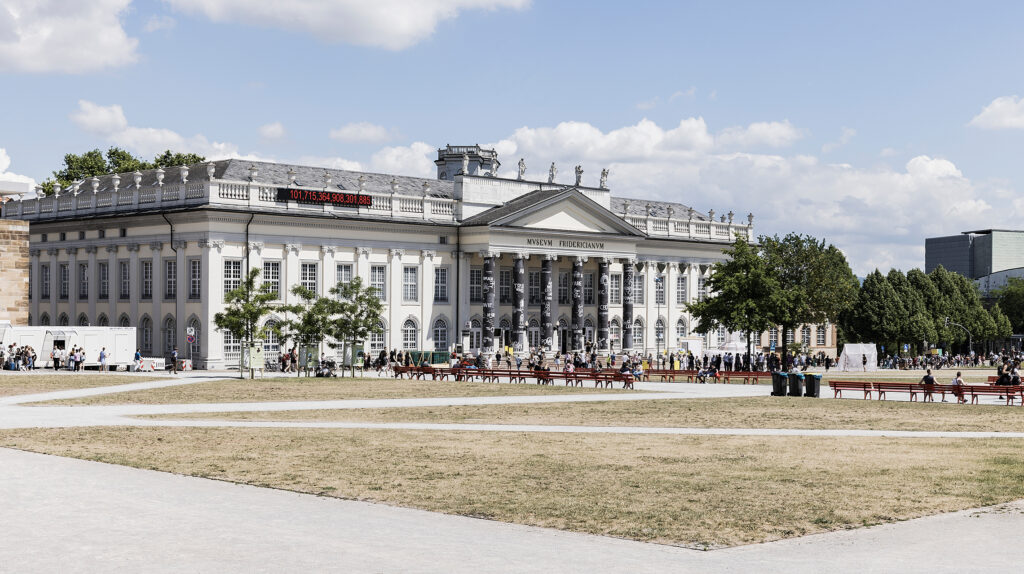
"The Documenta in Kassel is the most important exhibition of contemporary art worldwide," declares the website of the city of Kassel. Similarly, the Documenta itself puts it this way, followed by almost everyone who writes about it. Until the turn of the millennium, this "worldwide" reference almost exclusively referred to Europe and North America. Only with Okwui Enwezor did the radius expand to the entire globe. Ultimately, the Documenta, somewhat differently from the Venice Biennale, which is more decentralized with its country pavilions, claims to define the current state of development in art. However, at Documenta 15 it becomes apparent that it can no longer fulfill this claim, taken in its global scope, for various reasons.
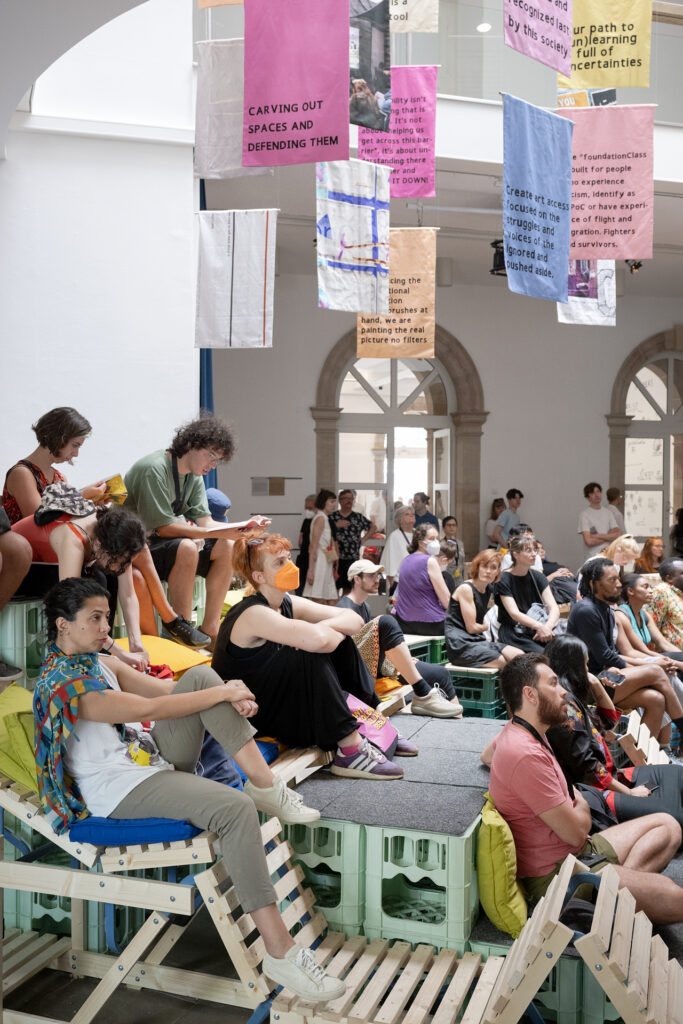

On the one hand, as the dispute over Documenta shows, Germany wants to make its own, derived from German history, principles the standard for the entire world. Jerusalem Declaration A consensus would probably not be difficult to achieve, because the global South is also positioning itself against racism. However, a large part of the world does not agree with the German state’s unconditional support for Israel, the IHRA’s definition of antisemitism, especially in the German version, and the BDS resolution of the Bundestag. Former colonial countries feel more closely connected to their own history than to the expulsion of the Palestinians since 1948, the occupation of the West Bank, and the attacks on the Gaza Strip, and they view the State of Israel rather as a settler colonialist project. A discussion of this issue, as in the conversation series We need to talk It was planned, but it will not take place. For that both sides would have to listen to each other. Germany would therefore also have to acknowledge the atrocities of the Suharto dictatorship, including the involvement of Western countries, as history that needs to be addressed; but also the sufferings of the Palestinians, which are not yet history but a painful present. In other words: The moral, ethical and political criteria according to which the Documenta is structured are unilaterally shaped by Germany.
Dipesh Chakrabarty has written a book in 2000 that is titled Provincializing Europe It should be pointed out that the values of Enlightenment can indeed have emancipatory effects in other parts of the world, but they are nevertheless shaped by the specific history of Europe. To provincialize Europe means to understand everything that has spread from Europe across the world not as universal, but against the backdrop of European history. Only in this way can the differences between the various conceptual and value systems be perceived and negotiated at all. Antisemitism originated in Europe, first in the form of the exclusion of people of other faiths, then intensified in the form of the racial theory. An antisemitic stereotype on an Indonesian billboard can only be traced back to an import from Europe. This alone should be a reason for a little caution before pointing the finger at others who use this stereotype, perhaps in ignorance of the background.
Among the European achievements that have spread across the world is also modern and contemporary art. One can argue that the Modernism, unlike the art of the 19th century, is not a purely European affair, since it is significantly linked to the reception of non-European forms in so-called primitivism. Art in the European sense existed, conversely, already in the colonial world, including in Indonesia. Contemporary art has developed, as Charlotte Bydler in The Global Art World Inc. On the Globalization of Contemporary Art It describes, however, only after 1989 has it spread throughout the globe. Nowadays, almost 300 biennials are held in all parts of the world, in an international network of curators. A continuous renegotiation of value standards is taking place, with global standards regarding the quality of the works on display playing a role, as does local value standards, such as the question of head and body covering in Islamic countries.
The Documenta does not determine these questions alone or in the first place. To the extent that it seeks to make the lessons of its own German history the standard for the entire world, instead of recognizing fundamentally equal aspirations in the history, the sufferings, and the emancipation efforts in other parts of the world, it nevertheless reveals a provincial perspective. Driven by the public debate about it, it is provincializing itself. A majority of the world now sees things differently than those that were hotly debated during the Documenta 15 in Germany.
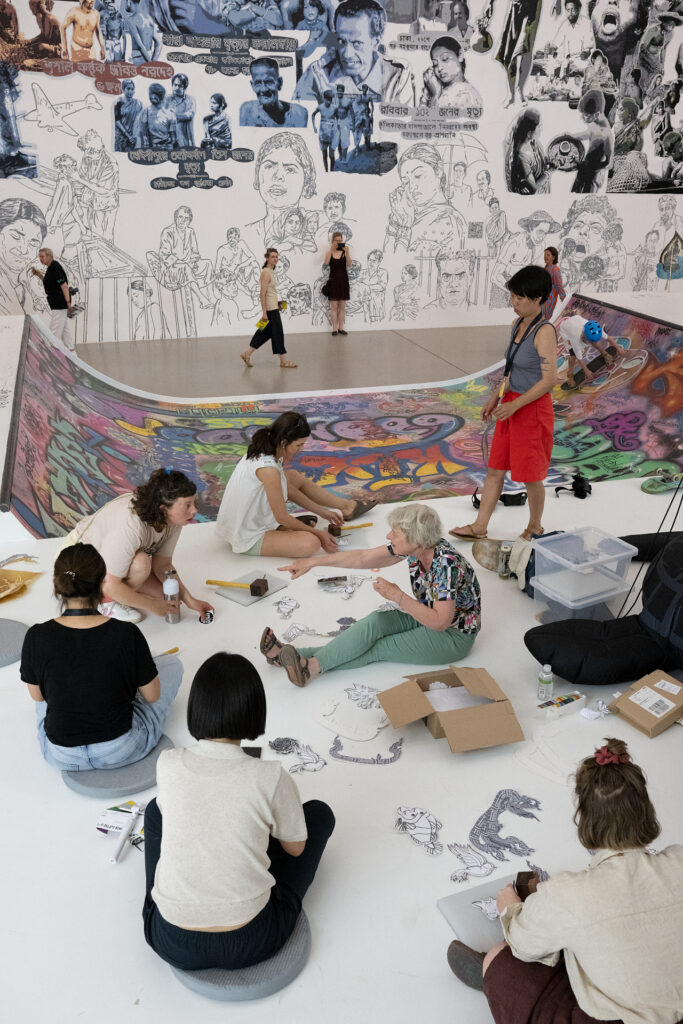
However, another type of provincialism has also entered Documenta 15. The Ruangrupa concept, as illustrated by the image of the rice barn, attempts to transfer Indonesian standards to Germany. However, the development of contemporary art in Indonesia since the 1990s has been different from that in Europe. It was first shaped by the interest of international collectors, following the boom of Chinese art, and then by resistance to Suharto. Both of these factors have not led to the establishment of a type of contemporary art that has developed in the same way as in Europe over the last few decades and has thus determined the quality criteria of Documenta to date. Art in Indonesia is, to put it bluntly, not sophisticated conceptual art that no one understands, but rather colorful, loud, and expressive. It is questionable whether there are any training and exhibition facilities there at all, like those in Europe. Ruangrupa probably didn't create this educational platform for nothing. Damn, Art often takes place in public spaces, through posters, comics, and performances. The collective’s emphasis is directed both against the commercial artist and against the attempt to find one’s own values.
Some of this may also seem interesting to the Western world. But it cannot replace the standards of quality that have emerged over the seven decades since the Documenta has been held. A critic of the New York Times came to the conclusion after the end of Documenta 15: "The World's Most Prestigious Art Exhibition Is Over. Maybe Forever." In the subtitle he adds: "Whatever comes next will never be what it was before."
The Documenta is currently celebrating its 70th anniversary; the program can be found here: 70 years of Documenta.
On March 18, Naomi Beckwith, the curator of Documenta 16, first insights into their approach provided.
Under the title Art in Conflict. Antisemitism and the Postcolonial Debate at Documenta Fifteen The Documenta is publishing a book about the events, which is to be presented on April 18th, edited by Meron Mendel and Heinz Bude.
A series of talks is now scheduled to take place at the Villa Stuck in Munich starting May 3, in which the preparations for Documenta 15 will also be discussed; the series is titled The Condition of No. Conversations about Boycott, Censorship and Protest in Germany It originated in connection with an exhibition by Tania Bruguera last year and was originally announced for January, then in March, but was then cancelled at the insistence of the city of Munich. The date and the people involved in the Documenta project are not yet fixed at the moment.
The Kunstmuseen Krefeld are dedicating the first retrospective in Germany to Charlotte Perriand’s multifaceted and astonishingly contemporary work.
 7 min read
In the new premises of Plateforme 10 in Lausanne, the Photo Elysée Museum can finally unfold its potential.
 12 min read
The exhibition "Six Five Four Three Two" featuring works by the New York-based artist Josephine Meckseper at the Heppenheim Art Society.
 9 min read