
 7 min read
 7 min read
Approximately 300 kilometers north of Helsinki, in a wooded area amidst the Finnish Lakeland, is the Gösta Serlachius Fine Arts Foundation. The privately owned foundation manages one of Finland’s most renowned art collections and is dedicated to preserving and beautifying the surrounding municipality of Mänttä-Vilppula. The municipality has a population density of 17.5 inhabitants per square kilometer – less than half the population density of Germany’s least densely populated region. Nevertheless, according to the foundation’s own statements, it manages to attract between 80 and 150 thousand visitors annually.
An idea makes it clear how the foundation succeeds in doing this, because it attracts international audiences as well as art-lovers and locals alike: an art sauna. Guests from far away can relax here, while locals do exactly what they would otherwise do, but in award-winning architecture surrounded by art and design. Because up to 90 percent of Finns go to the sauna at least once a week.


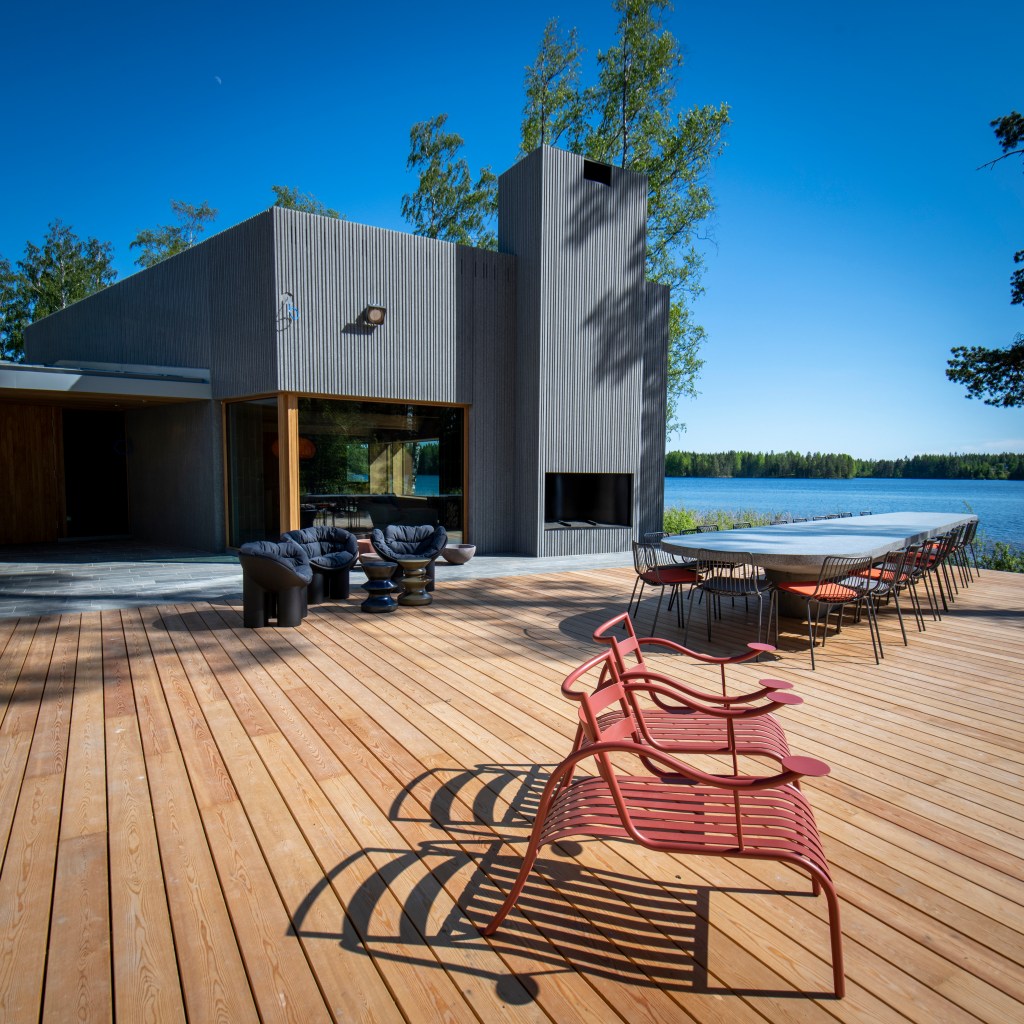

The art sauna, called "Taidesauna" in Finnish, was designed by the three Spanish architects Héctor Mendoza, Mara Partida and Boris Bežan. Their approach is a phenomenological architecture that makes things appear and become tangible instead of being exhibited. The sauna is not a museum.
To get to the sauna, you have to pass through the extensive sculpture park, past the former residence of the Serlachius family, which is now a museum. From the embankment path, the large art gallery, designed by the same architects, can be seen on its long side. The vertical structure of the wooden facade and the reflective glass elements imitate the forest and its surroundings. The sauna, located at the end of the park, takes up this structure in the material of concrete. Its light gray color is reflected in the stones, the water, and the sky.
Upon entering the sauna house, a bright room opens up with panoramic views of the lake. In front of it, a long banquet table with chairs by Oscar Tusquets is set up. In the rear part of the room, a cozy and stylish living room with a fireplace connects to the outside, from where the lake and the terrace can be viewed. The furnishings and decoration are chosen classically to iconic levels, combining Finnish design (Alvar Aalto, Ilmari Tapiovaara, Klaus Haapaniemi) with international pieces (Patricia Urquiola, Jasper Morrison, Faye Toogood).
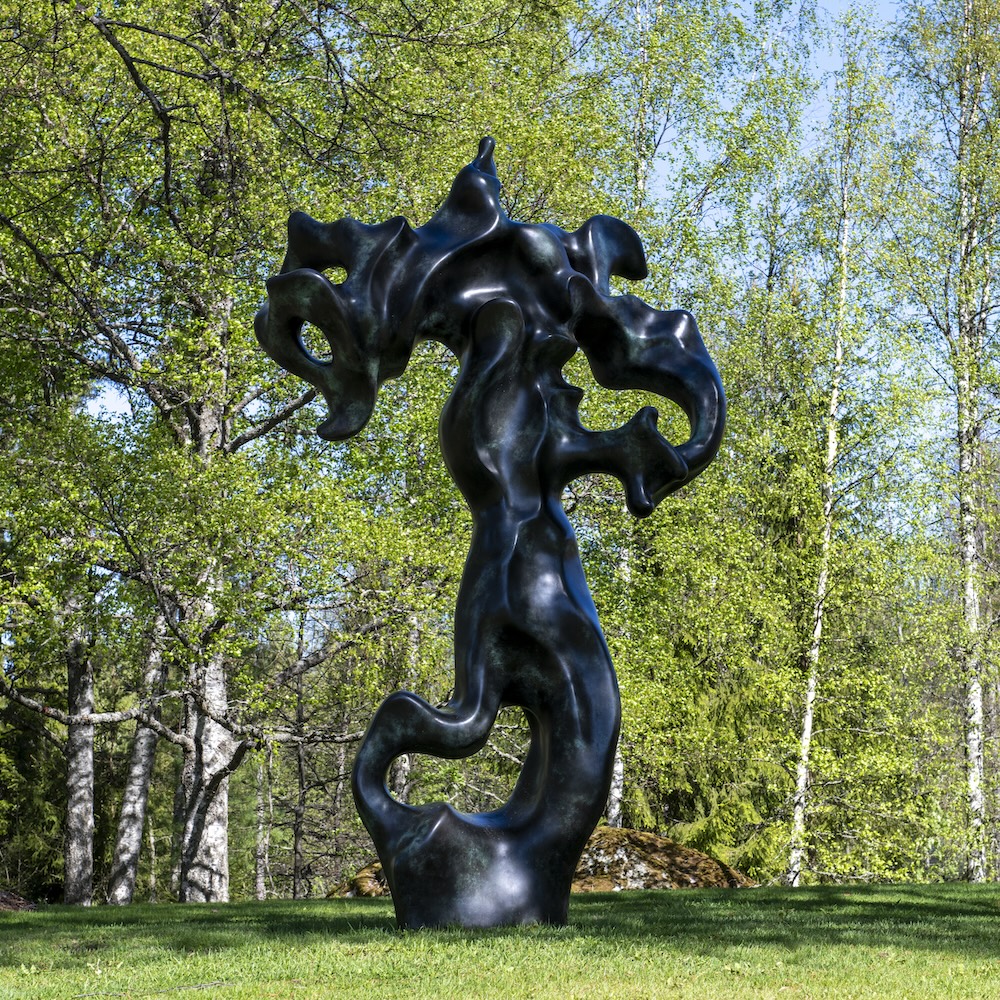
The right hand leads past a colorful mural by Satu Rautiainen to the changing rooms and showers. A wooden door is adorned with a wall sculpture by Noora Schroderus, which in playful forms reminiscent of female genitalia reads "INTIM" and "INTERIÖR". After we have cleaned up and wrapped ourselves in towels designed by Satu Rautiainen, we step out into the cool air. The view from the terrace of the building impresses with its clear but bold forms. Inside and out they play together. The actual sauna area is at the end of the complex on the edge of the forest. It is circular, the stove is also circular, powerful and filled with black hot stones. The heat of the steam, in Finnish "Löyly", warmly embraces the entire body. From inside a large square window opens onto the lake and a poetic land art work by the Finnish artist Laura Könönen. After the sauna, you can cool off in the outdoor shower, bathed in the dazzling light show of a tile mosaic by Tuula Lehtinen. Or you can take a bath in the lake. From the pier, touching sculptures catch your eye; from the foundries in the stone garden, childish faces peel off – a work by the Finnish artist Anne Koskinen.
The sauna sharpens the senses and lowers blood pressure, makes one feel hungry and thirsty, leads to sleep, or revitalizes. It satisfies in its excessive intensity and abundance. Perhaps we need to occasionally go beyond our limits, notice the thresholds of our sensory fields to be able to fully exhaust our sensory repertoire. The intoxication that the body involuntarily experiences under the influence of the elements only makes the senses more sensitive to the atmosphere, the light, the forms, and the images. In pure sensation, art appears like a natural phenomenon. The works of art reflect the relationship between humans and nature, their history, and themselves. Publications can be read about the works and their meanings. However, in the sauna house there are no wall titles or labels. One can and must feel them.
The works in the Art Sauna all come from the Serlachius Collection. It includes almost ten thousand works from the so-called "Golden Age" of Finnish art (1880–1910), early modernism, and ancient European art from the Netherlands, Spain, and Italy from the 16th to the 18th centuries. Since the 2010s, the collection has also been expanded to include contemporary works. Over half of the new additions over the past five years are by female artists. These are exhibited in permanent and temporary exhibitions in the former home of Gösta Serlachius and his modern extension. A historical exhibition about the place and the foundation is on display at the foundation’s headquarters in the town center.
Even the museum visit leaves a feeling of pleasant difference: The repertoire of free service and mediation offers is overwhelming. The most diverse free offers for people with disabilities are offered. Tours are designed specifically for various interest groups. Through its audience development work, the museum tries to contribute to the "well-being" of its guests through "material and immaterial" cultural offerings, according to the head of audience development, Päivi Nieppola. For example, hiking poles, bicycles, or boats can be borrowed for free. Food, sauna, and nature experiences are also part of the museum program, as are old masters. Meals are created in the inspiration of classic still-life paintings, and the forest is explored during a sound meditation. Knowledge here is less hierarchical and idealized, making mediation formats more accessible and vividly linking them to history. Thanks to this low profile and accessibility, the foundation has indeed evolved into what many museums have only ever hoped for: a place for the community.
Some major art exhibitions and museum complexes not only generate wealth and pleasure, but also local conflicts. Some construction projects and mediation concepts fail to involve both the local and the foreign population equally. One example is the Biennale in Venice, whose visitor flows are hardly able to be sustained by the local residents, or the Humboldt Forum in Berlin, whose facade is set to be completed this month, but the debate about it is likely never to end. In Mänttä-Vilppula, things seem to be different. The municipality has transformed itself from an industrial settlement into an internationally renowned "Art Town" thanks to the foundation. The foundation hosts seven to eight temporary exhibitions each year, sometimes attracting audiences from abroad. Events and mediation offers take place almost daily, and the Mänttä Art Festival, the Mänttä Food Festival and the Mänttä Music Festival take place annually. An art residency is also part of the foundation’s activities, as are children’s and youth camps. The foundation has left its mark throughout the town, just as Gösta Serlachius did when he started the art collection. As a paper manufacturer, he expanded the town into an industrial model settlement in the 1920s in order to find workers. But he also invested in social and cultural infrastructure. He commissioned a church that became famous for its sculptures by Hannes Autere, the stained glass windows by Alvar Cawn and an altar window by Eric Ehrstrom. He also supported the construction of a maternity hospital and financed public saunas.
Until the 1950s, saunas in Finland were more important than the home. Here, not only were people cleaned. In the sauna, children were born and the bodies of the deceased were washed. Here, guests were accommodated, food was cooked and preserved. Because the sauna was a sterile place that was easy to clean and heat. The Finnish sauna culture has been included in the UNESCO's "Representative List of the Intangible Cultural Heritage of Humanity" since 2020, because it is deeply rooted in Finnish culture. Even today, the sauna in Finland is more than just a place for relaxation. It is also a sociable place where people chat and drink, but not about work. In the sauna, everyone is equal – financial and social differences remain out of the question.
The Kunstmuseen Krefeld are dedicating the first retrospective in Germany to Charlotte Perriand’s multifaceted and astonishingly contemporary work.
 7 min read
The exhibition "Six Five Four Three Two" featuring works by the New York-based artist Josephine Meckseper at the Heppenheim Art Society.
 9 min read
In the new premises of Plateforme 10 in Lausanne, the Photo Elysée Museum can finally unfold its potential.
 12 min read