 9 min read
 9 min read
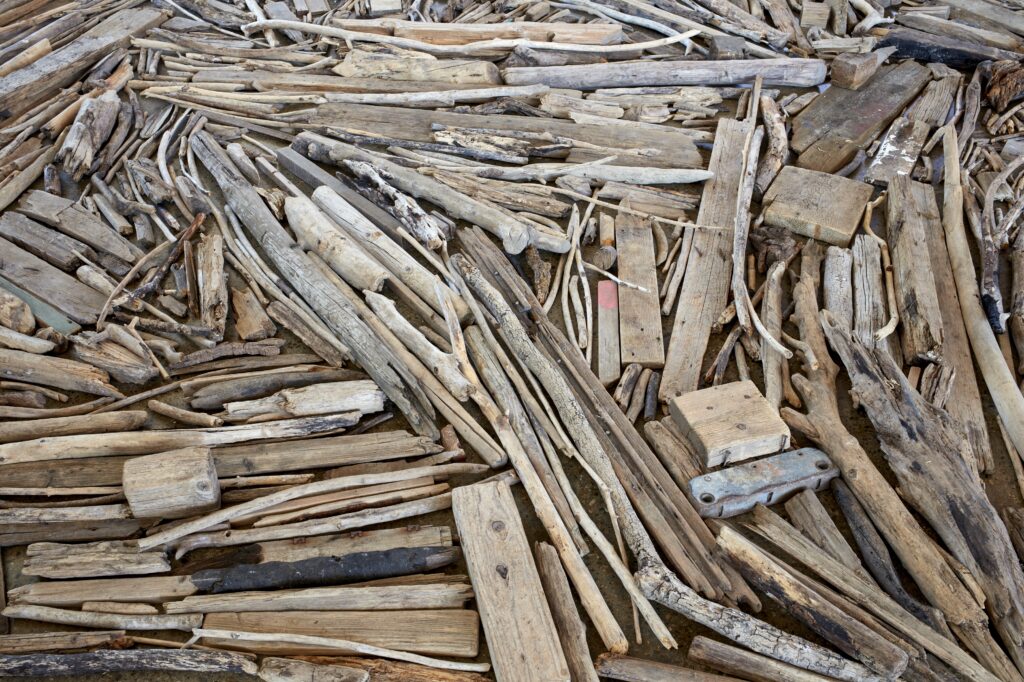
The beams of various shapes and colors meander through the former storage space at Kaistraße 14a in Düsseldorf. Fragile branches and massive trunks lie close together, forming a ground work that can be seen from all directions. The wood covering the entire area is loosely combined into a 40 square meter rectangle. The inner pattern of the wood covering all the shades of gray to brown was determined by sketch by the artist Richard Long. In the newly occupied, new premises of the KAI 10 / Arthena Foundation When it is experienced synesthetically, the work exudes a latent perceptible scent of rough wood and deep waters.
This hardly comes as a surprise, as the nearby Rhine forms the source of the debris that was washed ashore in the last kilometer before the Dutch border. This is a situation that could hardly be more fitting for the exhibition venue, given that the Rhine flows right past the Düsseldorf media port in the final kilometer, and the wood thus hardly feels like a foreign object despite being placed inside the hall. One almost thinks the river has entered the banks and the wood was specially flushed into the high hall. The arrangement, which mimics the movement of waves, alone reveals that human hands were involved here.
"Rhine Driftwood Line" is part of the "Satellites" project of the Konrad Fischer Gallery. The 23-year-old Long first exhibited in the newly opened gallery premises in Düsseldorf in 1968. For this, he covered the entire floor with thousands of willow rods collected from the river Avon within the "Sculpture for Konrad Fischer". On the occasion of his 80th birthday, the gallery is now initiating a special exhibition project that it has previously staged for Carl Andre in a similar manner. Long is closely associated with the Rhineland through his long-standing collaboration with the gallery. His works can be found in numerous institutional and private collections throughout North Rhine-Westphalia. Why not present them simultaneously? The director of the Düsseldorf gallery location, Thomas Rieger, explains that the organization of shuttle buses and guided tours was deliberately avoided. The variety of excursion destinations should encourage independent exploration, especially in the current summer temperatures.
This fits a artist whose oeuvre can be traced back to cultural techniques of walking and seeing. Born in Bristol, at the West of England College of Art and later at St. Martin's School in London with Anthony Caro and Frank Martin, Long achieved a breakthrough in 1967 with the work "A Line Made By Walking". The resulting trace was created by repeatedly walking a straight line in a high-grown field. It formed the basis for his further oeuvre characterized by solo walks on foot. His wanderings led him to various remote and inaccessible regions of the world, resembling pilgrimages in their meditative seclusion. Walking through the Long Mountains and deserts, he explored the dimensions of space, time, and distance. He also documents his travels in photographs and short texts, which sometimes form the only testimonies of the site-specific, sometimes ephemeral installations.
Long’s sculptures are created using objects found on the road made from natural materials such as stone, wood, or ash. The artist arranges these in geometric structures, resulting in lines, labyrinths, spirals, circles, crosses, and ellipses. In such a universal form of expression, the sculptures appear like relics of archaic peoples, playing with aspects of symmetry and balance, reminiscent of the concept of life paths. They serve as a realization of movement, never becoming invasive interventions to the natural world. Instead, Long works from nature and in the signs that delicately integrate into their surroundings or disappear again. The conscious rejection of handling the material and the use of exclusively hand- or foot-operated objects illustrate the importance of human measure as a starting point. Unlike many other sculptures, mine are also located just above or directly on the ground, are laid horizontally instead of vertically, and do not require a base.
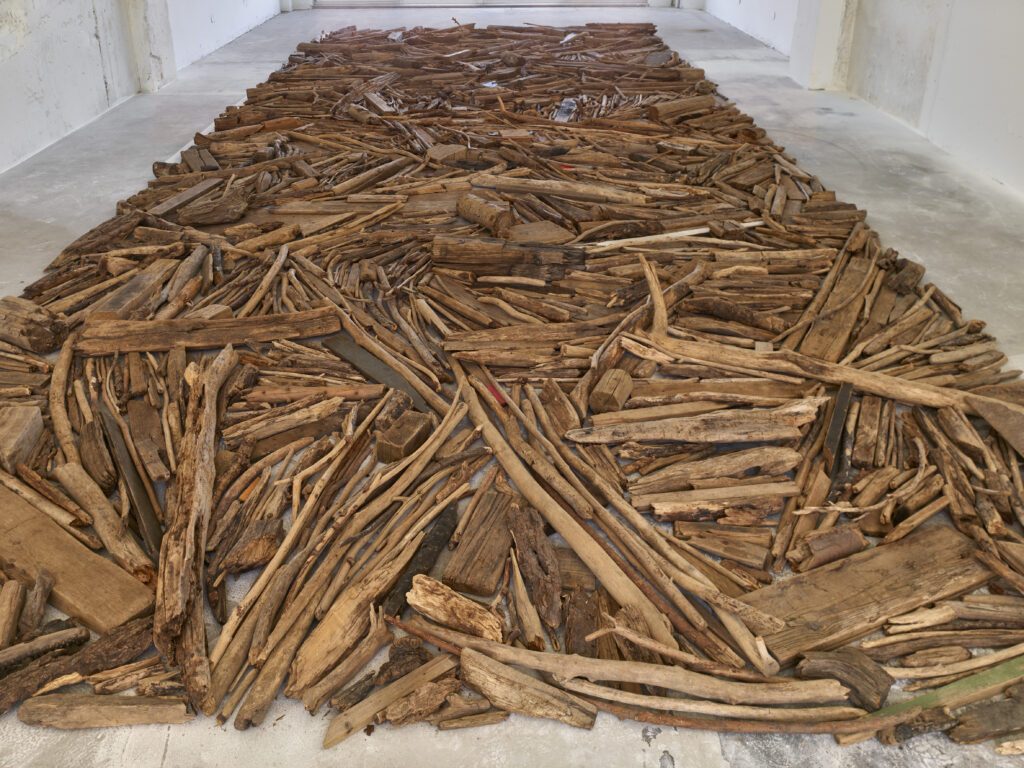
The "Satellites" works are mostly seamlessly integrated into the respective existing collection presentation of the participating houses or complement the program in the outdoor space. The opening took place at KAI 10, following the inauguration of the new rooms. The work acquired by the collector Monika Schnetkamp this year at Art Düsseldorf has a history that can serve as an exemplary example of Long's connection to the region. Created in 2001 in the context of an exhibition at the Kurhaus Kleve, it was then moved to the DKM in Duisburg in 2013. Both are partners in the gallery project. In Kleve, for example, the sculpture "Midsummer Flint Line" made of Norfolk Flint stones is permanently exhibited. The photos of previous staging show how differently the "Rhine Driftwood Line" can appear in the context of an exhibition. Although variable in terms of size, the arrangement nevertheless follows a predetermined order – or flow direction.
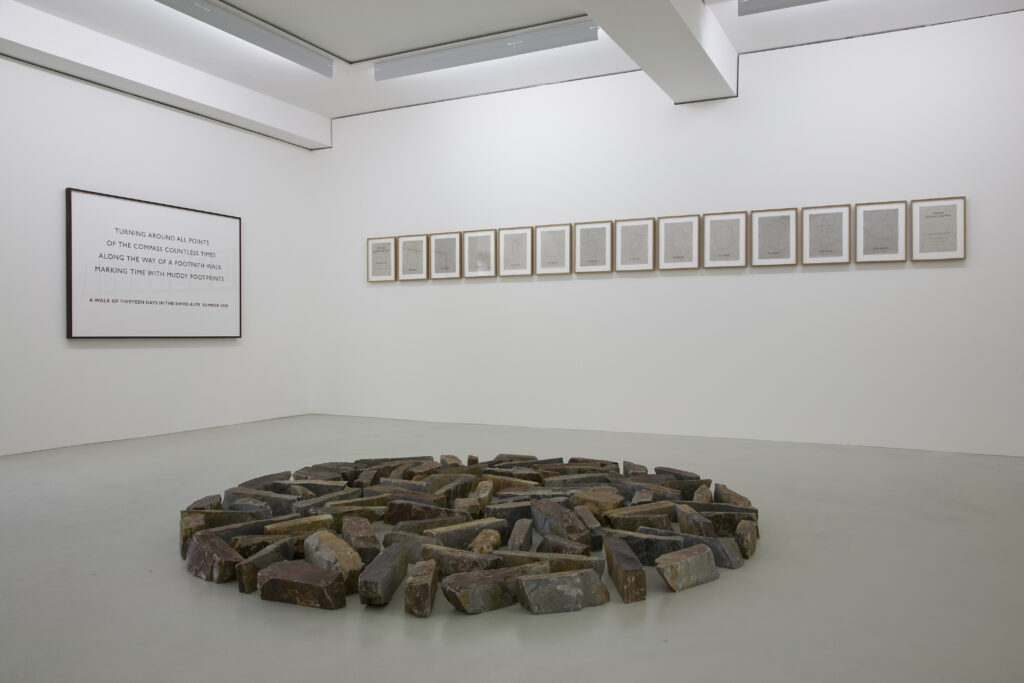
The DKM Museum, opened in 2009 by private collectors Dirk Krämer and Klaus Maas, is also part of "Satellites". In addition to the "Rhine Driftwood Line", which the museum presented as a loose collection of log cabins in the Düsseldorf area in 2023/24, the DKM even dedicated an entire room in 2018 to works made from larch bark, anthracite and charcoal by Long as part of the exhibition "Art & Coal – The Black Side". As a permanent part of the collection presentation "Lines of Silent Beauty", there is also an artist's room that has now been expanded on the occasion of its 80th anniversary. The central work is the "Cornish Slate Circle" from 1983. The floor work consists of 84 irregularly shaped slate stones from Cornwall. Similarly to the "Rhine Driftwood Line", there is no exact specification regarding the arrangement; the slate stones must not touch directly, but be arranged with the longitudinal side in a circle with a diameter of 2.40 meters.
The circle is a recurring structure in Long’s work. It can symbolically represent life, whose paths repeatedly lead to the center and are associated with both perfection and transience. In the sense of a wheel, it also evokes movement like no other form. In the DKM, the work is complemented by photographs, graphic works, artist’s books, and so-called "mud paintings." The latter show handprints applied to painted cardboard that are never the same, almost like silhouettes of embryos. They are images of the artist’s gestures, instantly transforming the speed of his carefully executed hand movements into form. At the same time, movement freezes time and is brought to the paper.
In a similar way, the drawn outlines of stones serve as waymarks, with kilometer markings, for a hiking trail that depicts the distance traveled. Alongside this, the temporary exhibitions on the grounds feature the early ground-based work "Red Stone Line" from 1977, which winds through the ground in a zigzag line of 65 stones and is flanked by works by artist Claudia Terstappen. This creates a wordless dialogue between Long and Terstappen, who in their photographs attempt to capture the aura as sacred places in Japan through repetitive moments. Combinations like these or the fact that interested visitors must first walk through a room containing works by Arik Levy to reach Long's zigzagging trail make the museum's special energy.
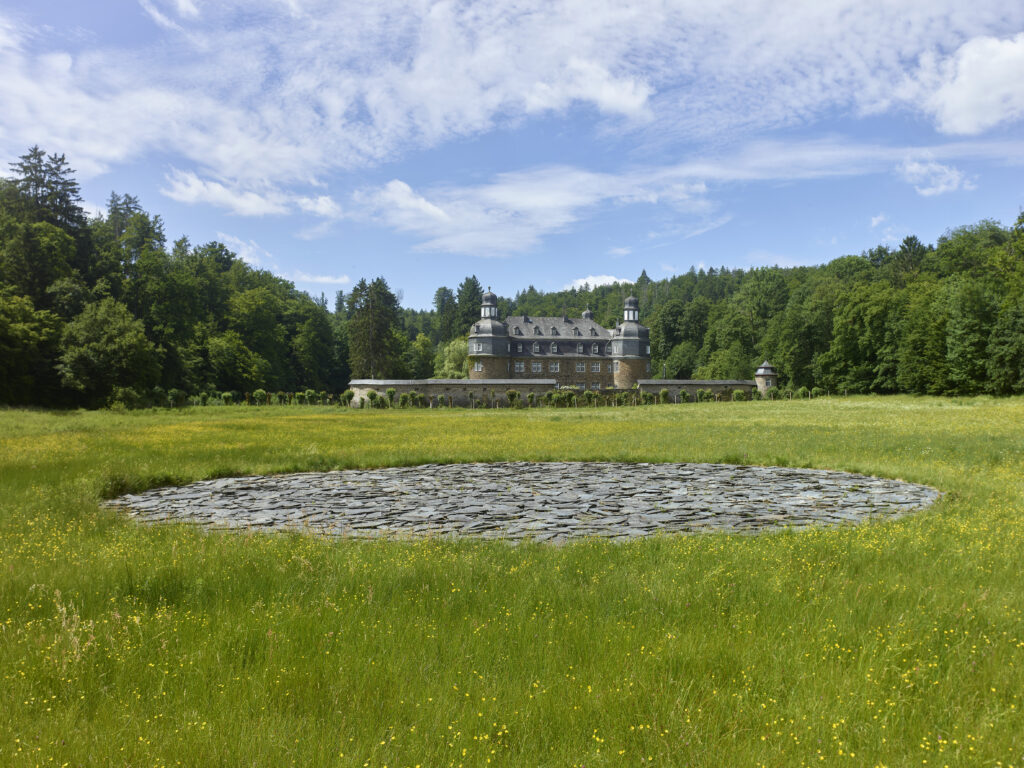
In addition to large buildings such as Museum Ludwig in Cologne, Kunstsammlung NRW in Düsseldorf or Museum Folkwang in Essen, works can also be found in remote locations. For example, the Schloss Crottorf near Friesenhagen is also part of the project. The former manor, first mentioned in written records in the 13th century, stands on the foundations of a medieval castle and was converted into a water castle in 1542. Subsequently expanded in Baroque style, the castle is today owned by Hermann Graf Hatzfeldt-Wildenburg-Dönhoff. Set in idyllic nature just beyond the border with Rhineland-Palatinate, the small castle lies amidst a large pond in the narrow valley of the Wildenburger Bach. After passing a large entrance gate to the grounds, one travels through three bridges to the three-winged manor house. Unfortunately, the interior of the privately owned castle cannot be visited, but at least the outdoor area, characterized by lush nature, offers a view of the surrounding forest.
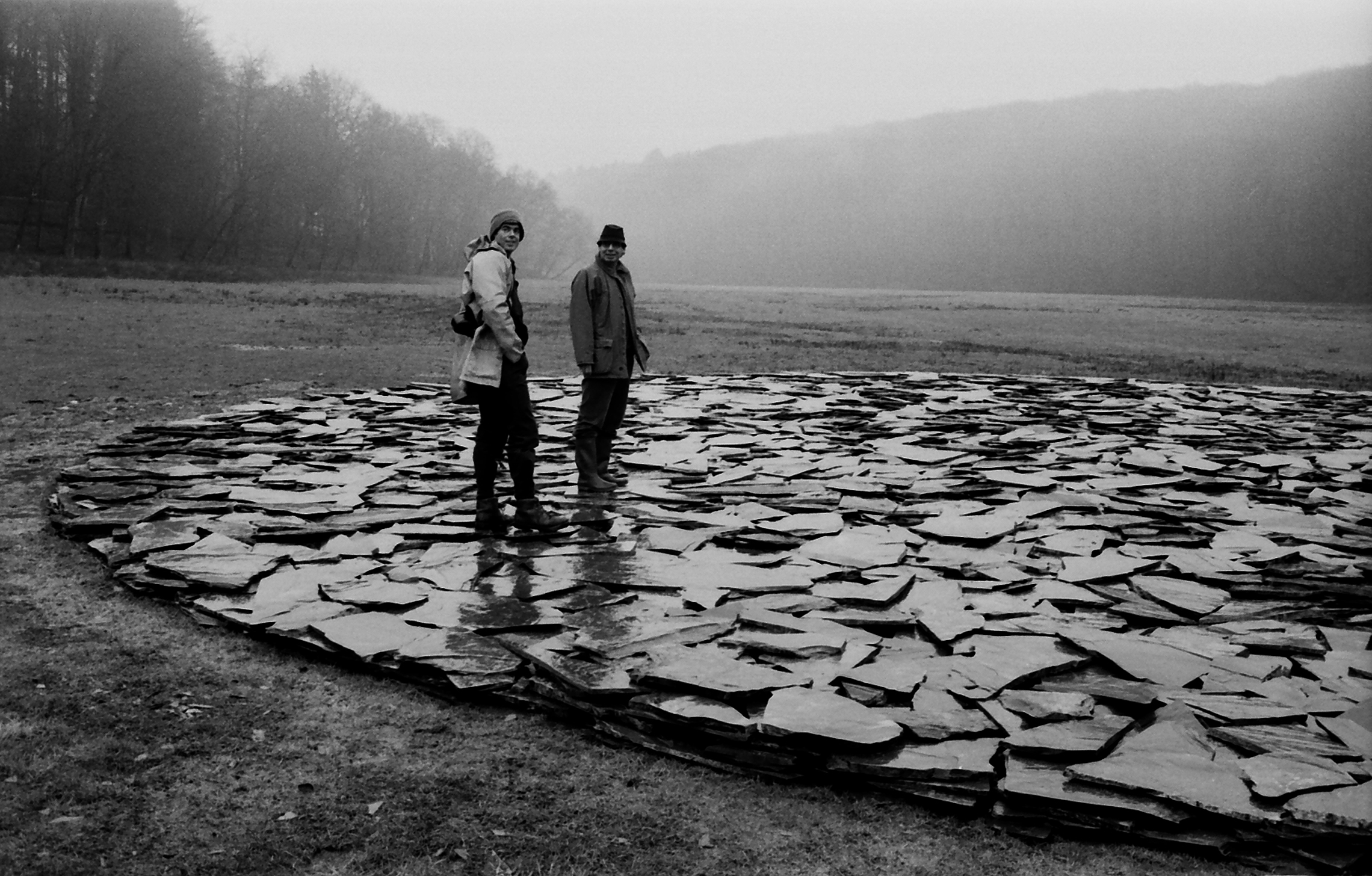
The castle and the gardens seem to have sprung from a fairy tale. Accordingly, the Italian stucco artist Giovanni Domenico Rosso, who was called upon to decorate the interior, described the complex as "a piece of paradise that fell from the sky" as early as 1661. Within the park, there are several sculptures, for example by Richard Serra, among the tall trees. However, the Richard Long acquired by Galerie Konrad Fischer is not quite so easy to spot. Passing by the water moat, a small plaque from the undergrowth reveals the work "Stone Lake". The stone lake itself is not accessible, but can be seen from a fence at a distance of about 50 meters in the vastness of the valley. Very close to a small pond, the "Stone Lake" made in 1988 consists of concentrically arranged slate slabs, which is its topographical equivalent.
Water represents a constant source of fascination for Long. The artist repeatedly uses the liquid material to leave traces or recreates dried riverbeds on foot. As an intense scent, the water was originally also part of the "Rhine Driftwood Line", which has gradually faded over time. What all these works have in common is that they allow the audience to experience them with all their senses. They invite the audience to follow the artist's movements themselves, whether imaginatively through the artist's books or physically in the room. Thus, we move around the lines, circles, and rectangles, following the movement inherent in the eyes, allowing the gaze to wander beyond the work into the surrounding nature. Just like a landscape painter, Long feels at one with nature, shifting our focus through abstracted forms and reversible interventions. The latter, however, refrain in their minimalist execution from the great gesture of the world-changer. Long’s works, by contrast, always move to the rhythm of the human and allow for a increasingly relevant sensitive approach to nature. His sculptures are themselves landscapes.
The Kunstmuseen Krefeld are dedicating the first retrospective in Germany to Charlotte Perriand’s multifaceted and astonishingly contemporary work.
 7 min read
The exhibition "Six Five Four Three Two" featuring works by the New York-based artist Josephine Meckseper at the Heppenheim Art Society.
 9 min read
In the new premises of Plateforme 10 in Lausanne, the Photo Elysée Museum can finally unfold its potential.
 12 min read