 10 min read
 10 min read
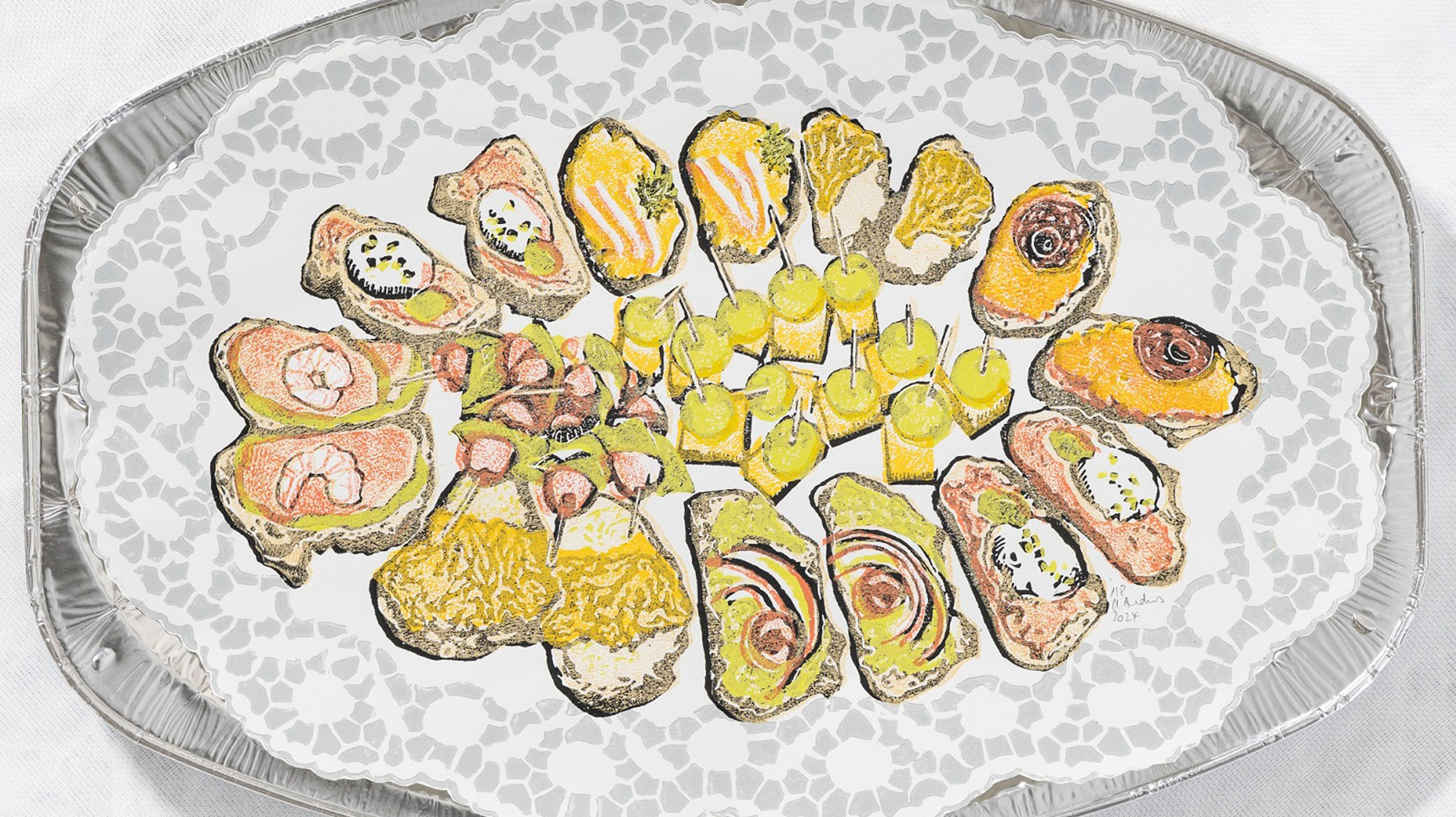
With Linol slices The Bietigheim-Bissingen City Art Gallery is currently welcoming its visitors: a humorous contribution by Claudia Anders to the competition Linoleum cutting today. On a serving plate covered with aluminum foil lies a seemingly perforated paper base on which baguette slices and cheese cubes printed in a linocut technique are placed. For the 13th time this year the city has announced the competition, the most important one in its field. The results are always displayed in the City Gallery.
Bietigheim and the linoleum: for a long time this was something like two sides of the same coin. With the founding of a linoleum factory in 1899, industrialization began in the city, located just over 20 kilometers north of Stuttgart. Over the next 40 years, Bietigheim grew from 4,000 to 9,000 inhabitants. The Deutsche Linoleumwerke (DLW), to which the manufacturer joined in 1926 along with several others, were for a long time the city's largest employer. Thus, when the city's municipal gallery was founded, it was not difficult to find a unique selling point: every three years, the city, since the 1975 municipal reform of Bietigheim-Bissingen, held a competition.
The Bietigheim-Bissingen City Art Gallery was established in 1989, the same year as the ZKM in Karlsruhe and the Akademie Schloss Solitude in Stuttgart. It was the era of the art-minded Minister President Lothar Späth, who came from Bietigheim-Bissingen. He had recognized that the industrial society was on the verge of transforming itself into an information society, in which cultural capital played an important role. During Späth’s government, from 1978 to 1991, the new building of the Stuttgart State Art Gallery by James Stirling and the founding of the majority of the municipal art galleries in Baden-Württemberg took place. There are 31 of them, more than in any other federal state, as the working group Fine Art in Municipal Galleries and Museums The Museum Association of Baden-Württemberg maintains that its spokeswoman, Isabell Schenk-Weininger, is the director of the Bietigheim-Bissingen City Gallery. The driving force behind the founding of the museum was the long-time mayor Manfred List, an old friend of Späth, who he joined the state parliament in 1991. Bietigheim-Bissingen was to be not just a train station on the way to Stuttgart, but an independent cultural center.
The Municipal Art Gallery is located in a historic grain barn, complemented by an extension built in 2000. Those arriving by public transport can reach the gallery from the train station instead of by bus in a half-hour walk, which passes through green areas by the Enzufer river, along a rocky wall with a geological educational trail, under a viaduct from the early days of the railway, through a garden square and finally through the historic old town. It is also a sculpture trail with numerous works by Gerhard Marcks to Jürgen Goertz and beyond.
Schenk-Weininger is from Bietigheim. After studying in Tübingen, she started working at the Göppingen Art Gallery and has been working at the Stadtische Galerie since 1999. With an exhibition on the topic of her doctoral thesis, War – Media – Art, In 2004, the year of the American invasion of Iraq, she staged a coup. The exhibition continued to travel to three locations. Since then, she has been running the City Gallery.
The linoleum cut is not only the subject of the competition, but also a focus of the collection. Linoleum was invented around 1860, and the linoleum cut came into use around the turn of the century. One of the first to make use of the new technique was Henri Matisse, because it was easier to cut round, curved lines in linoleum than in wood. Picasso followed in his footsteps. Also August Macke, Gabriele Münter and Christian Rohlfs made linoleum cuts. All of them are represented in the collection, which includes linoleum cuts by more than 300 artists: all of them have also been exhibited at the City Gallery since that time. From the very beginning, an exhibition on classical modernism is held once a year, precisely because there have been linoleum cuts since that time. There have also been solo exhibitions of Emil Nolde, Lyonel Feininger and Ernst-Ludwig Kirchner.
One of the highlights in 2014 was a large retrospective of Marianne Werefkin. The artist, born in 1860, significantly influenced the group of artists. The Blaue Reiter. It was only through her that Alexei Jawlensky became an artist. Asked how she managed such a large project, Schenk-Weininger replied that only a few museums possessed a significant number of Werfkin’s works, including the Lenbachhaus in Munich and the Museum Wiesbaden, which had not held any exhibitions on her work for a long time. Many works, however, were in private hands. She contacted the collectors, and when she had found enough lenders, the foundation in Ascona, which preserves the artist’s bequest, was also on board. The initial fear that not enough works would be collected turned out to be unfounded.
Exhibitions on classical Modernism, and especially the Linolschnittpreis, offer the opportunity to constantly expand the collection. A second focus is on regional artists: although one cannot always separate the two. The most recently exhibited Paul Reichle, for example, lived most of his life in Bietigheim, where he worked as a graphic designer for the DLW: on the recommendation of Willi Baumeister, from whom the company’s seal originated. However, his starting point was a semester at the Bauhaus, where he studied with László Moholy-Nagy, Josef Albers, Paul Klee and Wassily Kandinsky and collaborated with Oskar Schlemmer in the stage workshop. Fifty Bietigheim residents submitted photos to an invitation from the City Gallery to display Reichle’s works in their homes: a successful way to attract an audience.
To mark the 50th anniversary of the twin city, the Stuttgart-based artist Doris Graf has done what she has already done in São Paulo, Rio de Janeiro and Istanbul. At town festivals, she invited people of all ages and from all walks of life to draw a favorite place or a characteristic image of their city. She then distilled the results into pictographic square panels that will be exhibited in the gallery starting in October. Such exhibitions with local focus usually run in parallel with others that reach beyond the regional boundaries.
The linseed print competition immediately attracted great interest. Over 300 artists submitted their works on the first try. This time, there were around 500 from 33 countries. They first submitted photos. Approximately one in four of them was asked to send the originals, which were then displayed throughout the gallery and reviewed by a jury. Approximately one in three of them took part: up to three works by 45 artists are now on display in the exhibition.
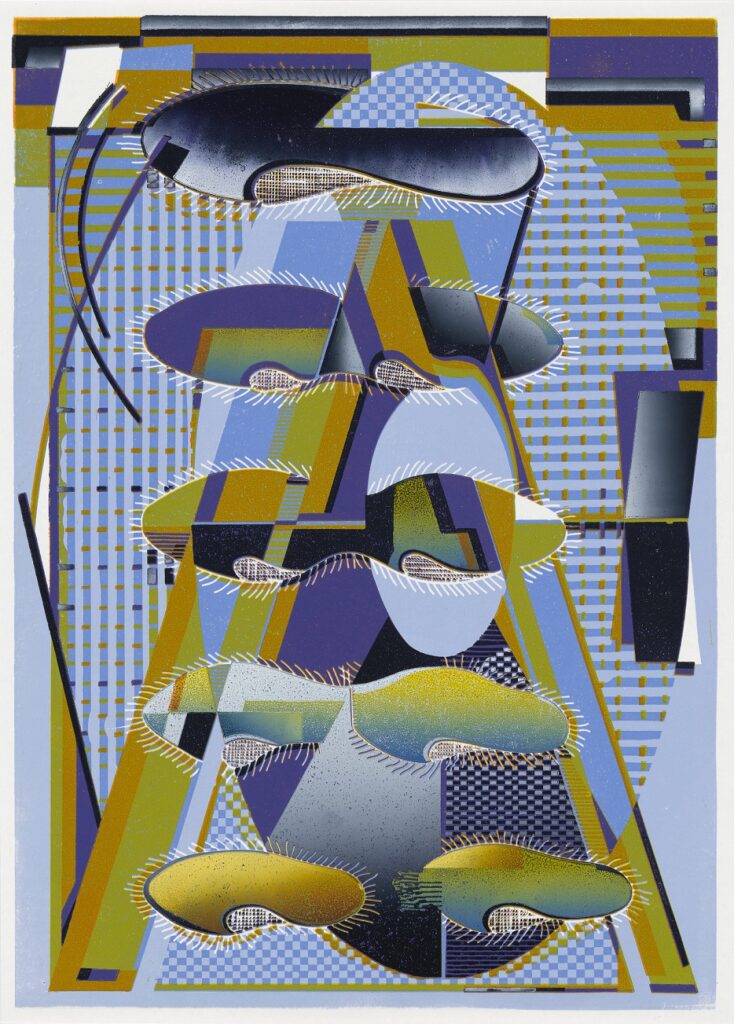
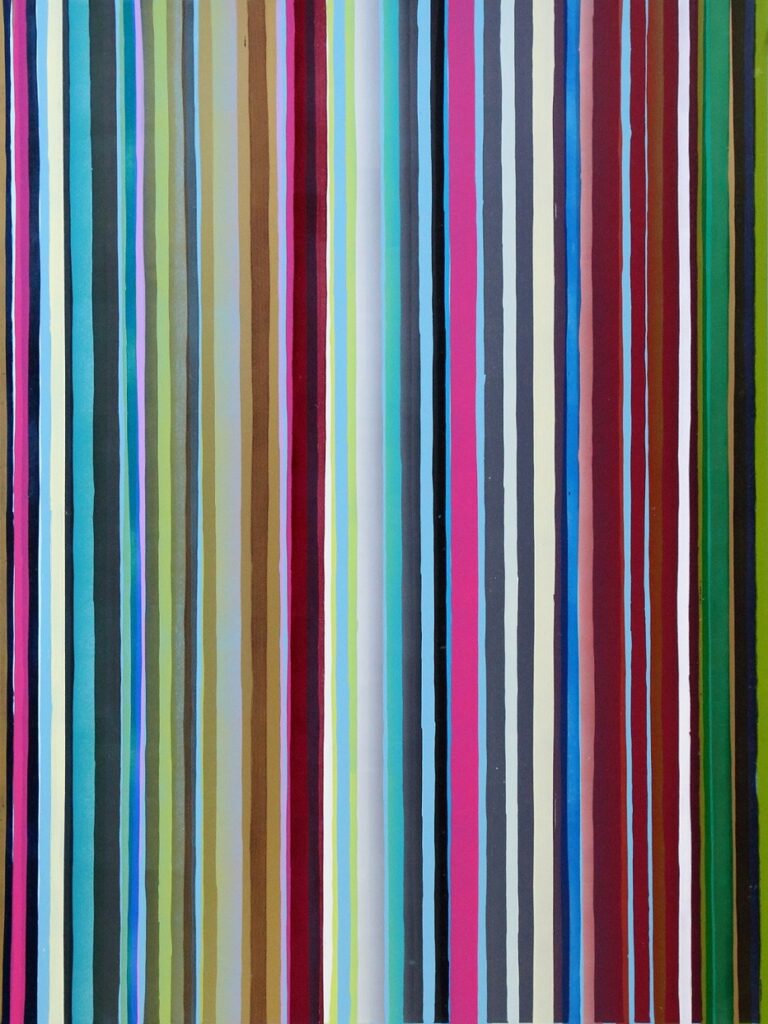
Linocut printing, like all printmaking, is considered a medium for reproduction. However, from the works of the competition only small series of two to five copies have been produced, although there are also editions and artist’s books. A third of the works are unique, either because they are further processed in the technique of lost-wax casting after each printing process or for other reasons. Approximately a third of the works are colored, that is, printed in several steps; the strip patterns of Susann Pönisch and Timo Moors are all about the complex color sequence. Not infrequently very large formats are used, such as the original-size representation of twelve graffiti-sprayed rental apartment letterboxes by Franca Bartholomäi; Anja Klafkis’ transformation of Rembrandt’s Night shifts into a blue underwater world; or the 7.20-meter-wide fjord You don't play with war by Florian Haas in the style of the gaming consoles of the 1980s, which takes the war in Ukraine to task.
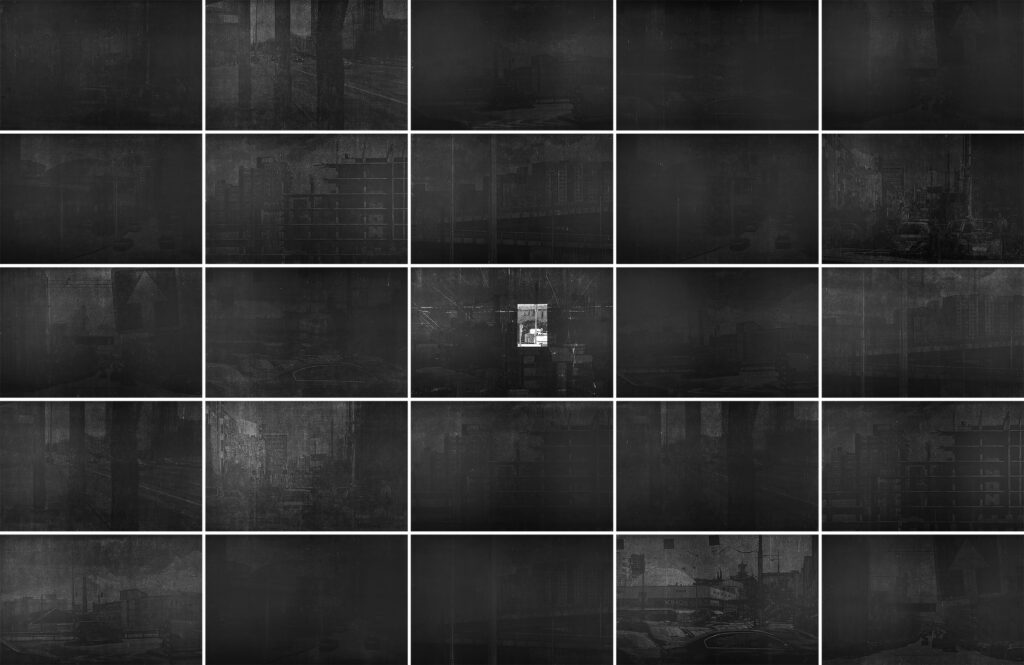
The works are extremely diverse. The last time, in 2022, a topic that was at the center was the coronavirus crisis, says Schenk-Weininger. This time, however, the competition, which was last held in 2019, was not affected by it. Some are dealing with the war. This is the case of the Ukrainian Olesya Dzhurayeva, who receives the second prize for it: a 2.50 by four meters area made up of 25 rectangles, which she has colored almost black. Only in the center remains a small Windows of hope free. There are also quite simple works, abstract and realistic, sometimes of breathtaking virtuosity: in black and white, for example, the grasses of Michael Hennevogl; a surreal, thorny weave by Wiesław Haładaj; or the wild vegetation of Georges Wenger. Eun-Joo Shin, a Korean living in Frankfurt, draws the forced tattooing of Korean "comfort women" during the Japanese occupation in World War II, but also two survivors of the concentration camps: Borys Romantschenko, 96, who fell victim to Russian bombings in Kharkiv in 2022; and Sintiza Zilly Schmidt, who died at the age of 98 in the same year. With their highly complex linear structures, Shin's works resemble copper engravings of the Renaissance.
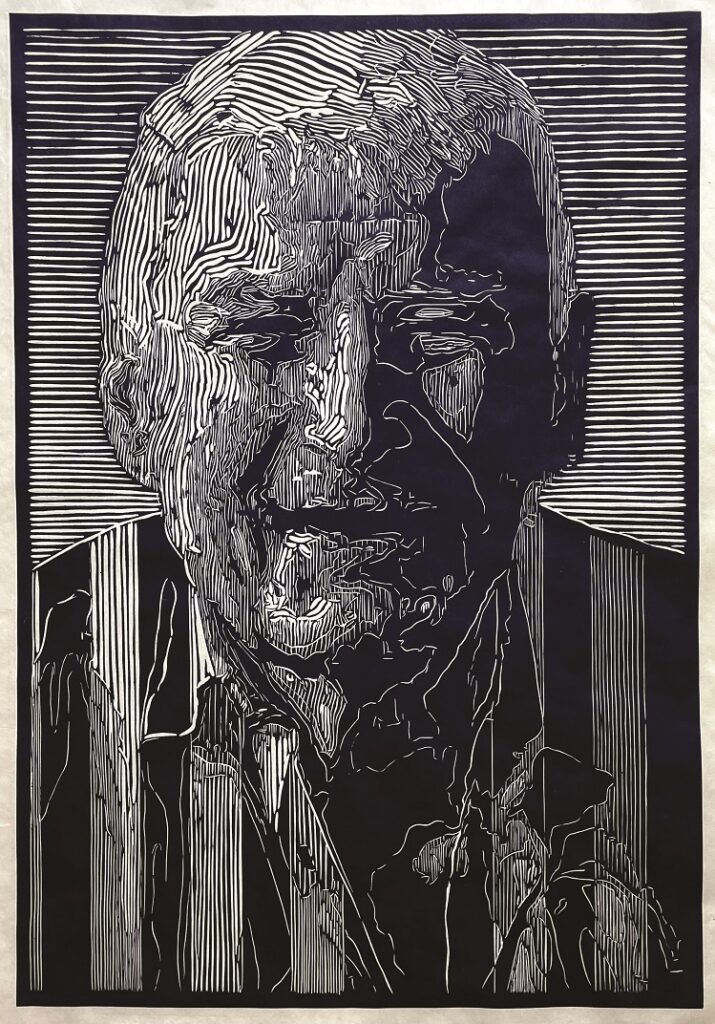
If there is something that connects the works across all the contradictions so that they push the linocut to the limits of the possible. Sometimes even beyond the limits of printmaking. In Julia Schulz's case, for example, two silhouettes move in a video. Although a table tennis table is present in the room, it takes a while before the puck falls: The prebent figures with outstretched, grasping hands are table tennis players. Jacques Wilhelm Kannemeyer from South Africa, on the other hand, has created several portraits using AI. "In an ink style a depiction of a trendy man with a big beard and glasses emerges", so begins one description, from which the software Midjourney created an "artistic" representation of an older man who somewhat resembles George Bernard Shaw. If in conceptual art it was once said that the artist only provided the idea, the execution was secondary, Kannemeyer turns this statement on its head: the AI provides the design, only the artistic execution by the artist is the responsibility of the artist.
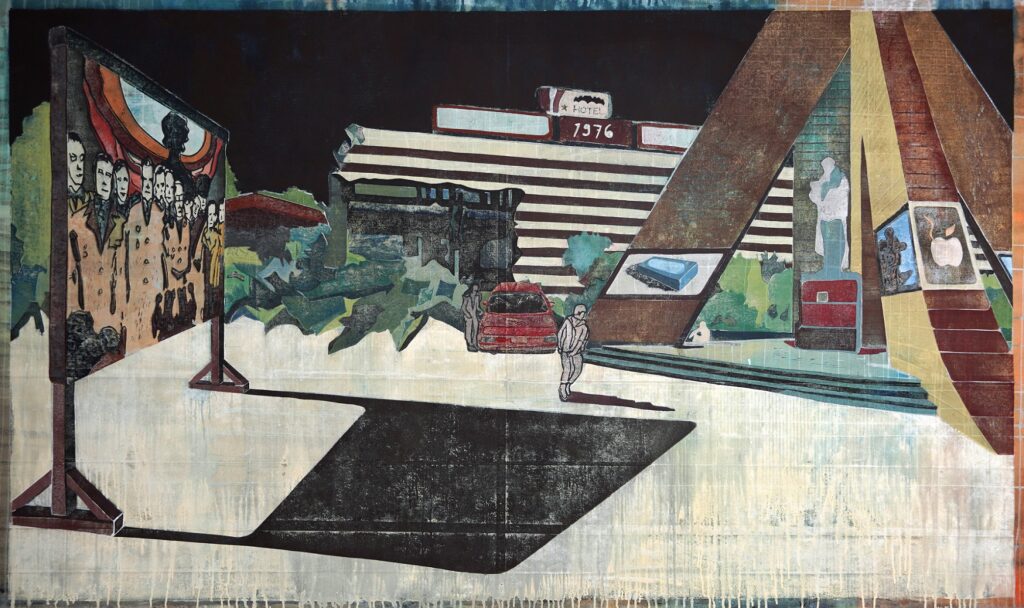
About half of the participants are taking part for the first time, while others are attending for the fourth or sixth time. The opening ceremony, to which many people come, is also always an opportunity to exchange news about developments in the field of technology. Many of the artists have turned to linocut after their first participation, inspired by the works on display. The oldest artists are around 80 – there is no age limit –, while the youngest are just over 20. If a trend can be observed, it is that younger artists are sometimes working on existing image worlds such as manga, advertising or graffiti. The first prize winner, Sergei Moser, born in Moldova in 1976, combines his "linoleum paintings", as he calls them, from many different-colored printing plates, but his award-winning work is also thematically cohesive. The artist researched media images from his own birth year: On a billboard in his work appears the leadership lineup of the military coup in Argentina, opposite a monument to earthquake victims in Tianjin, China, on which the Apple logo is also displayed. The software company was founded this year.
All the works are for sale. As always, a catalogue will be published for the exhibition, which will be integrated into an original linocut after the work of the competition winner. In addition to the three prizes, three additional purchases will be made. The prize money was previously donated by the DLW. Since the bankruptcy in 2017, the city has taken over the amount. While Bietigheim-Bissingen is still economically doing well, the city was debt-free last time. If savings are needed, Schenk-Weininger believes that the gallery will also contribute its share. But the city does not skimp on culture. Art is important to the municipal councils.
The exhibition "Linolschnitt heute III" runs until October 26. In parallel, the works of Doris Graf can be seen until September 28, followed by those from Bietigheim-Bissingen from November 22, 2025, to March 1, 2026. The gallery is open from Tuesday to Friday from 2 p.m. to 6 p.m., from Thursday until 8 p.m., and on weekends from 11 a.m. to 6 p.m. Admission is free. https://galerie.bietigheim-bissingen.de
The Kunstmuseen Krefeld are dedicating the first retrospective in Germany to Charlotte Perriand’s multifaceted and astonishingly contemporary work.
 7 min read
In the new premises of Plateforme 10 in Lausanne, the Photo Elysée Museum can finally unfold its potential.
 12 min read
Alex Katz at the Tübingen Art Gallery
 8 min read