
 9 min read
 9 min read
It takes only a few moments in the pavilion of the Overbeck Society in Lübeck to understand that Lotty Rosenfeld: This Line Is My Weapon (English). This line is my weapon) differs from many previous exhibitions by the conceptual artist in its approach, because she understands and conveys her work from Rosenfeld’s family and life history. With exhibitions such as those at the Museum of Modern Art in New York, the Hammer Museum in Los Angeles, the 56th Venice Biennale, and Documenta 12 in Kassel, the 1943-born and 2020-deceased Lotty Rosenfeld has gained international recognition. Until now, the focus has been on her videoographic work from the 1970s and 1980s, in which Rosenfeld documented her actions in public space, where she crossed existing road markings with white lines as a sign of resistance against the Chilean Pinochet dictatorship.
Paula Kommoss, who has been in charge of the Overbeck Society Kunstverein Lübeck since last year, now for the first time in the exhibition she curated brings the spotlight to the beginnings and background of Lotty Rosenfeld’s artistic work. With early works and archival material that have not been shown before and that have been selected in close collaboration with Lotty Rosenfeld’s daughter and executor of her estate, Alejandra Coz Rosenfeld, the exhibition connects Lotty Rosenfeld’s line as form and political gesture with that of her familial origins as part of collective history.
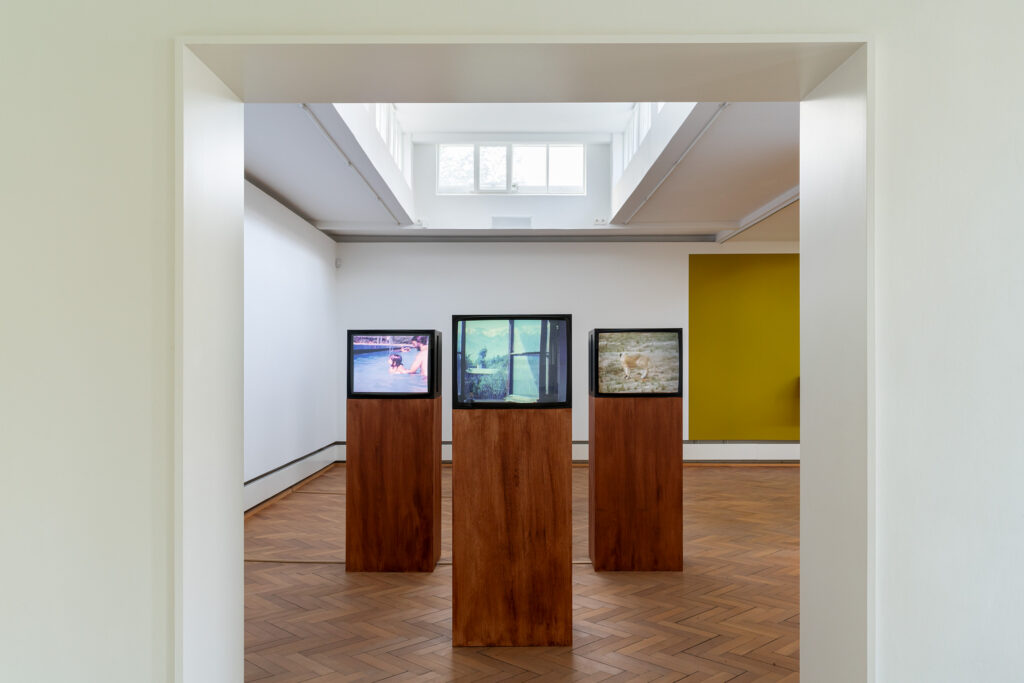
Rosenfeld's family history, which is marked by anti-Semitic persecution, imprisonment, death, and flight and survival, is revealed through previously unpublished documents, letters, and objects at the core of the exhibition, as well as through an extensive accompanying brochure. It is important for the visitors:, To learn about it right at the beginning. For the exhibition’s opening is a video collection of digitized 8- and 16-mm films by Ernst Rosenfeld, the artist’s father, from the years 1949 to 1978. The films presented on five monitors, which are broadcast in different directions of the Overbeck Society exhibition pavilion, show private recordings of Rosenfeld, which are part of the archive of the Fundación Lotty Rosenfeld are: Lotty Rosenfeld in her studio in 1978, the birthday of her two-year-old daughter Alejandra, the Rosenfeld family playing, photographs by Lotty Rosenfeld as a schoolgirl in 1949. Initially on black-and-white film, then in color, Ernst Rosenfeld documented over almost thirty years everyday moments and family rituals, situations accompanied by joy, the common life and their Surviving to show and to remind.
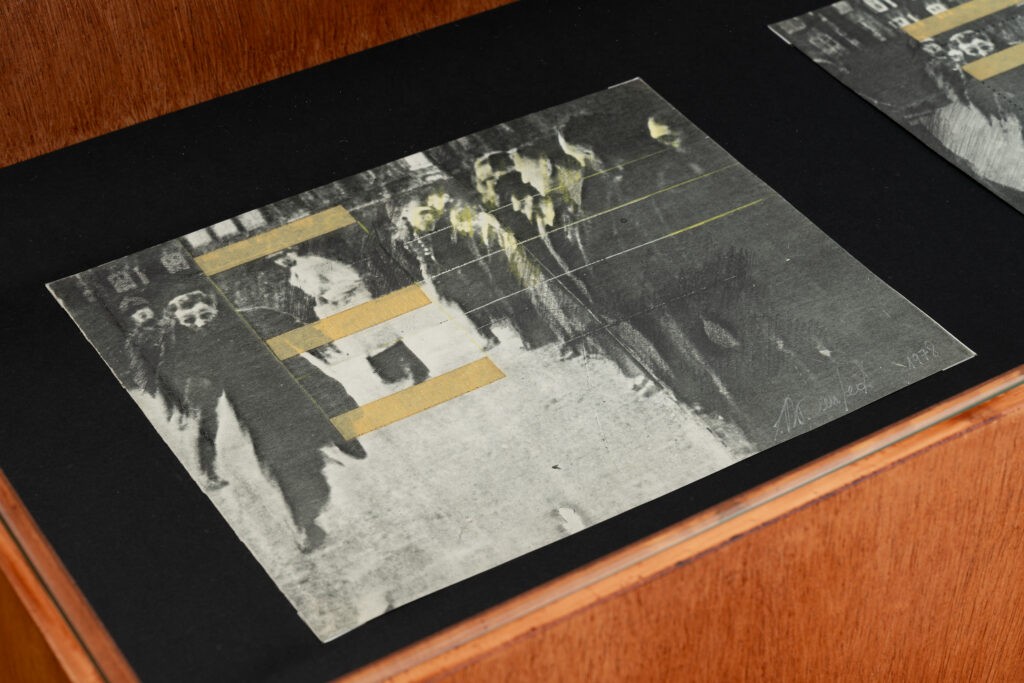
The practice of documenting through photography and film becomes formative for Lotty Rosenfeld. The experiences of the Holocaust are present in her family through the construction of a new life in Chile. Already in an early work by Lotty Rosenfeld this is evident. This is shown in a titleless photographic series from 1978, which is being exhibited for the first time at the Overbeck Society: In a chest-high showcase made for the presentation, three images are displayed that show a mass arrest in 1941 on the Jonas Daniël Meijerplein in Amsterdam. The photographs were taken during a raid carried out by Nazi police, in which about 400 Jewish men were arrested and then deported. The blurred, grainy photographic reproductions show a single moment, of which the change in the sections From image to image, more of the action of the original photograph becomes visible. We see men lined up side by side, uniformed soldiers, and a man running who tries to escape. Lotty Rosenfeld has added pasted-on, drawn, and perforated lines to these images. This frames the viewing directions or highlights body positions and actions through graphic markings. Her gesture is subtle and at the same time radical; it evokes through only a few artistic interventions the violence to which the captured Jews were subjected.
In these early forms of manipulation, the marking by the line becomes the artistic method of Lotty Rosenfeld for the first time. In 1979, Rosenfeld became a co-founder of the group Colectivo Acciones de Arte (CADA) and began to think of art as a social intervention. In her subsequent actions in public space in Chile, which she documented through film, she again uses the white line: its use now becomes a symbol of resistance against the Pinochet dictatorship that dominated the country.
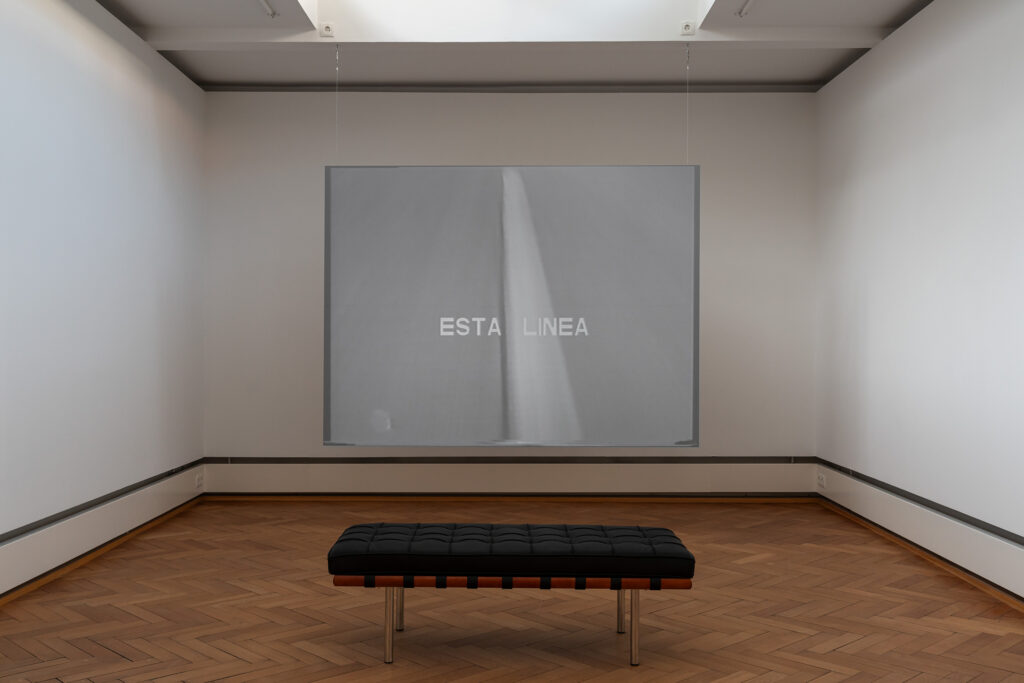
Lotty Rosenfeld chose the street, the roadway for motor vehicles, as the location for a silent protest against the political and social restrictions that began in 1973 with the military coup against the democratically elected socialist Chilean government under President Salvador Allende, led by General Augusto Pinochet. Public protests were banned under Pinochet; the media were subject to censorship. The film One Mile of Crosses on the Floor (English). A mile of crosses on the asphalt) (1979) was the beginning of Rosenfeld’s well-known series of works, and for this reason it is also an important part of the Lübeck exhibition. It shows a road filmed during a car journey with regular road markings, followed by Lotty Rosenfeld’s action in which she sticks a white tape across one of the road markings. The tape she applied to the asphalt has the same length as the road marking strip and thus forms a cross from the line, a plus sign from a minus sign – and symbolically represents a systematic regulation as an act of resistance. By repeating her action over a mile, Rosenfeld created a series of crosses that she then filmed again as it progressed. After this procedure, she later also marked sections of roads, for example in front of the government building Palacio La Moneda in Santiago de Chile or in front of the White House in Washington D.C. In the Lübeck exhibition, Rosenfeld's iconic film is followed on the same projection wall by the film that gives the exhibition its title. This Line Is My Weapon (1985). In it, Rosenfeld’s body movement and her own shadows lead to a crossing of the white line – they make the artist even more explicitly part of the line and the line becomes her tool, a conceptual weapon that she used throughout her work.
When her father Ernst Rosenfeld fled from Breslau via Hamburg on a ship to the Chilean port city of Valparaíso in 1935, the Jewish-German Rosenfeld family had already been subjected to the reprisals of the National Socialists for some time. In 1922, Lotty Rosenfeld's grandparents, Rudolf and Charlotte Rosenfeld, had purchased the "Hotel Rom" in Breslau, which offered shopping facilities and furnished rooms for guests. After Adolf Hitler came to power in 1933, the "Brown House", the seat of the NSDAP leadership in the Gau, was established in the immediate vicinity. Rosenfeld's hotel business, which had established itself as a prestigious address in Breslau, was initially boycotted, then confiscated, the family evicted from the house, and torn apart. Rudolf and Charlotte survived in Siberia, After the Second World War, they were able to follow their son Ernst to Chile, who had already established a family in Santiago de Chile by then. Ernst's sister Frida also survived; however, his second sister Steffi was murdered in the concentration camp in Auschwitz.
That's what's in the series Valparaíso (1985) illustrated in a touching way by black-and-white photographs: The images were created in connection with one of her video works at the coast of the Chilean port city of Valparaíso, where the father of Rosenfeld, who had fled the Nazis, and other family members reached by ship with Chile. Years later, Lotty Rosenfeld sought out this place, crossing a lane of traffic by placing the white line in a cross and positioning herself at the intersection of the lines. Behind her body, railway tracks and the sea are visible. Another photograph shows rotten railway carriages, a half-submerged object in the harbor waters, and behind it the city landscape stretching up the hillside. A third image shows the view of the asphalt section marked by Rosenfeld and of a passing ship on the sea. Here, Lotty Rosenfeld not only remembered the history of her family as part of a collective destiny. Her action was also dedicated to the memory of Sebastián Acevedo, whose children were arrested by the Chilean government and who subsequently set himself on fire publicly. Thus, the artist marked a point of intersection between history amidst the political system characterized by violence and repression under Pinochet, which was to last until 1990.
For the first time, the exhibition showcases an excerpt from Lotty Rosenfeld's theory work implemented in 1968. Commercial Gallery in a Hotel, In it, she completed her studies in Applied Arts at the Universidad de Chile. In it, she designs a concept for a fictional hotel as a place of cultural exchange – and, with the idea of a shop passage featuring products of local origin, links it to the lived life of her family in the Breslau Hotel Rom. The excerpts of this work displayed on the wall are directly opposite in the exhibition space in vitrines that refer to the family history of Rosenfeld: a historical photographic view of the Hotel Rome, cutlery, a chest with family recipes; then photographs of the family, passports, an affidavit of the Rosenfelds to claim compensation, which was granted in the Federal Republic in 1960; finally, a letter that the Rosenfeld’s aunt Steffi, murdered by Lotty Rosenfeld in Auschwitz in 1940, wrote to her mother.
The documents handed down by her family are once again echoed in her work. Revista Bravo from the year 1979, for which she designed a page in the same-named Chilean cultural magazine. In doing so, she used identity documents as the basis for her artwork: the collage thus shows a copy of her grandfather's passport, which, because Breslau, as a result of the war, now belonged to Poland, had been issued by a Polish authority after Rudolf Rosenfeld's return from Siberia (and before his onward journey to Chile), thus failing the attempt to obtain German citizenship. This passport is stored on a document that certifies a residence visa in Chile for Lotty Rosenfeld and her wife Charlotte. At the top of the collage is a copy of Lotty Rosenfeld's Chilean passport. The arrangement is accompanied by the words: "Status: Jewish. Place: Nazi Germany. Status: Refugee. Place: Chile." This reference to identity, expulsion, and memory is the first reference to her origins in Lotty Rosenfeld's work.
It's worth visiting the exhibition Lotty Rosenfeld: This Line Is My Weapon It is a time to encounter Rosenfeld’s work with great care, because it allows a careful examination of his work and the biographical connections that have developed through it. The interplay of archival materials, historical objects, and early works is touching, because in this constellation it becomes particularly clear how existentially Rosenfeld’s art is already at its beginning, indeed how closely Rosenfeld’s art and the history of the time were intertwined. In the clearly and sensitively curated exhibition, the Overbeck Society in Lübeck has succeeded in highlighting the significance of the interweaving of history and the present in Lotty Rosenfeld’s radical conceptual art and showing that these are always intertwined.
The exhibition is on view until January 25, 2026 at the Overbeck Society Art Association Lübeck to see, open Thursday –
Sunday 12 – 17 o'clock.
The Kunstmuseen Krefeld are dedicating the first retrospective in Germany to Charlotte Perriand’s multifaceted and astonishingly contemporary work.
 7 min read
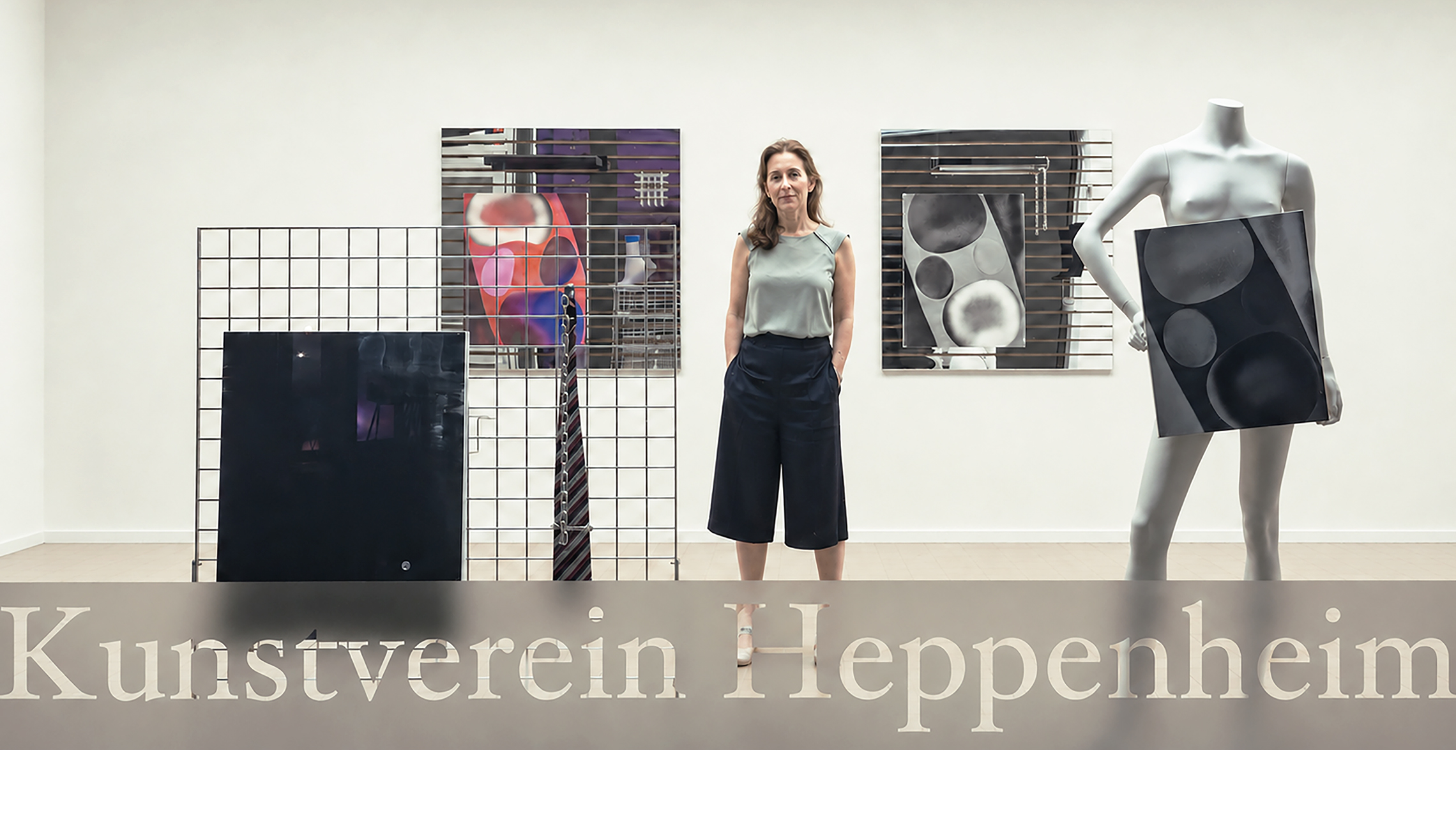
The exhibition "Six Five Four Three Two" featuring works by the New York-based artist Josephine Meckseper at the Heppenheim Art Society.
 9 min read
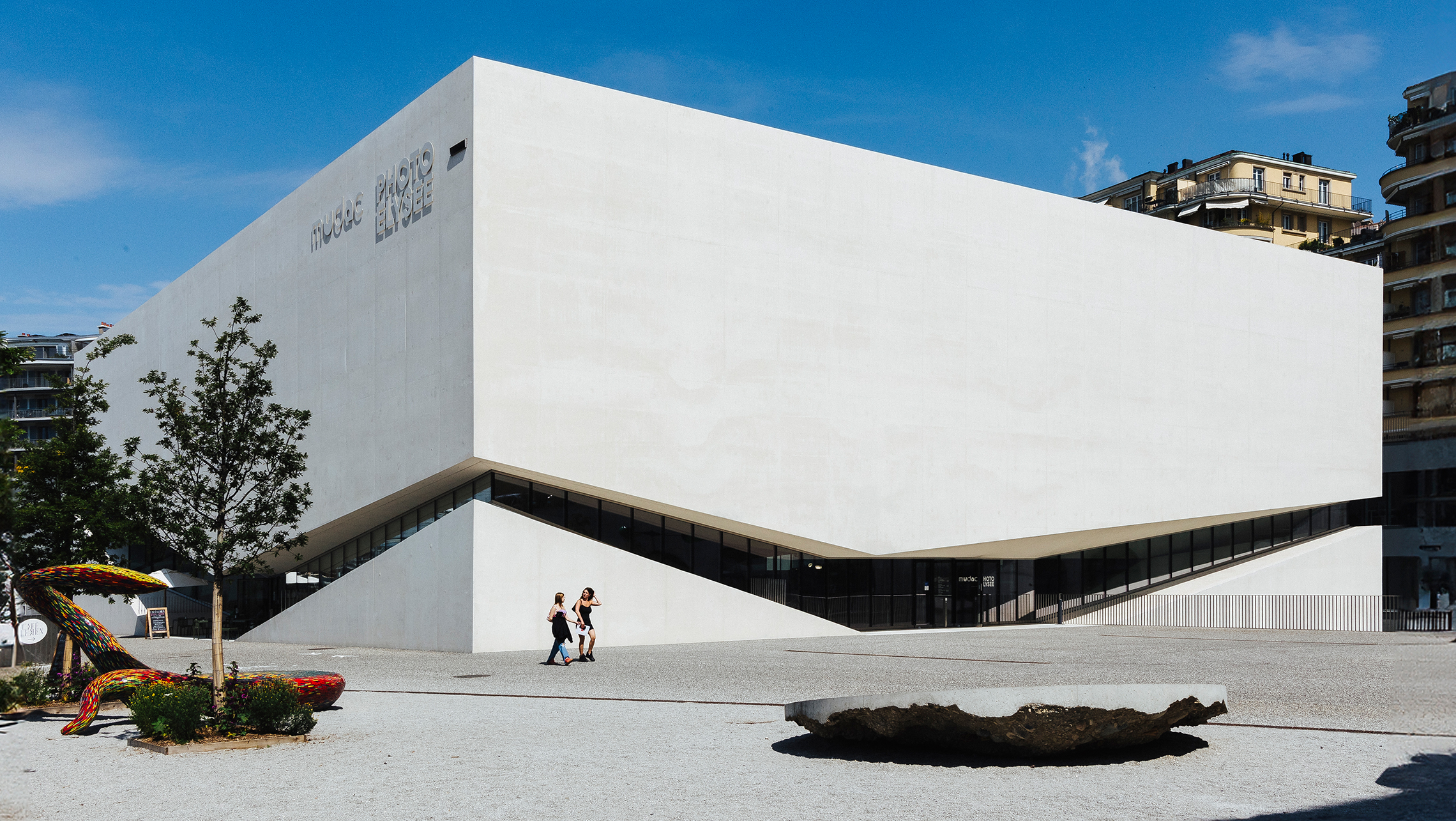
In the new premises of Plateforme 10 in Lausanne, the Photo Elysée Museum can finally unfold its potential.
 12 min read