 11 min read
 11 min read
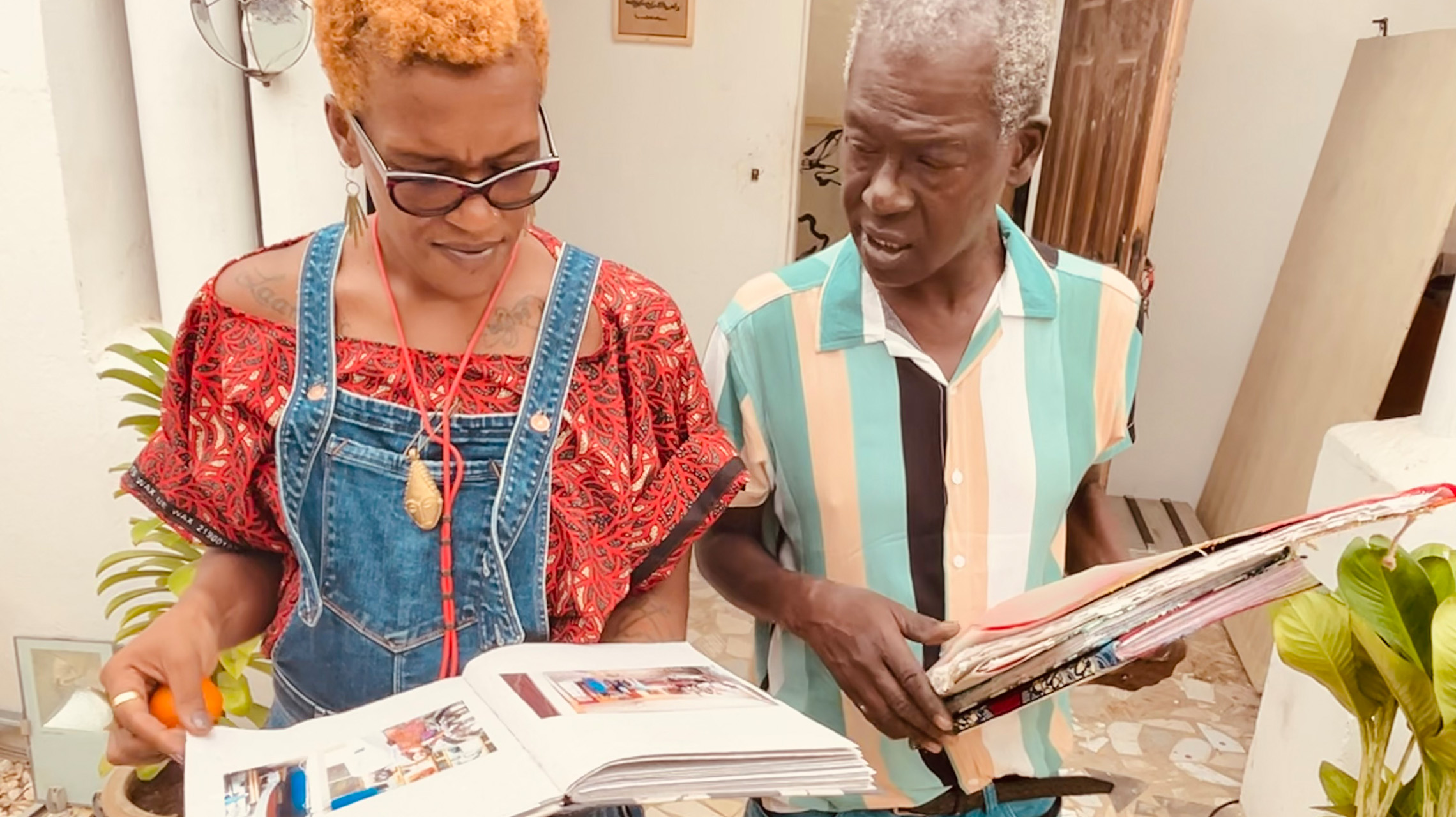
Ken Aïcha Sy had already been working in the cultural field for several years in Dakar, the capital of Senegal, after studying design and art history in Paris. Her mother, the cultural journalist Anne Jean-Bart, died when she was still young. She did what any descendant would do in such a situation: she went through the family archives. In her case, however, this did not only affect the family, but also the history of modern art in Senegal and thus the country itself. Anne Jean-Bart, a French woman with ancestors from Martinique, had come to Dakar in 1982. Her daughter found 50 articles by her in the archives of the largest daily newspaper in Senegal. Le Soleil. Her father El Hadji Sy played a special role in this, represented at Documenta 14 in 2017, one of the country’s most prominent artists. In the 1970s, he attended the art school founded by Léopold Sédar Senghor, the so-called École de Dakar Studied and then worked with Issa Samb and other artists in the group Laboratory Agit'Art Founded. Ken Aïcha Sy was born in 1988. She did not experience that time. As is often the case, her mother never told her about it. Moreover, the parents had separated.

Her interest was sparked. She embarked on a six-year-long search for clues that led her to Frankfurt, Bayreuth, Berlin, and London. Not that she had no contact with her father. But she lacked the background information. "We don't have an art history course; we don't learn about it in school," she laments. There are many private collectors in Senegal, but the works are usually not publicly accessible. However, the largest collection of her father's works is at the Frankfurt World Culture Museum, where in 2014 his largest solo exhibition to date also took place. But when she was there to view the works, she experienced a shock. Her father created huge murals in public spaces; he has always tried to make his art accessible to as many people as possible. Now she was in the depot and was only allowed to touch his works with cloth gloves under strict supervision by museum staff. The plan to return them as donations to the Senegal triggered insurmountable obstacles.
But that is actually her wish: to bring the works into circulation, to keep the history of modern Senegalese art and the discourses that it has produced alive. Survival Kit She calls her project that she cannot realize without traveling to Europe. In 2019 she came to Berlin for the first time. Three years later, as part of a two-month research stay funded by the German Federal Cultural Foundation at the Center for Art and Urbanism in Berlin (ZK/U), she had the opportunity to visit the World Culture Museum and the Iwalewahaus in Bayreuth, where in addition to a core of Nigerian art from the early post-colonial period, there are also some works from Senegal.
In 2014, when the great solo exhibition of her father took place in Frankfurt, the World Culture Museum was headed by Clémentine Deliss. She had already curated the groundbreaking exhibition at the Whitechapel Gallery in London in 1995. Seven Stories about Modern Art in Africa curated, part of the nationwide festival organized by her Africa95 under the auspices of Queen Elisabeth, Nelson Mandela and the former Senegalese president Senghor. The year 1995 was marked by the end of apartheid. However, at that time, African artists were hardly represented in contemporary art exhibitions. While this changed with the Johannesburg Biennale, which took place only twice, in 1995 and 1997, curated by Okwui Enwezor, with his exhibition The Short Century 2001 in Munich, Berlin, Chicago and New York and, above all, with Documenta 11 gradually changed this perception that this art did not simply fall from the sky, but has a history. Deliss had specifically addressed this in the Whitechapel Gallery, using case studies from seven countries. Ken Aïcha Sy followed in their footsteps to London.


Survival Kit is primarily eThe first exhibition series took place last year in The Musée Théodore Monod held in Dakar: one of the oldest museums in West Africa, whose origins date back to the colonial era. Founded in 1936 as French Institute of Black Africa (IFAN), which, with a constant abbreviation, took its name in 1960 Fundamental Institute for Black Africa It was modified while at the same time it was affiliated with the Université Cheikh Anta Diop. It is therefore a prestigious place where Ken Aïcha Sy could only exhibit reproductions, partly because the transport costs and insurance amounts exceeded his means. Only in the two exhibitions at the ifa galleries of the Institute for Foreign Relations, in summer in Berlin and now in Stuttgart, were original works on display. While she initially presented her project in Berlin, she is now returning to the origins under the first President of the country, Léopold Sédar Senghor.
Up to 25 percent of its budget was invested by the independent Senegalese state since 1960 under Senghor in culture. For comparison: in Germany, the share of culture in households is about one percent. In the mid-1930s, Senghor had called the Négritude movement in Paris with writers like him, Aimé Césaire. To, as stated in an eight-page information leaflet of the Stuttgart exhibition, "restore the dignity of black identity". While colonial propaganda stripped the colonized of any culture and declared them primitives who would only have to be civilized, Senghor claimed above all that the people of the African continent and the diaspora possessed their own distinct culture. He founded an art academy, often simply called "École de Dakar" named, that Dynamic museum, which exhibited modern art from African countries, but also European artists such as Pablo Picasso and Friedensreich Hundertwasser, and held the Dakar exhibition in 1966. Premier World Festival of Black Arts, which should demonstrate the diversity of the arts among Black people.
"The Tiger does not proclaim his Tigritude; he springs," scoffed the Nigerian writer Wole Soyinka. But even in Nigeria, artists such as Uche Okeke and Demas Nwoko had already, even during the colonial era, advocated replacing the European models and standards of art education with African ones. Wood figures and masks were considered hallmarks of the African style, as some works in the ifa exhibition show. In predominantly Islamic Senegal, mask cults were hardly widespread. Senghor referred to the ethnologist Leo Frobenius, who, while holding racist views, also had a Cultural history of Africa was written in 1933, shortly before Aimé Césaire and he coined the term Negritude The Senegalese and Nigerian artists, by contrast, drew inspiration from the classical modernism of Europe, which in turn had its origins in Picasso and the group of artists known as the Cubists. The Bridge They had taken as their models masks and wooden figures from African countries and the South Pacific.
Ken Aïcha Sy talks about the Modern art of their country. If she calls their early orientation as primitive, then not in order to attribute to it a closeness to supposedly primitive forms, but to emphasize the connection to the primitivism of classical European modernity. She also speaks of the Monochromia the Negritude: a silent critique of the essentialist concept of black artists, "Beware of those who demand that you be African before you are a painter or sculptor," she quotes Iba N'Diaye, after all a co-founder of Senghor's art academy, "before those who want to keep us in an exotic garden in the name of an authenticity that is yet to be defined". In a video interview that is featured in the exhibition, the 1954-born artist Viyé Diba, Senghor himself, already said after the Premier World Festival In 1966, its cultural policy was opened up to a global perspective and an interdisciplinary approach, as evidenced by the foundation of the Institute in the same year. Museum dynamic and the reform of the former School of Arts show, from 1971 an National Institute of Arts for all the arts was done.
Nevertheless, there was criticism. State-funded painting and sculpture tended towards representation. Exhibitions in enclosed spaces reached only a small, educated audience, while public life traditionally revolved around all forms of artistic expression in the public space. Here, the Laboratory Agit'Art an artist group founded by El Hadji Sy, the first of its kind. They occupied a former military base and transformed it into a Village of the Arts, In the period from 1960 to 1980, about 80 artists lived and worked there. They worked interdisciplinary, moved into the public space and became independent of state patronage. But that was not the end of the era of Senghor’s cultural policy. His successor Abdou Diouf pursued a neoliberal agenda. The national debt had grown dramatically, not from their own fault, but due to global dependencies. As the creditors demanded, Diouf reduced cultural spending, privatized state property, and allowed the private sector to take over the management of cultural institutions. Village of the Arts to clean up and that Dynamic museum Close.
"Çi-gît l'art", is written on an aquarelle gravestone from 1986, which is exactly from that time. It is the only work by El Hadji Sy in the ifa exhibition, yet there is no more detailed information about it in the exhibition. Now Ken Aïcha Sy does not need to know from what specific occasion her father painted the picture that has been kept in the Iwalewah house for a long time. But it stands emblematically as the only work at the place where she addresses the departure from the culture policy of Senghor, in which her father played a significant role: with Laboratory Agit'Art and the later artist groups Tenq and Eight FacetsThese are works that were represented at Enwezor's Documenta exhibition; however, they are only mentioned in wall texts without a single image.
Upon closer inspection, the exhibition leaves many questions unanswered: information about the individuals in the three people interviewed in the videos is missing. Ken Aïcha Sy says she has conducted 1,200 such video interviews, all of which are available on her platform. Wakh'art It cannot be found. This does not hold up to scrutiny. Some of these can be found on a YouTube channel. Was the starting point of the project not her mother’s discount? Why is not a single newspaper article about her to be seen? And apart from this one work, how little does it have to do with her father? The curator is overwhelmed that it was possible to create a large, colorful tapestry by Papa Ibra Tall, the first director of the École de Dakar, It was acquired from a Swiss private collection as a loan. But why is only a single drawing from the World Culture Museum on display, when that museum owns the largest collection of Senegalese art of that time?
Ken Aïcha Sy also spoke with Felwine Sarr and Bénédicte Savoy, who, with their recommendations to French President Emmanuel Macron, have sparked the restitution debate. The underlying problem remains that young people in African countries who want to learn about their own cultural history are forced to travel to Europe. However, the collections in Bayreuth and Frankfurt are not looted goods. The Iwalewahaus was founded when Ulli Beier, one of the key figures in Nigerian art and culture of the post-war era, left Nigeria, with his intention to permanently house an art collection. In the country itself, however, it did not receive any response to his initiative.

The situation was similar with the Senegalese collection of the World Culture Museum. It goes back to Ken Aïcha Sy’s father, who met the museum’s curator Friederich Axt at the end of the 1970s in Senegal and became friends with him. Axt was enthusiastic about Senegalese art. With El Hadji Sy’s help, he wanted to publish a book about it, which actually appeared in 1989. To this end, the artist assembled a collection of works, including fifty of his own, which then remained in Frankfurt, probably due to the austerity measures in Senegal. According to an article in Taz Given that Ken Aïcha Sy is exhibiting there as a solo artist, the permanent loan of the works means that he would have to contact her father in order to retrieve them back to Senegal.
There is still much to be done. And it would be best if German institutions such as the World Culture Museum, which has made significant contributions with its collection and the 1989 book Grundlagenarbeit (Foundations), worked together with local experts such as Ken Aïcha Sy. However, there seem to be reservations on both sides, while a continuous research tradition is missing. Even the Institute for Foreign Relations seems to have forgotten that in 1986 it was held in the Bonn-based ifa gallery under the title 6 artists from Senegal He had already held an exhibition once, in which El Hadj Sy, the curator's father, participated.
An encouraging aspect is the exhibition contribution by Cornelia and Holger Lund (Fluctuating Images), who have compiled a beautiful selection of ten music tracks from different African countries from 1967 to 1986, in the medium in which music has long been widely distributed on the African continent: on cassette.
The exhibition runs until March 21, 2026. More information and the program here: https://www.ifa.de/ausstellung/survival-kit/
Ken Aïcha Sys Website Wakh'art: https://wakhart.com/; Her YouTube channel: https://www.youtube.com/@AkachaSy
The contribution by Fluctuating Images: https://www.fluctuating-images.de/ken-aicha-sy-survival-kit-monochrome-of-negritude-or-the-introduction-to-the-modernists/
The Kunstmuseen Krefeld are dedicating the first retrospective in Germany to Charlotte Perriand’s multifaceted and astonishingly contemporary work.
 7 min read
In the new premises of Plateforme 10 in Lausanne, the Photo Elysée Museum can finally unfold its potential.
 12 min read
Alex Katz at the Tübingen Art Gallery
 8 min read