 8 min read
 8 min read
Working for the New York Times during these turbulent times is a double-edged sword. Recognition and appreciation from the politically-minded readership are guaranteed. President Donald Trump, however, has long been one of the United States" most important newspapers. He counts it along with the TV stations ABC, CBS and CNN as the "fake news media" that he believes should be combated and dealt with. In September 2025, he even sued the central organ of the left-liberal American intelligentsia for $15 billion (12.8 billion euros) in damages, alleging that the New York Times had allegedly provided illegal campaign assistance to Kamala Harris. The lawsuit was not only directed against the publisher, but also against individual journalists. As much as readers and colleagues may appreciate and perhaps even envy you as a New York Times employee: working for the prestigious newspaper title is not entirely harmless.
New York photographer Philip Montgomery is undeterred by such concerns and continues to go out and photograph the events in the country with great journalistic diligence, but also artistic originality. He sometimes takes great physical risks in doing so. In 2020, at the height of the Corona pandemic, he spent two months traveling through New York hospitals and funeral homes to capture the horror of the deadly disease in equally sensitive and shocking images. As an observer of demonstrations, he has already been sprayed with pepper spray and arrested. He stood waist-deep in water in flood-prone areas. And he was shot at by the police with rubber bullets because he still ventured out during a nighttime curfew.
However, Philip Montgomery, born in San Francisco in 1988, not only photographs for The New York Times Magazine. His regular clients also include Time, The New Yorker, Vanity Fair, The Guardian, Aperture, Harper's and the magazine of the German weekly Die Zeit.
At PHOXXI, the temporary exhibition space for the photography exhibition currently being renovated at the Deichtorhallen in Hamburg, the world’s first major institutional solo exhibition of Montgomery’s work is on view until early May under the title "American Cycles." It comprises around 110 works created between 2014 and today. Although Montgomery and Nadine Isabelle Henrich, director of PHOXXI and curator of this exhibition, occasionally also photograph in color, they have decided to show exclusively black-and-white photographs. The exhibition includes individual shots and series of images that have already been published in publications such as The New York Times Magazine or The New Yorker, but also entirely unpublished and new material.
One might liken Philip Montgomery somewhat to Arthur Fellig, the New York photographer legend who specialized in crime scenes, accidents, and other disasters. Unlike him, however, he regularly leaves the East Coast metropolis to go in search of images in the American countryside. He also avoids including too sensational details in his photographs. Boulevard-style shock shots are out of the question. Nevertheless, a certain film noir aesthetic, paired with dramatic light and shadow effects, is also characteristic of Montgomery, which gives his perfectly composed images a classic touch in today’s fast-paced times.
He frequently photographs in the so-called Rust Belt, the rural areas of the USA that are most affected by deindustrialization. He finds motifs in places like Ferguson (Missouri), Charleston (South Carolina) or Minneapolis (Minnesota), and many other smaller places. The events have either made it into the World News, such as the mass protests following the murder of the African American George Floyd by police violence in May 2020, or they are completely unspectacular, as they take place in the misery of precarious private living conditions.
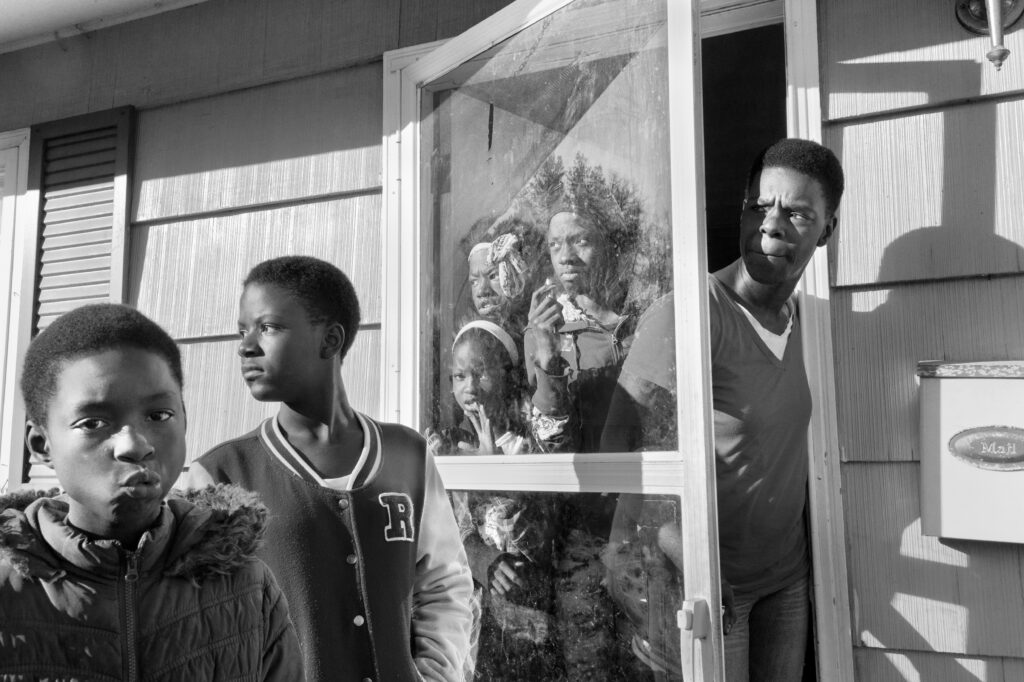
The footage "The Chatman family, Ferguson, Missouri, November 2014" shows the closely packed relatives of an African American family in Ferguson (Missouri), who barely venture out of their house in the face of the police-slammed protests on the eve, and who look with great skepticism at a passing police vehicle. The protests had been preceded by the acquittal of a white police officer who had shot an unarmed teenager.
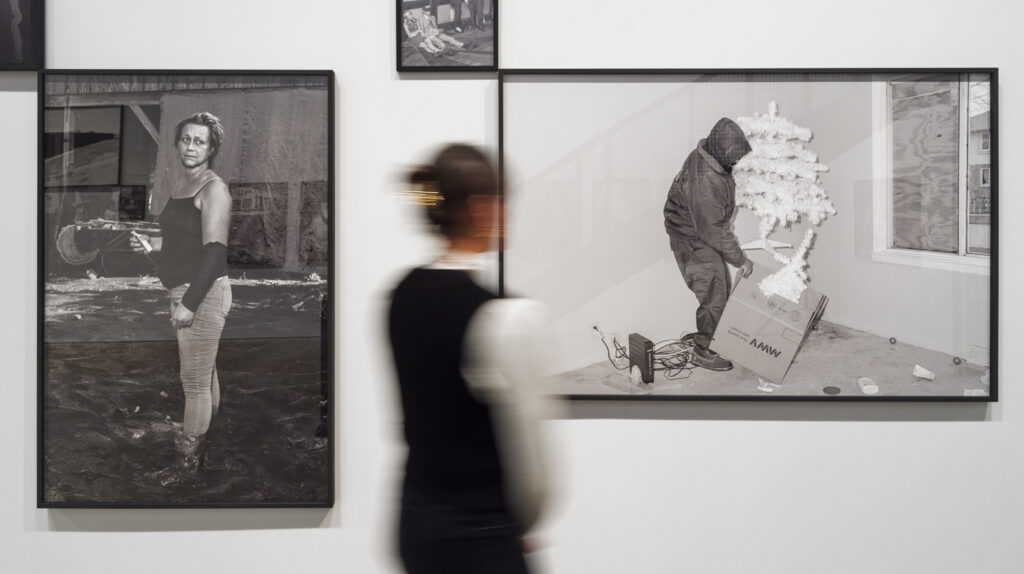
In the recording "A Christmas Eviction 2015", we witness a house eviction on Christmas Day. Montgomery takes us into a room that is already largely empty. One of the windows has been hastily replaced with a plywood panel. And a man with a hood sitting deep in his face is just picking up a white plastic Christmas tree to take it with him out of the house. Whether this is the evicted tenant himself or a member of the eviction team remains unclear.
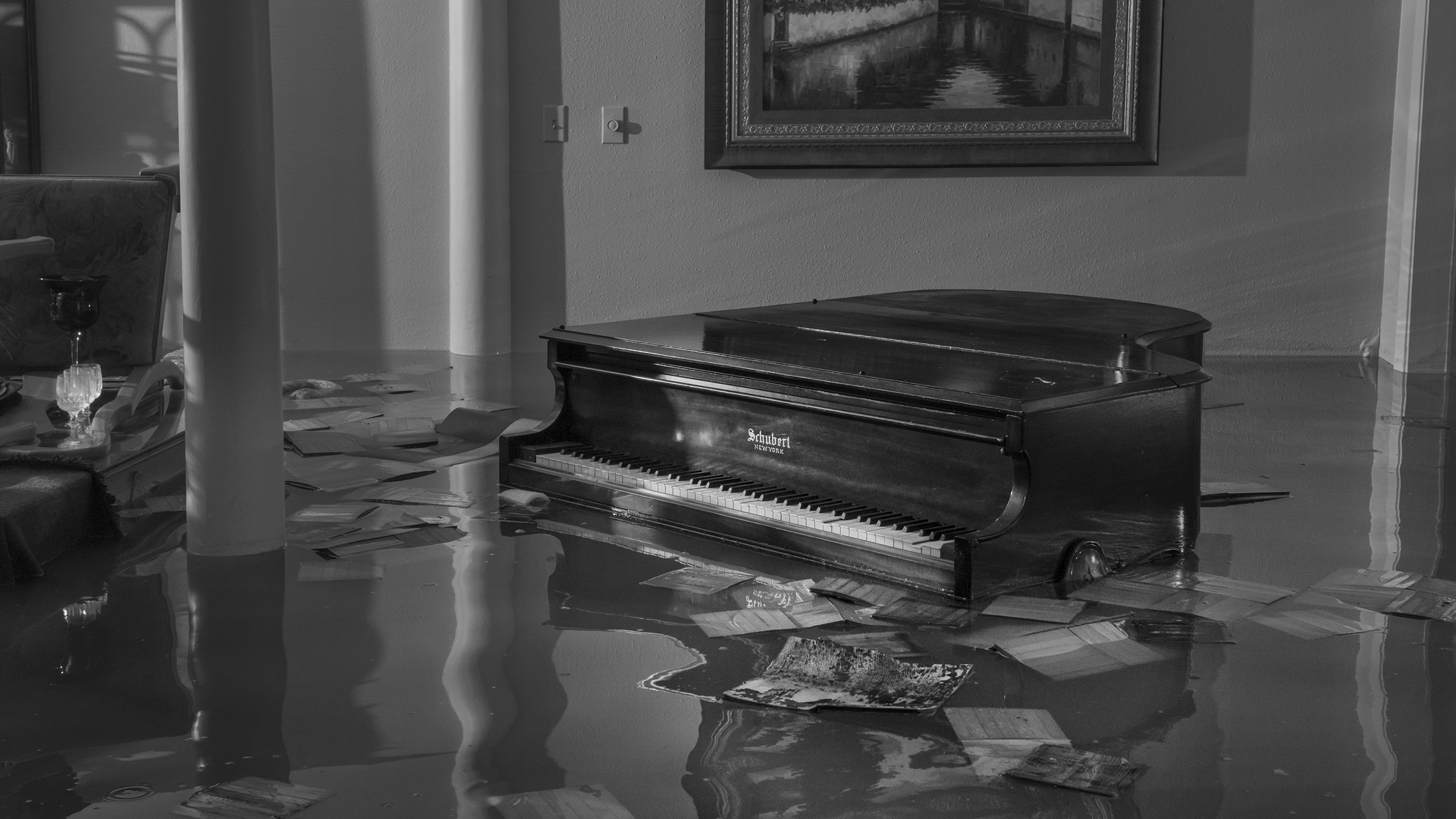
Montgomery then shows that even the social elite is not immune to storm and flood disasters in other images. For example, in the work "Piano, Hurricane Harvey, Houston" (2017). A concert grand piano is visible almost reaching the keys in the brackish water. In the background hangs a painting apparently dating from the 19th or early 20th century, on which a canal is ironically depicted.
"Saying Goodbye to Brian" (2017) is part of a group of works featuring recordings of victims of the opioid crisis. The abuse of opioids is the most common cause of death among Americans under the age of 50. The recording shows the grieving family members of a 33-year-old man who died quietly in the basement of the single-family house. They look into the body bag that is placed on a stretcher. While other bystanders, including police officers and a forensic doctor, remain in silent prayer with partly folded hands. This recording also bears certain similarities to Weegee: in him too, the horror often mirrored itself in the horrified gazes of the witnesses.
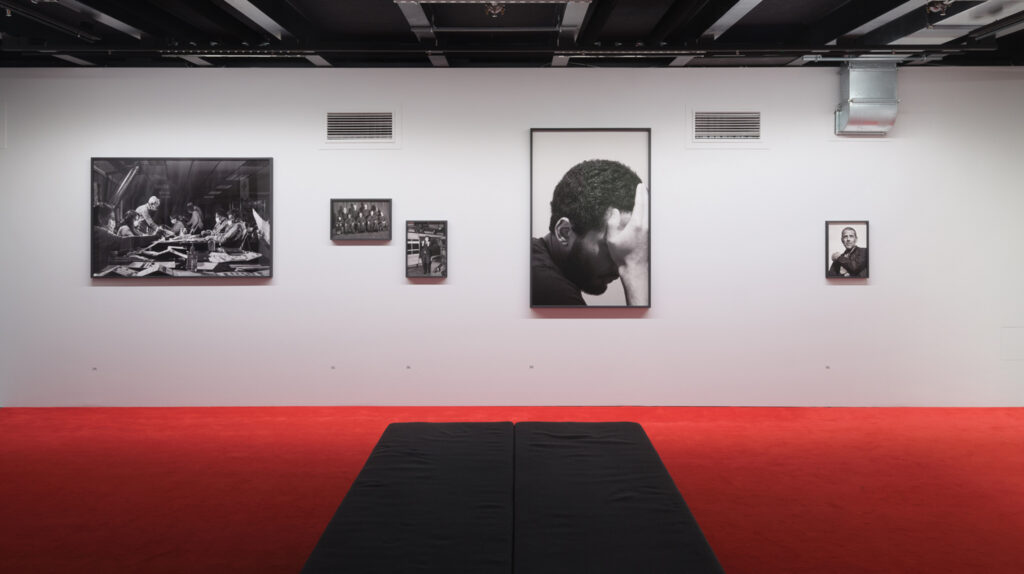
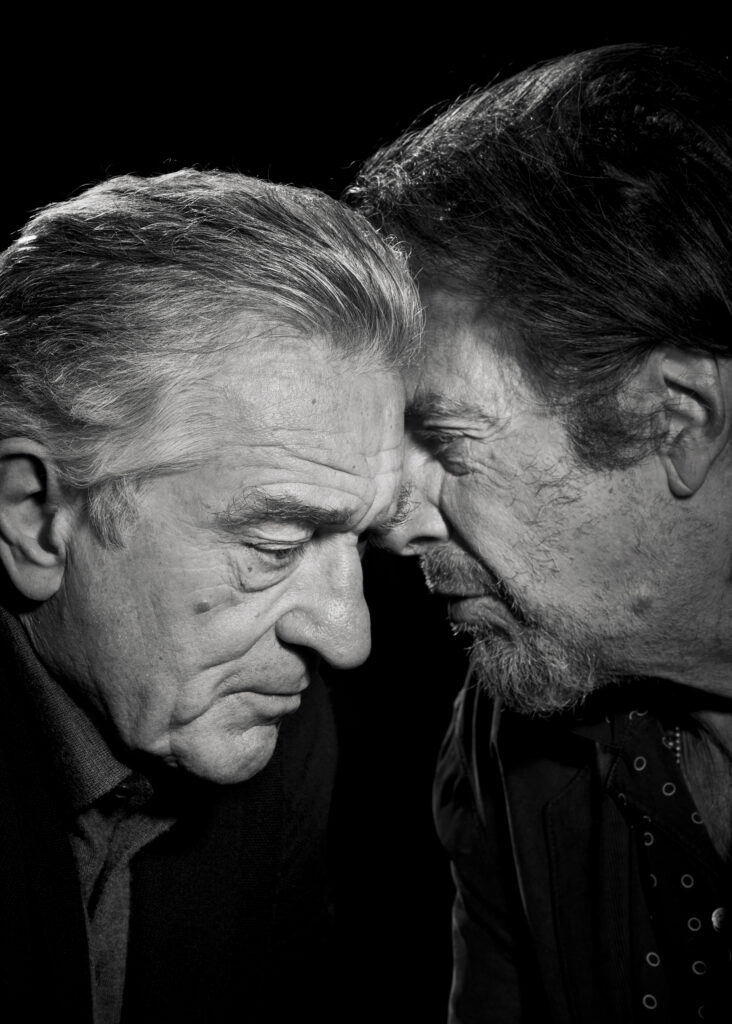
Especially on less dramatic shots, Philip Montgomery proves to be a master of lighting. For example, in the image "Robert de Niro and Al Pacino, actors, London, UK, October 2019". The well-lit faces of the two Hollywood stars are set in close-up, with their heads facing each other and almost touching at the forehead, against a deep black background. This motif is part of a whole series of celebrity photographs that are shown on the first floor of PHOXXI in highly darkened lighting conditions. The perfectly composed display also gathers numerous other shots of famous Americans under the chapter title "American Mirror". Among them are Barack Obama, Philip Roth, Laurie Anderson or Nancy Pelosi. Robert F. Kennedy Jr. is also represented with a portrait from 2023. With the choice of the title for the photo, Philip Montgomery makes it clear what he thinks of it. "Conspiracy theorist and health minister," it is said. This sequence speaks volumes.
Montgomery and the curator, however, blend this selection of easily recognizable celebrities with a panorama of ordinary American citizens. These "Average Joes" work, for example, as Trump merchandise sellers, police officers, or postal workers.
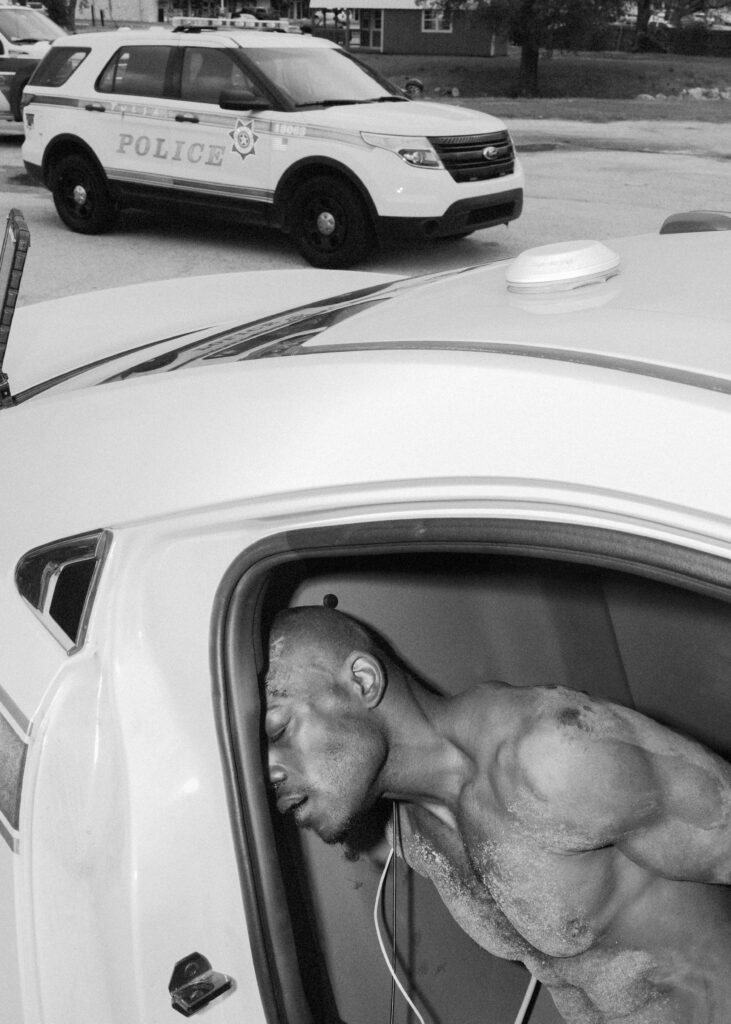
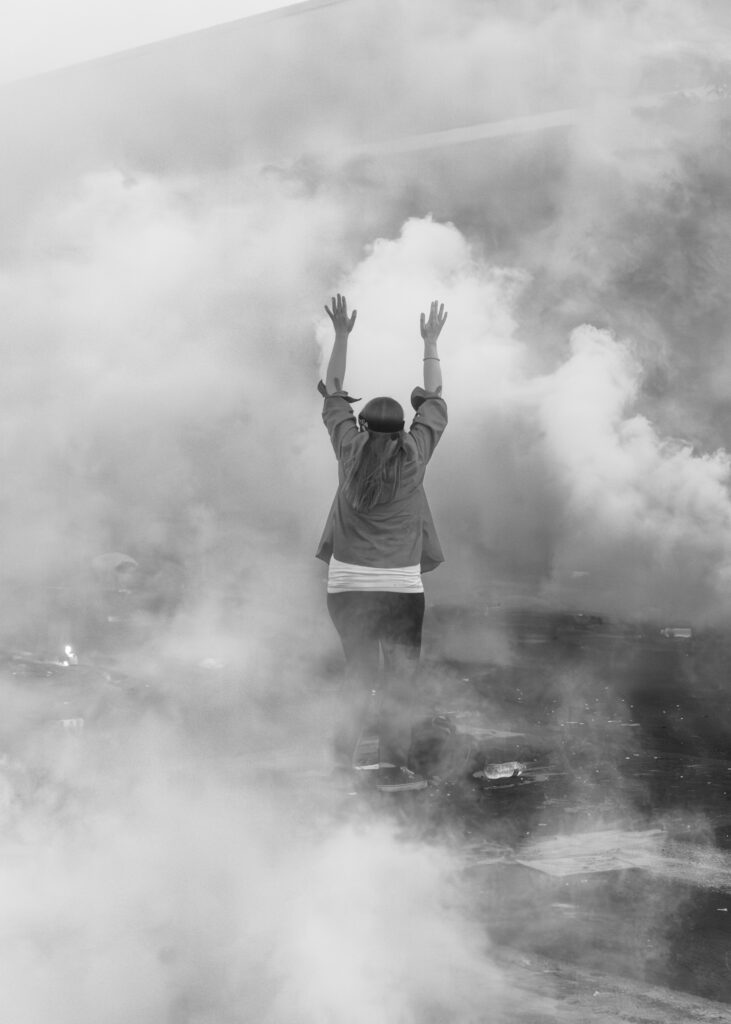
Whether it be flood disasters, forest fires, forced evictions, racial conflicts, police violence, the opioid crisis, or the rise of the MAGA movement under President Donald Trump: Philip Montgomery proves himself to be a chronicler with the rare ability to produce images that go far beyond what is shown on them. Among other things, he achieves this by deliberately using remote-controlled flashlights that he has previously hidden in houseplants, so that the subjects do not even notice this small staging trick. The result are strangely detached images of the world that are only perceptible to the naked eye, primarily of smaller groups of people in interiors. The exhibition features three striking examples: steelworkers organized by trade unions in their break room in Wisconsin, brokers on the New York Stock Exchange, or the members of the US Supreme Court.
These barely perceptible interventions make his photographs of extraordinary quality. In his images, Montgomery develops a very unique typology of places, people, encounters, conflicts, emotions, and states of anxiety. Alongside all the violence, fragmentation, and misery, he also repeatedly shows scenes of empathy and solidarity—whether in the family or among protesters.
The Swiss art theorist Paolo Bianchi considers the purely visual perception of an object as "a merely limited access to the medium of photography". And he advocates for a "photography of the imagination" when he writes: "More revealing is the realization that photography is indeed also imaginative and stages realities that in turn lead to a reference to other imaginative worlds. The photography of the imagination creates a doubling of reality in which the photograph always functions as a sign of signs."
For the American philosopher Richard Rorty, a new worldview corresponded to the "competition between a frozen vocabulary that has become restrictive and annoying, and a new vocabulary that has only half-formed and offers the vague promise of great things". This is exactly what Philip Montgomery's extraordinary method of approaching the world with the camera outside of it is all about. It is exciting to see what images this relatively young photographer will present to us in the future.
Philip Montgomery, American Cycles. Phoxxi, Haus der Photographie temporary exhibition, Hamburg. Until 10 May 2026.
As a catalog, there is a free booklet, 44 pages. In the Aperture Verlag, the book "American Mirror" with selected works by Philip Montgomery has been published in English.
The Kunstmuseen Krefeld are dedicating the first retrospective in Germany to Charlotte Perriand’s multifaceted and astonishingly contemporary work.
 7 min read
The exhibition "Six Five Four Three Two" featuring works by the New York-based artist Josephine Meckseper at the Heppenheim Art Society.
 9 min read
In the new premises of Plateforme 10 in Lausanne, the Photo Elysée Museum can finally unfold its potential.
 12 min read