 10 min read
 10 min read
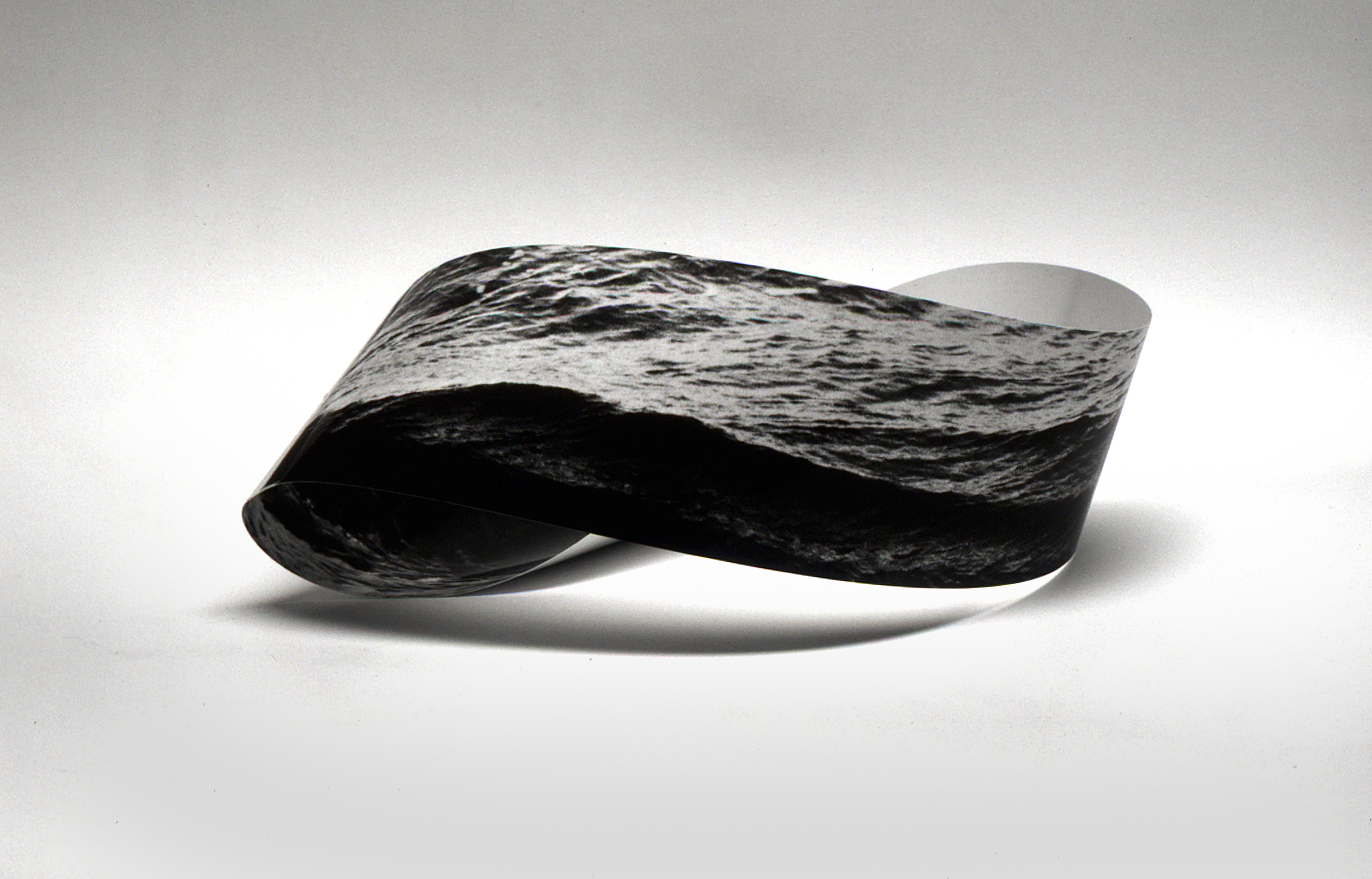
Mobius ribbons – the sea is visible on them. Foamy water, swirling waves, spray on the shoreline. In the early 1990s, the artist Dörte Eißfeldt cut the analog prints of her black-and-white photographs of the sea into strips and laid them in loops. Photo strips, simply twisted at the ends so that they congeal into an endless contemplation of the waves. Alternating between top and bottom, they show the impossibility of there being only one perspective from which the photographic image can be viewed – the process of seeing is fluid.
Eißfeldts Mobi tape, The sculptures, whose motifs vary according to the selected image section, are displayed as plastic bodies in eight showcases. The free-standing showcases arranged throughout the space, featuring collections of paintings, objects, and workbooks from the artist’s archive, form the core of Dörte Eißfeldt’s exhibition. Archipelago at C/O Berlin. They seem like a floating sea of islands, around which Eisfeldts analogous large-scale works, smaller image groups and sequences unfold in the show curated by Boaz Levin. The exhibition Archipelago
It pays tribute to the multifaceted work of the representative of experimental photography, who repeatedly challenges the medium with techniques such as multiple exposure, image montages, or the reversal of the roles of positive and negative from analog to digital photography.
"I didn't want to exhibit anymore," tells Dörte Eißfeldt, born in Hamburg in 1950, as we meet for a joint exhibition tour at C/O Berlin. After the artist ended her long-standing teaching career as a professor of free art with a focus on photography at the Braunschweig University of Fine Arts in 2016, she devoted herself to her archive. With a lot of time, she began to sort through the images and sketchbooks stored in binders and cabinets from nearly five decades of her artistic work, looking at the images. Some of them brought them into dialogue with a large-scale work wall to reevaluate them, cut them into pieces, or form constellations with existing works as well as with materials available in the studio such as paper, glass, or found objects. Eißfeldt, who lives in Hamburg and in Neuenkirchen in Mecklenburg-Vorpommern, planned to henceforth only produce photo books: to give her experimental photography in the format of a book a echo chamber. She succeeded in doing this with the book published by Distanz Verlag in 2024. Standing lying down Hanging, The exhibition consists solely of photographs that Eißfeldt took with her mobile phone from random and arranged image situations in her studio. It shows how Eißfeldt understands her archive as a living archive, and photography not only as a carrier of images but also as a material body in space, as a category of thought. The publication, which is now out of print, paved the way for a new era of exhibition.

Together with the artist Karø Goldt, Dörte Eißfeldt exhibited works at the Hamburger Künstlerhaus Frise, where her book was also presented. In 2025, when Eißfeldt was working on her first exhibition for the Berlin gallery Thomas Fischer, she received a call from Greenland: "Icebergs and the Northern Lights," says Eißfeldt, "an old dream of mine. I had just put the wish to experience them to bed. And then came the offer to exhibit my photographs at the Illulissat Art Museum." Both exhibitions took place simultaneously – and in Paris she was awarded the Prix Viviane Esders The solo exhibition was already in the works at C/O Berlin. "Curator Boaz Levin envisioned that the studio moment, as conveyed in my book, could be experienced as an exhibition." At the same time, Thomas Fischer planned another exhibition featuring Eisfeldts work in his gallery, which he began in parallel with that at C/O Berlin: Conil, named after the coastal areas that Eißfeldt photographed in the middle of the Atlantic some years ago. "Suddenly I had so many options to place my works according to the context." She adds with a smile: "I could really make the most of it."
The exhibition presented at C/O Berlin on the upper floor begins with a self-portrait that Dörte Eißfeldt took in 1988: Her body is faintly outlined, her hands frame a light spot, and structures in the background reveal an interior space. Eißfeldt photographed herself as a reflection in one of her photographs in her then-studio. The subject, against whom she positioned herself and to whom she reacted through the gestures of her hands, also frames this exhibition. It appears repeatedly in the exhibition extending over three cabinets as well as at its very end as the precisely framed image in which she reflected herself.

Eißfeldt was important in the C/O Berlin project Drachenblut II To show that it hangs primarily in the first exhibition room as a large-format print without frame. Already in 1989, Dörte Eißfeldt had overexposed this image with two black-and-white negatives stacked on top of each other: light-shadow reflections of trees that mark a path merge into the spotted fur of an animal. Due to its special development process, in which the silver gelatin print glows golden, the image has a special patina in which the smallest light reflections become part of the image. At that time, when Eißfeldt overexposed the image in several prints, she decided on a series that she Drachenblut I When she was going through her archive in 2023 and came across the image now shown at C/O Berlin and previously in the Frise in Hamburg, she decided to remove it, which is now lined with bends and corners – and destroyed the previous version.
The process of interpreting and updating photographs, from which the work itself also stems Möbius tape Dörte Eißfeldt consistently uses this method in her work. For example, she repeatedly overexposes the visible elements in the same negative and interprets the images by removing them in the darkroom, as the artist did in 1988 with her work Snowball aimed to create 32 different image variants of the motif in 24 images. To show that photography has a body that it displays in its turn – through light, water, chemical reaction or paper – as Eißfeldt wrote in the text in 1992 The body of photography Although described in the text, this is still an issue in her work. And so the text has been republished in the exhibition-themed C/O Berlin magazine.
Dörte Eißfeldt always thinks about the relationship between image and space when exhibiting. There are images like Drachenblut II, These are works that are only brought to the wall using magnets. Or works like the one depicting a knife, in which the shape of the image seems to match the shape of the glass panel, which is only attached to the wall with nails. The presentation methods are related to the motifs, (cut-out) formats and textures of her images – and in this way Eißfeldt’s photographs unfold as bodies. Extremely dark, underexposed portraits of women with closed eyes, which Eißfeldt took in 1990 and can be seen in deep steel frames, hang almost on the top edge of one of the walls. They lead the viewers’ gaze upwards, where the heads of the illuminated figures rest in silence.


Compared to them, a series of works differs sharply: photographs that Eißfeldt took in 1988 from a building near the Dessauer Straße in Berlin. However, the view of the urban landscape is always obscured by her hand, which slides in as a black, slightly blurred shadow into the frame. Only at the edges of the photographs are buildings visible; the Gropiusbau can be seen, and the Berlin Wall. At C/O Berlin, the series hangs right next to a large tinted window overlooking the Zoo station, and one is tempted to make a visual connection to the cityscape with one’s own hand. "I rediscovered these images shortly after Boaz Levin visited me in the studio. It actually doesn’t take a month for me to make a discovery. I am searching for something, and suddenly something else falls into my hands."
Eight vitrines, which are connected to one another at different heights, overlap and confront each other, form the center of the exhibition and refer to the core and breadth of Dörte Eißfeldts work. For in them are collected notebooks, sketchbooks, contact sheets, leporrellos, editions, photographic objects and suspended objects from the entire period of her photographic work, from the late 1970s to the present day. Eißfeldt, who studied at the University of Art and Design in Hamburg from 1970 to 1976 and initially dealt with painting and film, developed her media-reflexive photographic practice as a self-taught artist. She kept ideas for images that did not always immediately translate into reality in notebooks, which she kept – day by day or on trips – in notebooks that she developed into continuous series. For example, she named a series of notebooks Ribbon booklets, In the early 1980s, she assembled fragmented photographs and developed a working method based on the fragment. This was in the early 1980s. She exhibited these booklets with montages last in 1985 at the Kunstverein Pforzheim. "The things displayed in the vitrines at C/O Berlin are the heart of my work – and the way they are presented corresponds to my work," says Eißfeldt.
The artist designed the showcases with light-sensitive Orwo paper, which has been tinted from its original rose-tinted shade to a violet-gray-brown hue in all those places where no exhibits have been arranged. This is visible in one of the showcases where one of the objects is slightly distorted. Originally, Eißfeldt herself had an extensive collection of vintage photo papers, which she began to donate as part of her engagement with the archive. The photo roll used here was received from the Berlin Lette Verein and was formerly part of the collections of Sibylle Bergemann and Arno Fischer.


Eißfeld's discussion of paper is the subject of further works that accompany the vitrine collection on the walls. The series of images Afga Brovira (2009/2015) now shows around 100 years old photo paper that Eißfeldt stacked one on top of the other and photographed digitally. She reused the papers in another series., Vera Ikon (2011), in which the artist created a photogram of each individual leaf. Both series are presented together for the first time in Archipelago exhibited; they are complemented by the photographic papers that can be seen as objects in one of the showcases. "These works form a link in my work between analog and digital photography," explains Eißfeldt.
This is also evident in her visual style, for example. Daylight (2017/2025). For this purpose, she arranged scraps of paper on undeveloped photographic paper in daylight and scanned the resulting photograms, which she subsequently digitally edited with image-editing programs. These works are juxtaposed with a series of four large-format analog photographs of a female back at the very end of the exhibition, which are not arranged as a parcours, "but which lead back again, thereby allowing one to take a different perspective on the images", as Dörte Eißfeldt suggests.
And yes: When strolling back, the medium- and small-format photographs arranged freely on the wall, which accompany the display of the vitrine archipelago, gain a different weight. After intensively looking at Dörte Eißfeldt's photographs, in which the work and the photographic history are closely intertwined, the individual images and loose sequences, most of which belong to her "Small Favorites" collection, seem like a free view of the ocean. Fragments of bodies appear in them: a shiny eye, the silhouette of a head, two moving legs on a rainy street. A series shows the sun reflected in the water, a pair of images that shows the foaming sea; Eißfeldt's snowball rests on a palm. "I have tried to compose the images in my exhibition so that a web is created in which each image plays off another or several others or enters into a dialogue," she says. In doing so, visual encounters arise that, like Eisfeldts Möbius strip, secretly blend their photographic image moments and even personal experiences. "In my work, I always react to something that is already there," she concludes, and almost casually notes: "At another time, I would probably have become a surfer."
Dörte Eißfeldt, Archipelago, February 7 – June 10, 2026, C/O Berlin
The Kunstmuseen Krefeld are dedicating the first retrospective in Germany to Charlotte Perriand’s multifaceted and astonishingly contemporary work.
 7 min read
The exhibition "Six Five Four Three Two" featuring works by the New York-based artist Josephine Meckseper at the Heppenheim Art Society.
 9 min read
In the new premises of Plateforme 10 in Lausanne, the Photo Elysée Museum can finally unfold its potential.
 12 min read