 10 min read
 10 min read
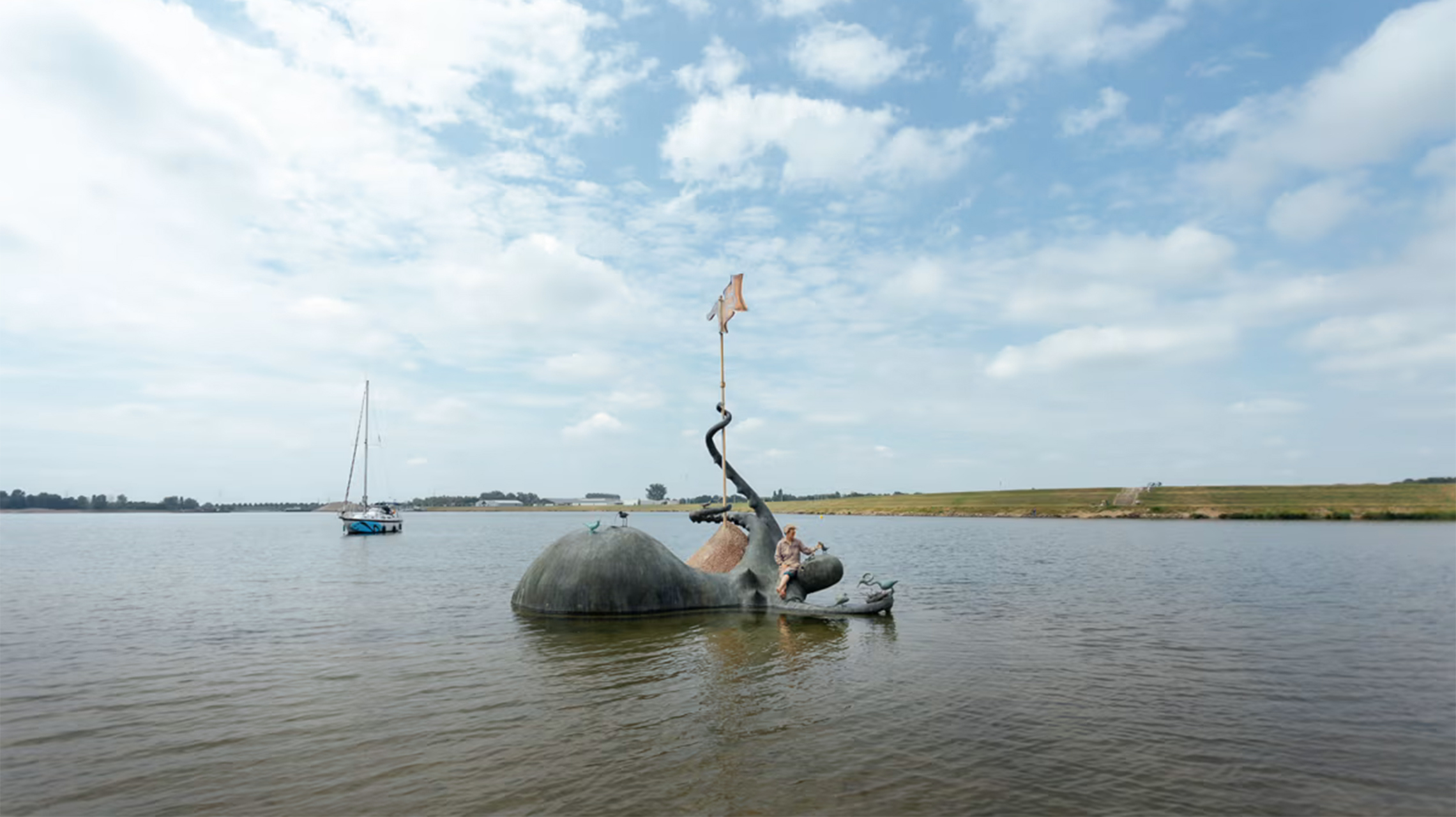
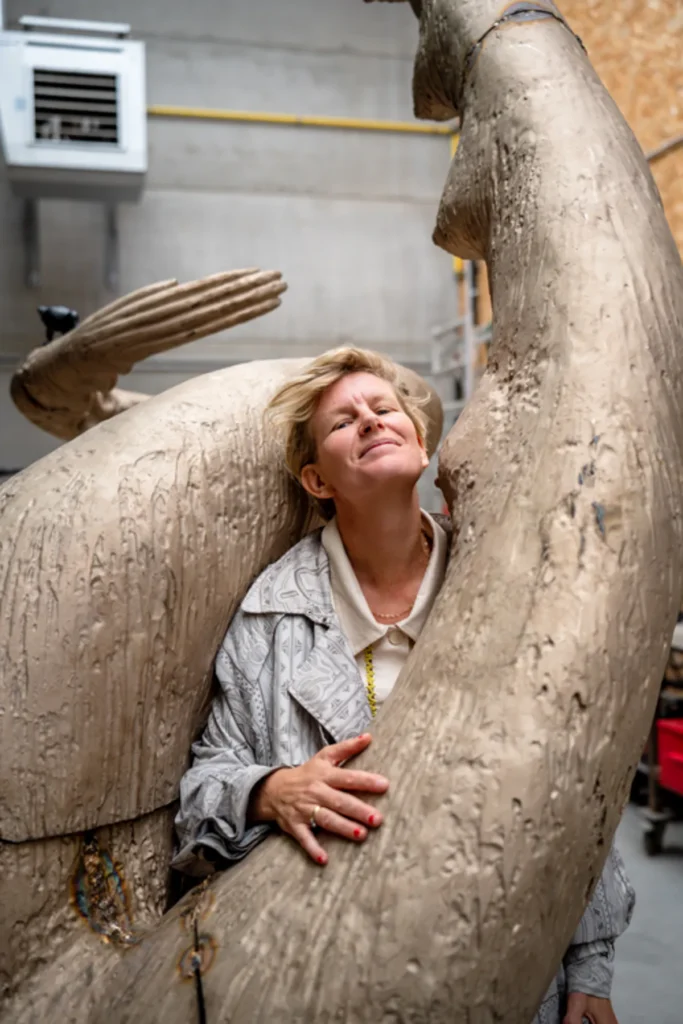
Laure Prouvost takes off her heavy black leather boots. The renowned French artist has picked a handful of wild camellias on the banks of the Meuse river. "These flowers are for her; I am bringing them to her now," she exclaims enthusiastically. She is referring to the bronze sculpture she placed in the riverbed of the Meuse, with the beautiful title "Mother! Yes, Dream to the End". The hybrid of walrus, octopus, mermaid and pregnant woman that floats in the water is not only captured by the bronze sea birds that belong to the sculpture. Real birds are also attracted by the unusual object and are already nesting on the sculpture.
A vertically rising wind vane crowns Laure Prouvost's sculpture. The title of the work is inscribed on it. "This is not the Mediterranean," says the Turner Prize winner from 2013, born in 1978 near the northern French metropolis of Lille, who lives in Antwerp and London. Yet she reaches down to her knees into the cold waters of the Meuse to place the bouquet of camellias on her sculpture.
The permanent work of Laure Prouvost is part of the art project "Art on the Meuse", which has now been realized in Kinrooi on the Belgian bank of the Meuse in the Flemish province of Limburg. In addition to Laure Prouvost, four other artists have so far developed site-specific and permanent works in public space. The work of the Dutch artist Jennifer Tee is still in the development phase. The overall project dates back to an initiative of the art center Z33-House for Contemporary Art, Design & Architecture in Hasselt and the regional association Kempen und Maasland. The special feature of "Art on the Meuse": The works of art were not simply placed in the landscape, but were developed in close dialogue with the local community. This community was not simply included in the decision-making processes. The strengths of the region were also taken into account in the realization of the artworks, with local craft and industrial enterprises and artistic assistants from the region being involved in the production process whenever possible.
The 874-kilometer-long Maas is the longest tributary of the Rhine and flows into the sea at its mouth in France, Belgium, and the Netherlands. Along the way, it repeatedly changes its character. The section of the Maas in the Belgian province of Limburg is characterized by the fact that over the course of Earth’s history, the river has deposited an immense sediment load of sand and gravel here. This sediment is still being dredged and used by the construction industry. For a long time, the Maas in the Limburg area was largely canalized, so that during flood disasters there were always significant damage and casualties. However, the two riparian states, Belgium and the Netherlands, have learned from the past in recent decades by improving the levees and creating natural floodplains. The result is lush meadows and riparian zones covered with shrubs and trees, which are now populated by countless waterfowl as well as mammals such as beavers, otters, galloways, and semi-wild conelike horses. Nevertheless, the Maas remains a so-called "rain-fed river", that is, a stream that is subject to strong fluctuations in water levels.
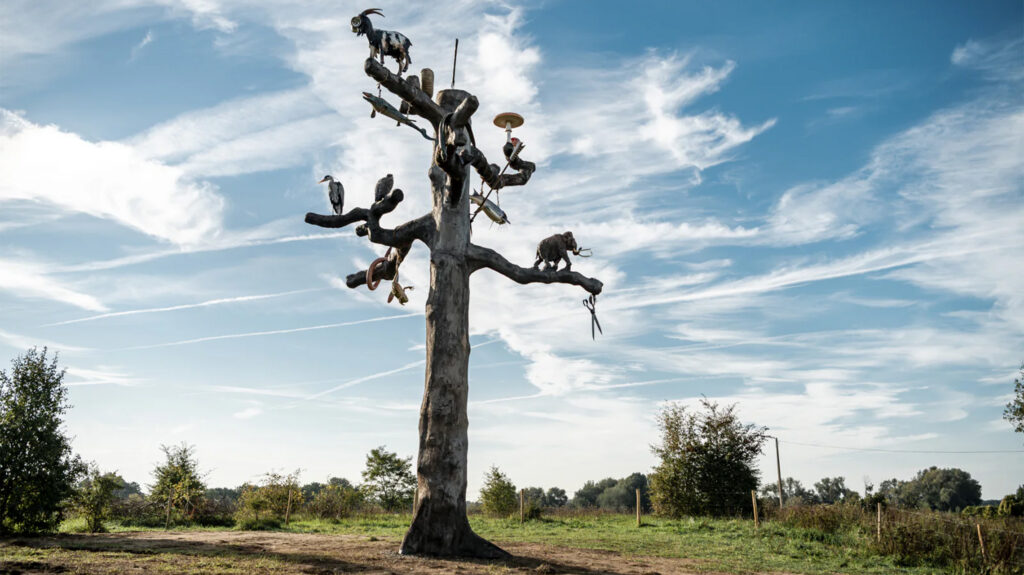
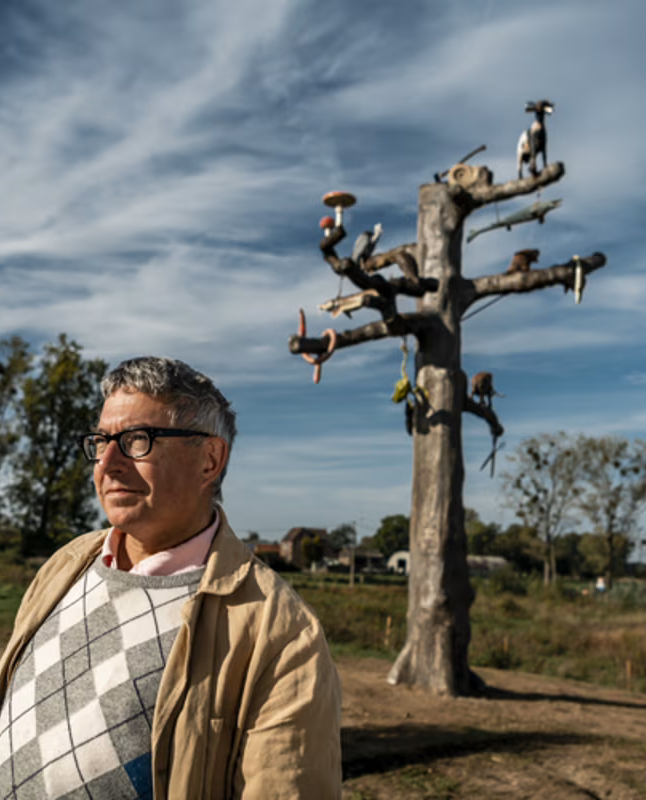
As early as four years ago, the first permanent work of the Parcours was erected with the work "Tree of Life" by the US artist Mark Dion, born in Massachusetts in 1961. Dion's "Tree of Life" stands on a small hill in the municipality of Lanaken, where during the regularly recurring Maas floods the animals find refuge to escape drowning. Dion's six-meter-high tree sculpture also features numerous animals. Although Dion also represents representatives of the current animal world with replicas of a large rainworm, a beaver, and a signal-green frog, it was nevertheless important to him to also undertake a journey into the past. And so the oldest animal representations include a 75-million-year-old mosasaur, a scaly lizard that could grow up to 18 meters long, and a woolly mammoth that is around 12,000 years old.
"This is an atypical tree in the landscape, because the last thing you expect when you approach a tree is to see strange things hanging from it," says Mark Dion and adds: "We are playing with proportions and scale here." He was inspired by the fact that after every flood the floodplains are covered with driftwood as well as a wide variety of objects and finds. Sometimes even drowned animals are involved. "The river has been flowing through here for thousands of years, and it will continue to flow through here for many thousands of years after our existence," says Dion. "But time also flows through a landscape just as water flows through a river."
"Tree of Life" can be read as Mark Dion's prototypical work. The fusion of slightly outdated (pseudo-)scientism with a finely formulated aesthetic of the Wunderkammer and an artistic stance that is both critically aware of civilization and loaded with humor characterize the work of this internationally active artist.
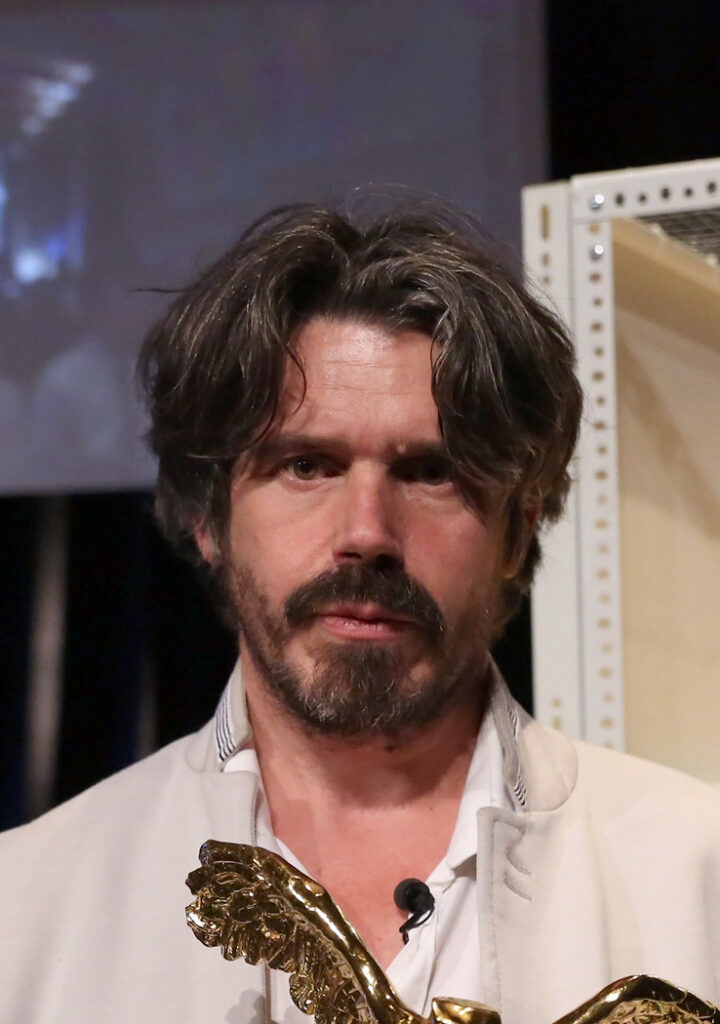
While Mark Dion, on the other hand, rather combines historical insights with snapshots of the present, the Belgian artist Koen Vanmechelen takes a look into the future. His work is titled "Future Fossil". The Belgian born in 1965, whose studio is located in nearby Genk, is currently also having a major exhibition in Venice. At the Palazzo Rota Ivancich there he is showing 40 new sculptures in parallel with this year's Biennale. The leitmotif of his work is the artistic confrontation with genetic hybridity. "Nature does not need our pity, but only our willingness to coexist. The secret of survival lies not in conquest, but in reciprocity and hybridity," says Vanmechelen. Therefore, the transition states between humans and animals are at the center of his works in the face of the ecological framework of their existence.
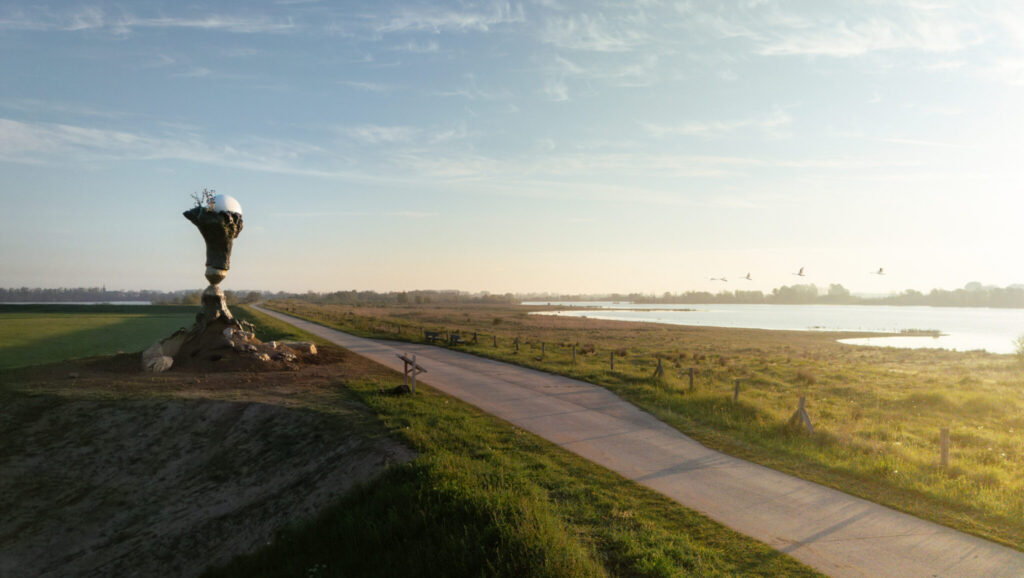
In Dilsen-Stokkem, a long-stretched small town brutally cut off by the Belgian National Road N78, he has chosen a rather quiet spot on the left bank of the Meuse. From a distance, passers-by and cyclists can recognize the charred stump of a gigantic meadow, additionally tormented by the surrounding traces of a beaver. The whole thing stands on a cone-shaped mound of earth, which reveals most of the tree’s root system. Additionally, the sculpture is supported by several sandbags, which are used as an emergency measure in case of flooding. However, Vanmechelen adds a hopeful component to the dystopian backdrop. The tree is crowned with a giant white egg, from which – according to the artist’s projection – a healing creature may emerge in the future, reconciling man, nature, and the environment in peaceful co-existence. The small green shoots that sprout from the thicket at the very top also underline the hope for departure and a new beginning.
Like all other artists, Koen Vanmechelen met with local residents during several working visits as part of small workshops and was inspired by their stories, experiences, and future fears. Because one thing is certain: The Maas is not an easily assessable waterway in this area. As beautiful as it may be through the lush green meadow landscape in good weather, it can become dangerous for people, animals, and homes during floods. After the already severe floods in 1993 and 1995, the area was particularly badly affected in 2021 during the Centenary Flood, which also cost many lives in the Eifel region.
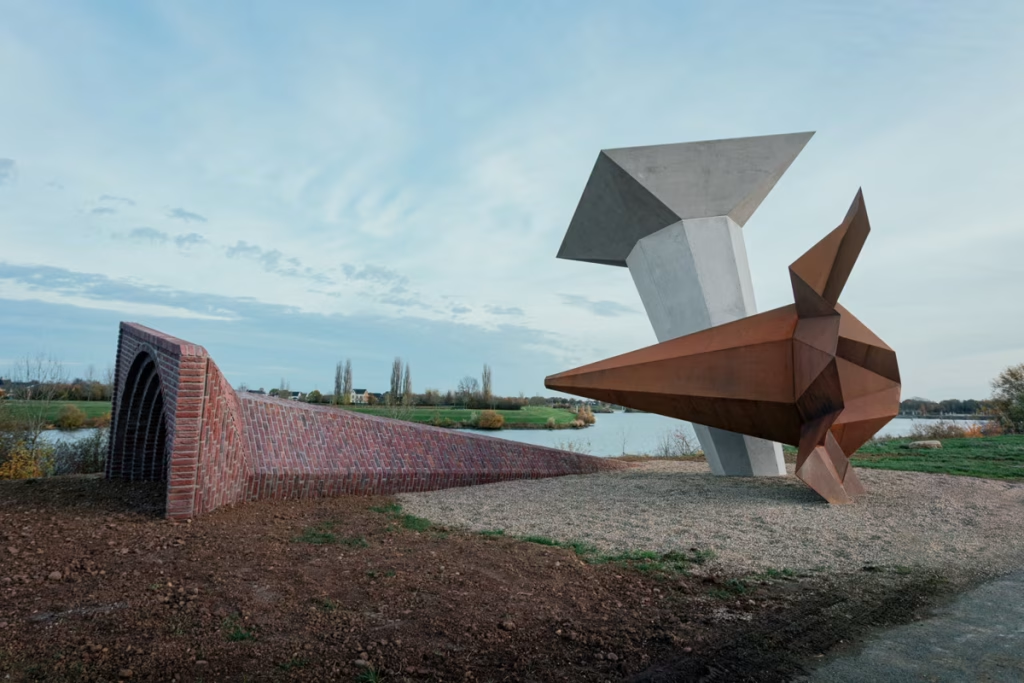
On the other hand, works by the Belgian Adrien Tirtiaux and the Dutch Germaine Kruip are significantly more minimalist than the works described so far. The Belgian Adrien Tirtiaux, born in 1980 in Brussels, quotes in his work in Maaseik, the birthplace of the Flemish painter Jan van Eyck (1390-1441), the distinctive basic forms of three important church towers in the region, two of which are in Belgium and one in the Netherlands. The work was created in close collaboration with people from the surrounding area. "Echoes of a Landscape", as the title of his contribution goes, is located in the middle of a newly emerging, urban, development area above the Meuse. Therefore, in contrast to the other projects of "Art on the Meuse", which are predominantly located in idyllic (restored) nature, it must contend with the functionality of standardized purpose-built structures. But that can also be a challenge.
Adrien Tirtiaux, who trained as an architect and sculptor, has indeed used the architectural basic forms of the selected church towers. However, in his highly deconstructivist work, he effectively subverts their true function. The towers have been either turned upside down, placed on their side, or transformed into gigantic megaphones. Furthermore, Tirtiaux here plays with the theme of material: the visible concrete, the corten steel and the red brick are all sourced from the region and each represent one of the industries that are based here.
Thus completely stripped of their once sacral function, the tower sculptures by Adrien Tirtiaux, which appear like gigantic toys, radically challenge traditional visual habits and at the same time create a unifying element between Belgium and the Netherlands.
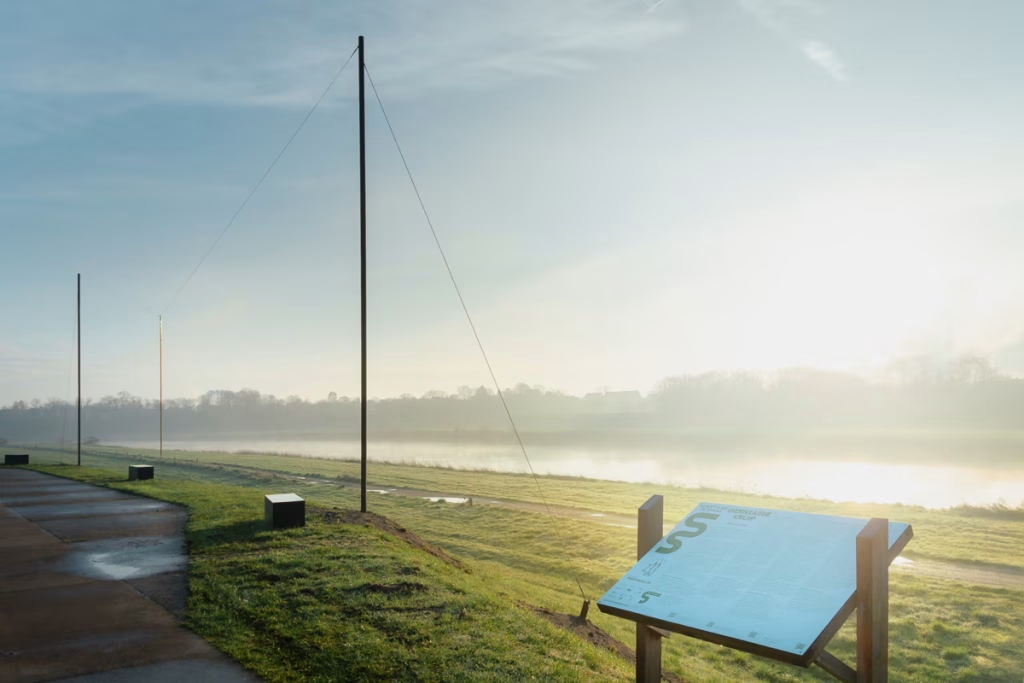
Germaine Kruip, born in 1970, also spoke with local residents and found that there was a ferry connection between the two small towns, Meeswijk (Belgium) and Urmond (Netherlands), that were located directly opposite each other, right up until the 1950s. Unfortunately, that connection no longer exists. And so the river now separates the residents, who look back on a common history, customs and traditions and even speak the same dialect.
With her work "Reflection", Germaine Kruip, who lives in Brussels, Amsterdam and London, is now constructing a kind of acoustic bridge. More of a publicly accessible musical instrument than a sculpture, the work invites visitors to elicit the sounds and tones that can be heard on both sides of the river. The visitors are invited to set the five-meter-high brass tube that is held in the air by two metal bars and steel ropes at vibration with a small mallet attached to a chain, thus creating sounds that propagate in a wave-like manner. Meanwhile, visitors can take a seat on two black granite benches.
Kruip, who has brought renowned Bremen-based instrument maker Thein Bras on board, explains: "I want to create a moment where people not only hear the story, but also experience the silence that now prevails. It is a work that inspires peace but also connection – just as the ferry once did."
As Tim Roerig, Senior Curator at Z33 and artistic coordinator of "Art on the Meuse", reports, the budgets for art and culture in Belgium are currently under strong pressure due to general budget cuts and increased defense spending, so it is not expected that further sculptures will be realized on the Belgian bank of the Meuse in the foreseeable future. However, Germaine Kruip would very much like to continue her project on the Dutch side. She is already initiating talks for that. It seems therefore that the authorities in her home country are not entirely opposed to Kruip's initiative. Perhaps Kruip's initiative could be the starting point for expanding "Art on the Meuse" into a truly cross-border, bi-national project in the coming years.
What distinguishes all the works of "Art on the Meuse" is the artists' and the curatorial team's unmistakable sense of the peculiarities of the respective Genius Loci and their willingness to put the still predominant anthropocentric view, which views nature as something to be subjugated, to the artistic test through humorous, ironic and metaphor-rich works.
"Art on the Meuse" takes place in various locations on the Belgian banks of the Meuse (Herbricht, Lanaken/Kinrooi/Maaseik/Maasmechelen/Dilsen-Stokkem). A short guide is planned.
"Art on the Meuse" on the Internet: www.kunstaandemaas.be/en/, www.rivierparkmaasvallei.eu, www.z33.be/en/
The Kunstmuseen Krefeld are dedicating the first retrospective in Germany to Charlotte Perriand’s multifaceted and astonishingly contemporary work.
 7 min read
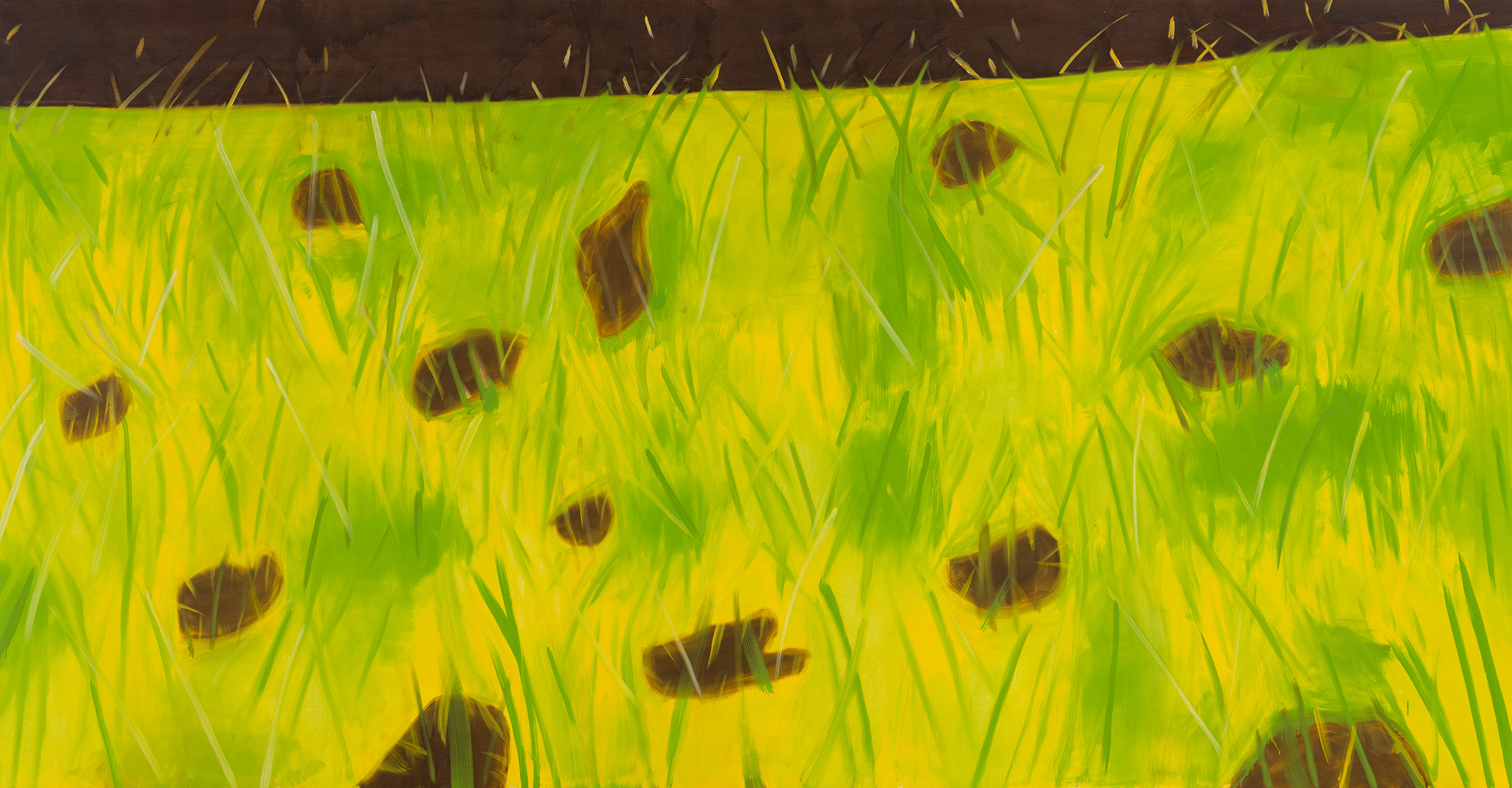
Alex Katz at the Tübingen Art Gallery
 8 min read
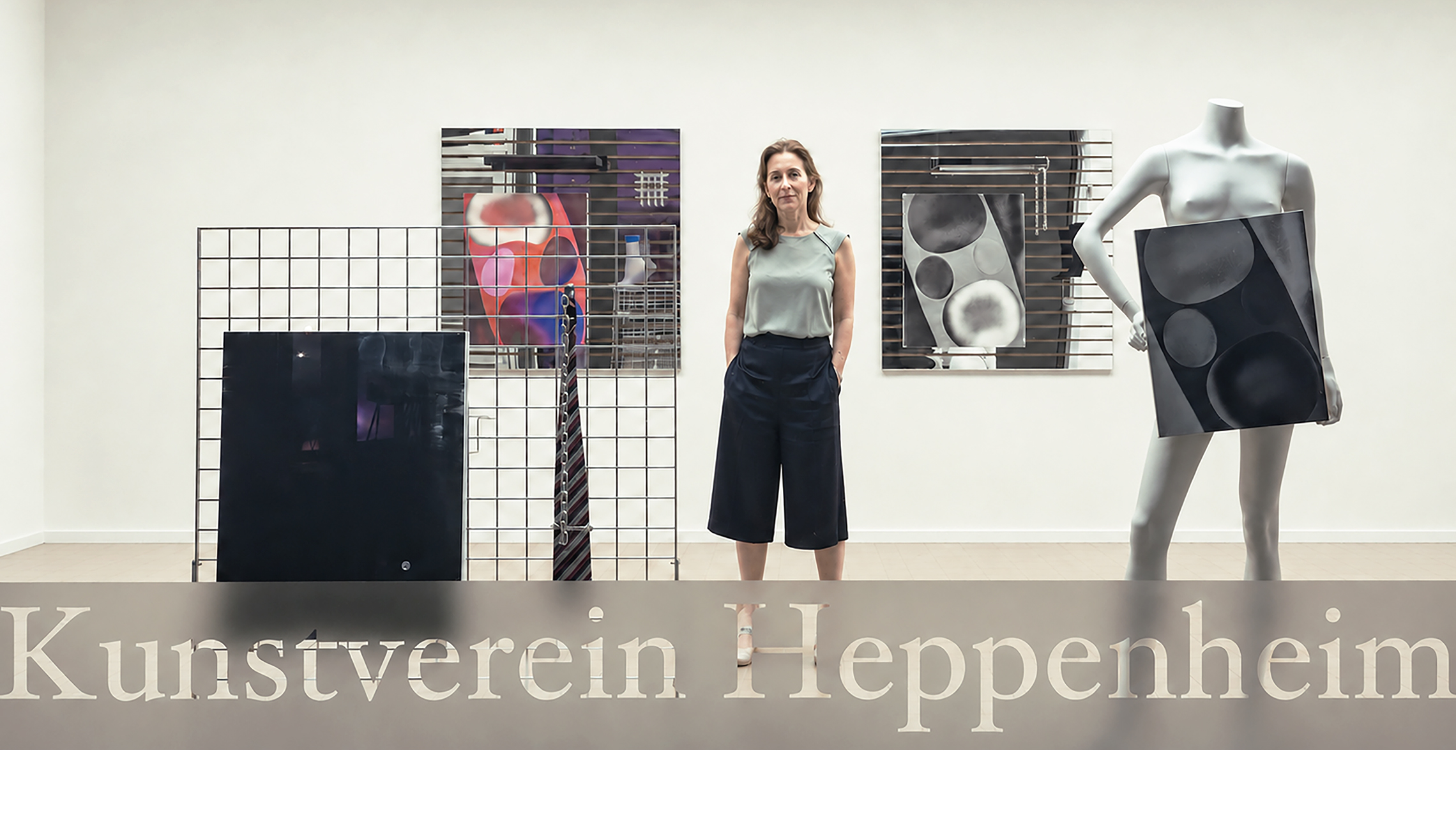
The exhibition "Six Five Four Three Two" featuring works by the New York-based artist Josephine Meckseper at the Heppenheim Art Society.
 9 min read