 6 min read
 6 min read
A taut system of wire lines becomes a tangible space of sound, vibration, and structure in the Haus der Kunst. The immersive installation "Algo-r(h)i(y)thms", currently on view in the exhibition by Tomás Saraceno, was developed by the artist as part of a long-standing exchange with researchers in the fields of bioacoustics and animal behavior. Spiders and their webs have long served as models for communication, cooperation, and spatial organization. The spider's limbs perceive their world almost exclusively through vibrations; they sense the vibrations that run through their webs haptically. Inspired by this special sensory world of spiders, Tomás Saraceno has equipped his elastic net with electronic mechanisms that translate vibrations into digital sounds that reverberate through the space. The entire network thus becomes an oversized string instrument that can be played together by the visitors, but rather "like a harp, and not like an electric guitar", as curator Sarah Johanna Theurer points out.
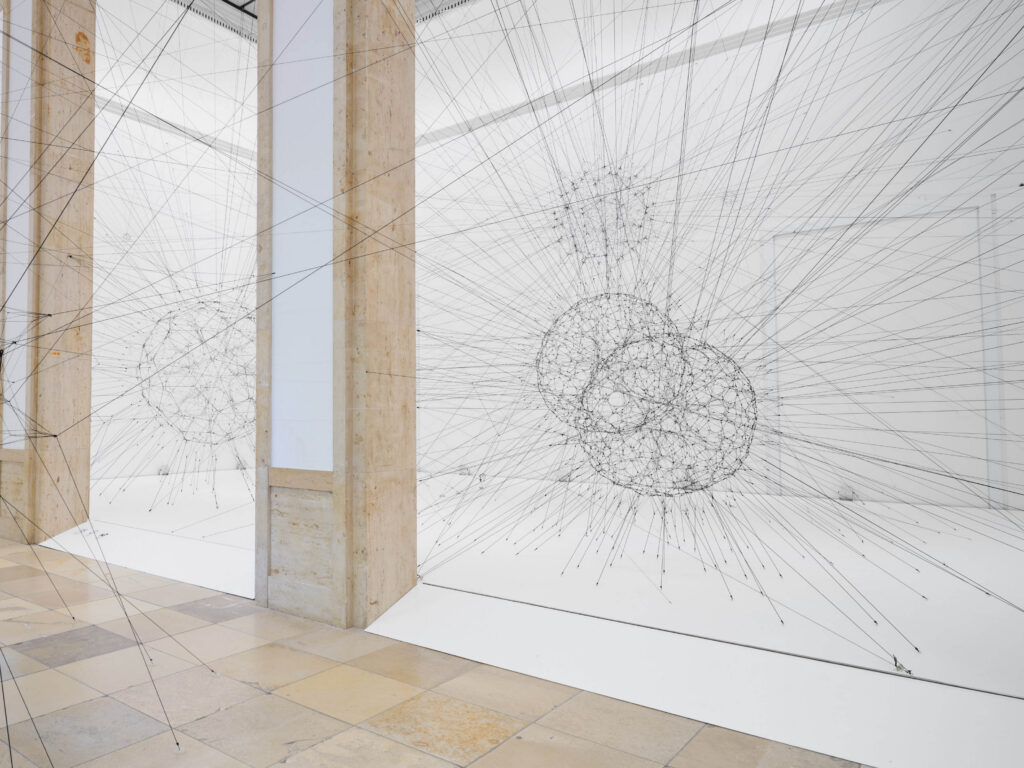
Networks, connections, and collaborative approaches are central to Tomás Saraceno’s artistic vocabulary. With his transmedia strategies, he connects fundamental processes with biological structures, scientific research with artistic imagination, and ecological issues with social relationships. The exhibition "Tomás Saraceno in collaboration. Interwoven Worlds" at Haus der Kunst brings these different levels together in a comprehensive form. However, the exhibition, curated by Sarah Johanna Theurer and Andrea Lissoni, is not a classic retrospective; rather, it reorders Saraceno’s works and thus makes numerous connections and references that characterize his practice tangible.
Saraceno occupies a large area on the ground floor of Haus der Kunst. Here, floating sculptures, documentary materials, sound and light works, and immersive installations meet. Air, water, vibrations, dust, and light form the fundamental design elements. The exhibition eschews a linear narrative; instead, connections emerge between works, spaces, knowledge fields, and geographical locations that become increasingly visible as the tour progresses. Alongside his floating net, Tomás Saraceno has placed a selection of real spider webs of various spider species. In a darkened room, these fragile systems are positioned like precious gems behind glass and skillfully staged with the help of light globes. These complex geometric structures appear both organic and mathematical, like woven cotton wool or the models of star nebulae in distant galaxies. This claim, which extends from the microscopic to the cosmic, runs through the entire exhibition.
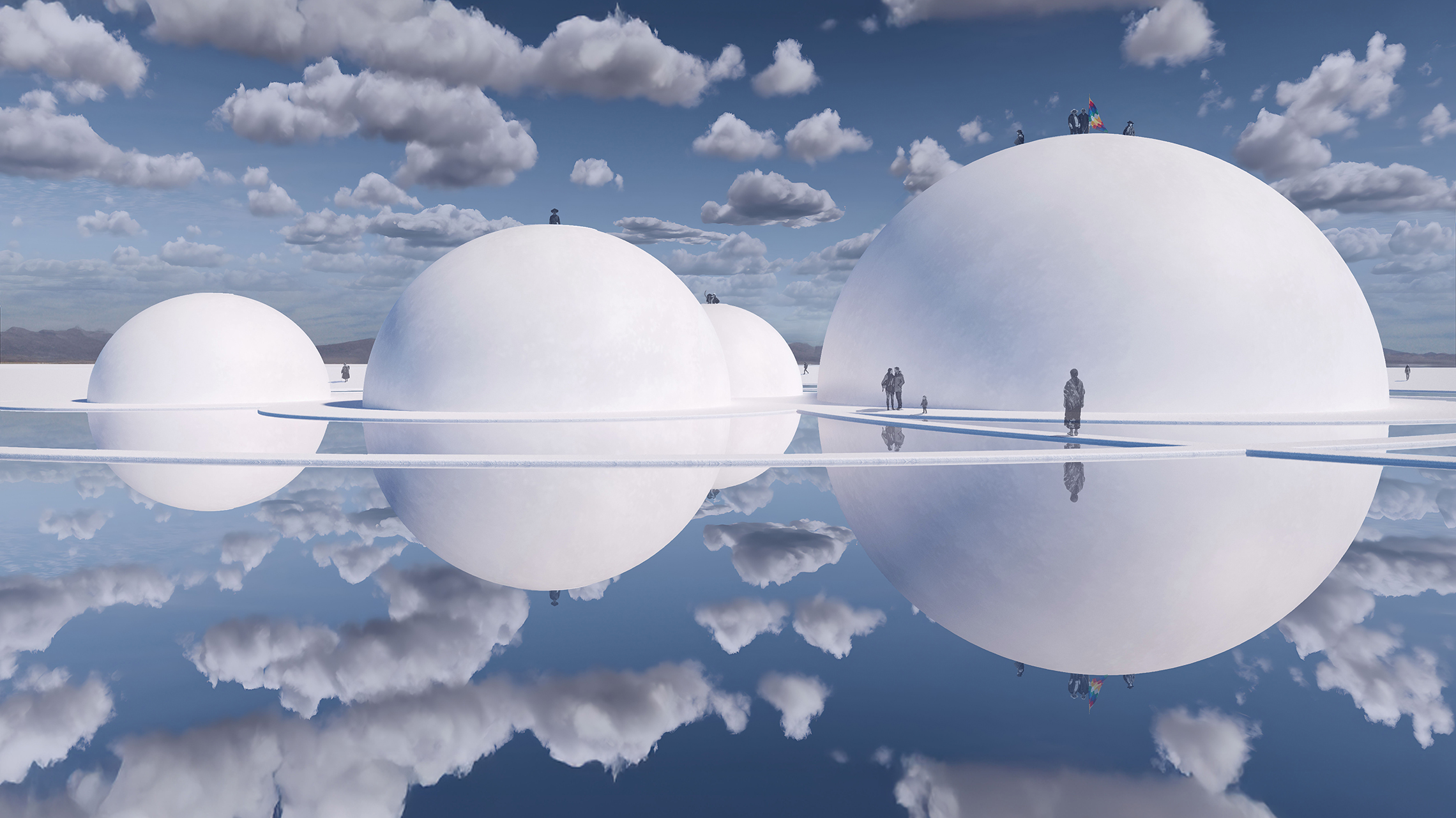
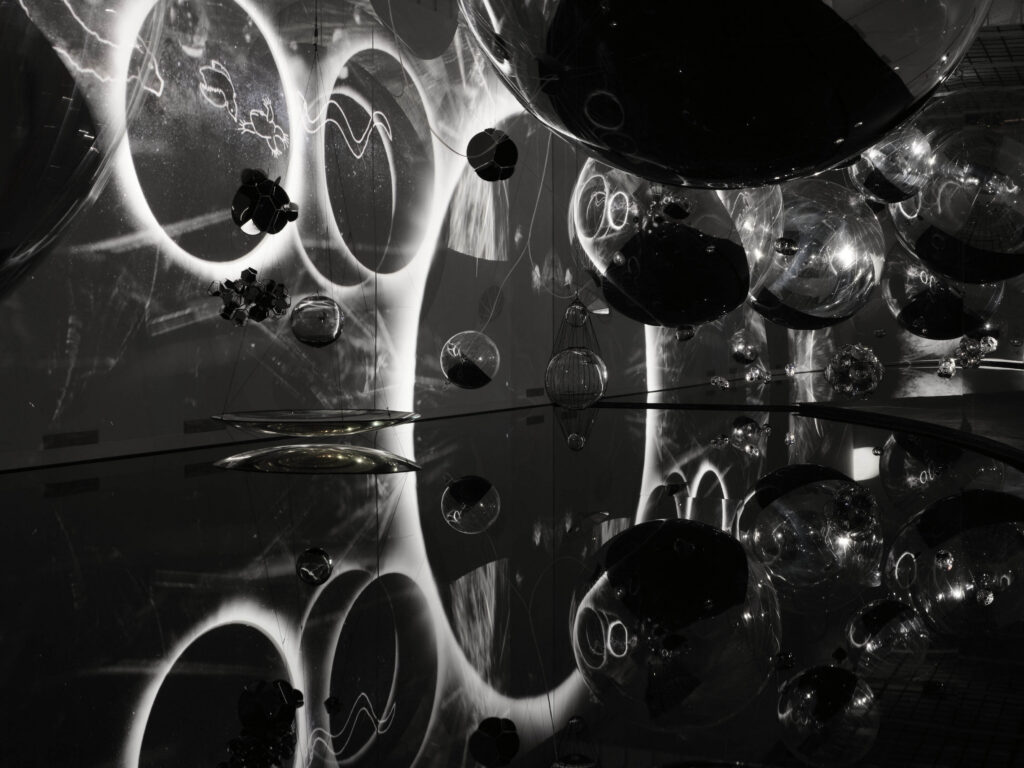
Like a cosmic dreamscape, the monumental installation "Towards the Sanctuary of Water" forms the centerpiece of the exhibition. Water surfaces, reflections, light, floating globes, and projected images create an environment in the semi-darkness whose appearance is constantly in motion. The space simultaneously feels open and concentrated. The visitors move freely between reflections and shadows, becoming part of this immersive, enigmatic, and poetic installation. How this work is simultaneously complemented and mirrored on the other side of the world is revealed in the next room. Here, one enters a bright hall, the floor is extensively laid with white salt, and wall panels, vitrines, and videos illustrate the global scope of this project. "Towards the Sanctuary of Water" originated from Saraceno's long-standing collaboration with the indigenous communities of the Salar de las Salinas Grandes in the north of his homeland Argentina. Together, they are developing "The Sanctuary of Water" (El Santuario del Agua), a permanent land-art project that advocates for the protection of water resources, traditional knowledge, and the territories of the communities in a region increasingly threatened by aggressive lithium mining. On an artistic-scientific level, Saraceno addresses the globally relevant issues of water consumption and waste, sustainability, and the protection of indigenous communities in the age of the capitalist era, where everything is subjected to an unrelenting capitalist economic system.
The salt, which was completely sustainably loaned to the city of Munich and serves as road salt in the winter, still crumbles under your shoes when you enter the next room. Here, in the darkness again, only a very bright light source throws its intense beam of light queerly through the room. Once the eyes have become accustomed to the situation, one begins to see the dust particles dancing in the light cone. These are the normal dust particles that are present in the air that are made visible here and, like the spider webs, remind one of star clusters in the depths of the universe. In all the crises and global problems, one must realize that we are nothing more than stardust in the vastness of space.
A communal space is the installation "Weaving with Red Atacama", which can be visited without a ticket to the exhibition. A seating area invites visitors to sit down and talk. The hand-woven blankets were donated by eleven indigenous communities in Red Atacama. Red Atacama is a socio-political network that represents people in the provinces of Salta and Jujuy in northern Argentina. Made from sheep and llama wool and dyed with plant-based pigments, their patterns tell stories from everyday life in the Salinas Grandes.
The equal juxtaposition of scientific approaches, political thematic complexes, and poetic works of art is one of the strengths of this exhibition. Tomás Saraceno blends artistic approaches with research to engage with ecological and social issues that extend far beyond the exhibition itself. Rather than simply providing background information or adding didactic elements, these diverse perspectives are woven together into a new whole that is increasingly compacted and held together by cross-connections. The webs of spiders reflect the webs of communities; the microscopically small is mirrored in the cosmic large; salt and water are recurring elements. The collaborative approach incorporated in the title, "Tomás Saraceno in collaboration," also plays a role. This is manifested in the actual collaboration with scientists, biologists, architects, and activists from indigenous communities. Even the spiders are here intimate accomplices.
The exhibition by Tomás Saraceno has two titles. The German version "Intertwined Worlds" refers to the complexity of our present, but also to the mutual dependence and shared responsibility for our planet and its inhabitants. The English title "Ancestral Futures" refers to the book "Ancestral Future" by the indigenous thinker and activist Ailton Krenak, in which he warns against the power of capitalism and its destructive effects. Saraceno deliberately uses the plural form of "future" to point optimistically to different possible futures in which we can together create a sustainable world beyond the current growth imperatives.
Tomas Saraceno in collaboration. Interconnected Worlds. To be seen at Haus der Kunst, Munich, 17.07.2026 to 7.02.2027.
The Kunstmuseen Krefeld are dedicating the first retrospective in Germany to Charlotte Perriand’s multifaceted and astonishingly contemporary work.
 7 min read
The exhibition "Seeing the Unseen" at the ERES Foundation in Munich shows how contemporary art attempts to approach the invisible worlds of quantum physics.
 6 min read
The exhibition "Six Five Four Three Two" featuring works by the New York-based artist Josephine Meckseper at the Heppenheim Art Society.
 9 min read