
 7 min read
 7 min read
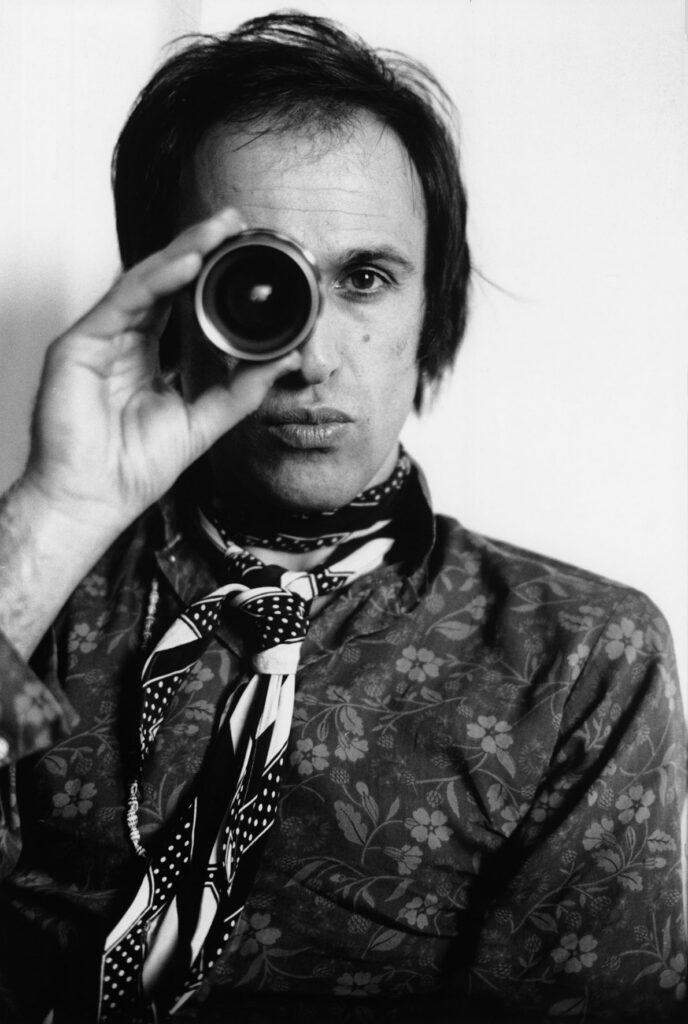
He was represented with Andy Warhol, Roy Lichtenstein, Jim Dine and others in the first important gallery exhibitions of Pop Art in New York and Paris, was personally acquainted with the Rolling Stones and participated four times at the Venice Biennale. But only now is the first German retrospective of Mario Schifano (1934-1998) taking place, in the private museum Schauwerk in Sindelfingen. Initially attributed to Pop Art, he nevertheless came to it in entirely different ways, which he later pursued in other ways. A discovery.
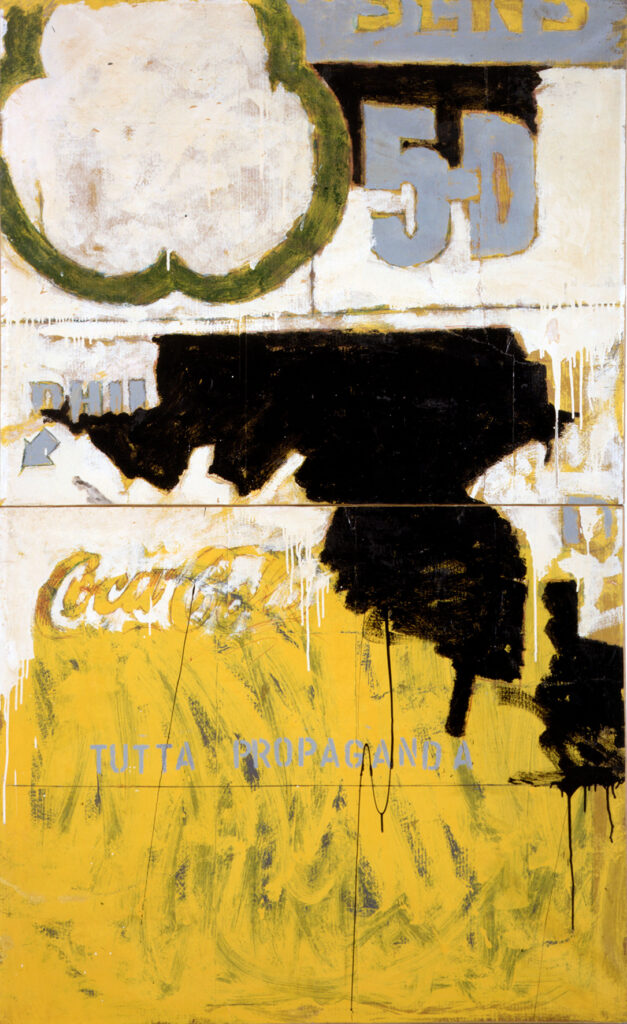
In his first solo exhibition at the pioneering gallery La Tartaruga, Near Piazza del Popolo in Rome, the Romanian-American gallery owner Ileana Sonnabend became aware of Schifano in 1961 and immediately signed him on. She had her finger in the game when he already the following year created a Coca-Cola-logo on the wall of the gallery. International Exhibition of the New Realists He participated in the Sidney Janis Gallery in New York, which helped Andy Warhol and many others achieve their breakthrough. As the New York Times noted: "With this show 'pop' art is officially here." The title of his work, Propaganda, In Italian, it can simply be said Advertising They are called names, but a double meaning was certainly intended, and there is also the possibility that propaganda fide The Catholic Church was in agreement. With its Paris gallery opened in the same year 1962, the "Mom of Pop", as it was soon called, paved the way for Pop Art in Europe as well. Schifano was one of the first artists to exhibit there.
But soon they diverged. On Saturday, he wanted to focus on works like the Coca-Cola advertisement. That was too one-dimensional for Schifano. He wasn’t like Warhol as an advertising graphic designer, who questioned his field and simultaneously used it to engage in conversation. Rather, the Coca-Cola logo was part of his everyday surroundings in Rome. Born in 1934 in the Libyan coastal city of Al-Hums (Homs) as the son of an archaeologist, he came to art as a dropout from school, an assistant to his father at the Etruscan National Museum, and self-taught. In 1959 he had his first solo exhibition. Then everything went very quickly: encouraged by success, he decided to become a painter and took part in the group exhibition 5 painters – Roma 60 The exhibition, which was revived nine years later in Turin because of its groundbreaking impact, was curated by Pierre Restany, who had previously helped Yves Klein achieve a breakthrough. Then came Saturday.
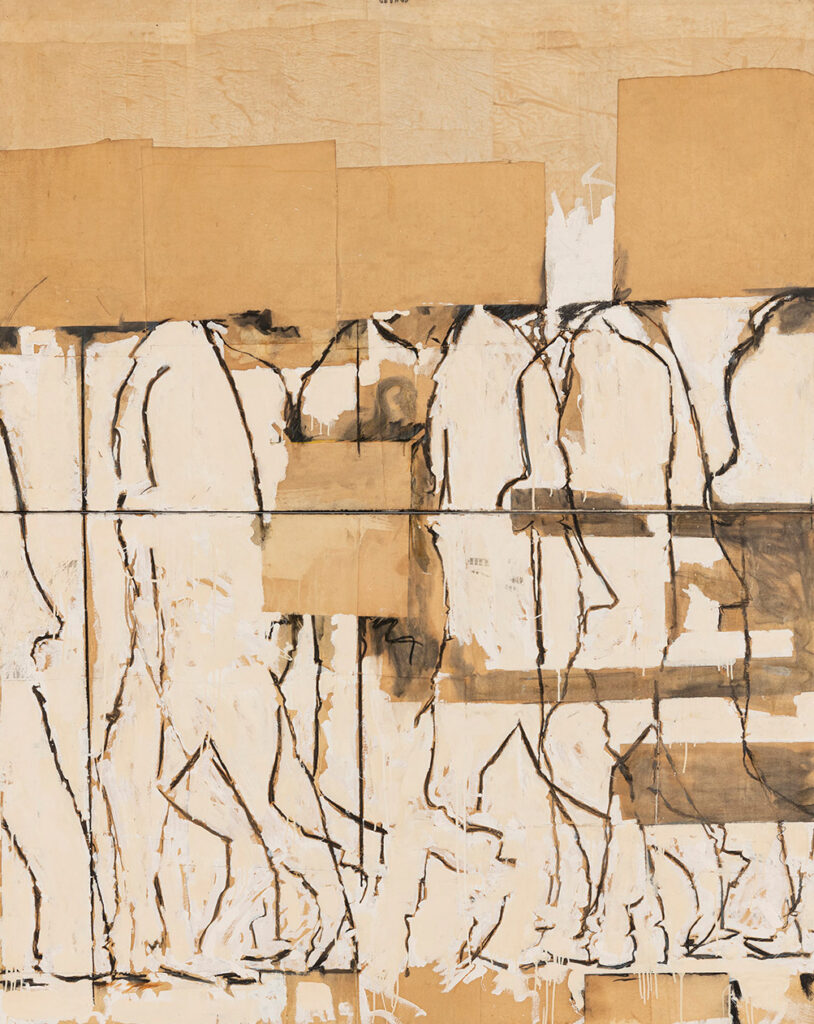
A reference to Yves Klein is evident in the oldest works in the exhibition, two small paintings. Monochromatic From the year 1960: paint and graphite drawings, which are banished to a back corner of the room with other small-format drawings, because the spaces of the exhibition, formerly production halls for air conditioning units, are high and spacious. Since the departure of the company Bitzer, the museum has been in existence; it was established in 2010 on the basis of the collection of around 3,500 works by the board members Peter Schaufler and his wife Christiane Schaufler-Münch. He passed away ten years ago; she died this year. Until now, the exhibition space featured mostly abstract art in large format. Pop art is new, which is probably due to the new director Svenja Frank, who has been leading the museum for a year. Schifano was discovered by the Schauflers in the 1980s in a gallery in Verona, where they purchased a work that was exhibited at the Venice Biennale in 1964: When I remember Giacomo Balla, Painted in 1964 in New York, the work shows the silhouettes of a series of figures without heads; repetitions and overlaps are intended to simulate movement sequences similar to Balla’s. Another work is dedicated to the Futurists; based on a well-known photograph of the group, Balla has also created a drawing; both are from the Gió Marconi Foundation in Milan, from which a large part of the loaned works comes. The Schaufler collection contains only five works by the painter.
What connects the Futurists with Pop Art? Modernity, immediacy, life from the moment. The figures dedicated to Giacomo Balla appear as if they were perceived from a sitting perspective on the fly. It enters my eye before it enters my heart," is another title: It catches my eye before the feelings reach me. One must have an open mind Another, translated freely: You have to create your own perspective. Particulars Schifano names some of his works: Ausschnitt. He worked extensively with photographs, whether they were for Coca-Cola advertising or a landscape. He does not hide this; on the contrary: The corners are rounded like in slides. Later, ektachromes take their place. Unlike Gerhard Richter, Schifano does not paint the photos in detail, but only outlines them and fills them in with coarse brushstrokes to get from the impression to the finished image more quickly. Later, there are photoshopped and retouched television screens, a 95-minute film, and black-painted, cinema-screen-sized still images.
Behind this lies less a specific period of time than rather a lifestyle. With Anita Pallenberg, soon thereafter Brian Jones's beloved, and then Keith Richards's partner, he traveled to New York for the first time in late 1963. However, Ileana Sonnabend intrigued the renegade. "Your enemies are my enemies," Leo Castelli is said to have told her. Nevertheless, she did not quite manage to get Schifano to leave. He had an atelier near Andy Warhol's. Factory, His neighbors were Frank O'Hara and Jasper Johns. Later he paired Mick Jagger with the singer Marianne Faithful, which did not prevent her from appearing in Schifano's film in 1969. Human not human somewhat listless and off-track in the playback Street Fighting Men to sing. The song dates from the same year Monkey Man on the Stones LP Let it Bleed, "Dedicated to Schifano," it says, not very flattering: "I'm a cold Italian pizza," "I'm a sack of broken eggs / I always have an unmade bed."
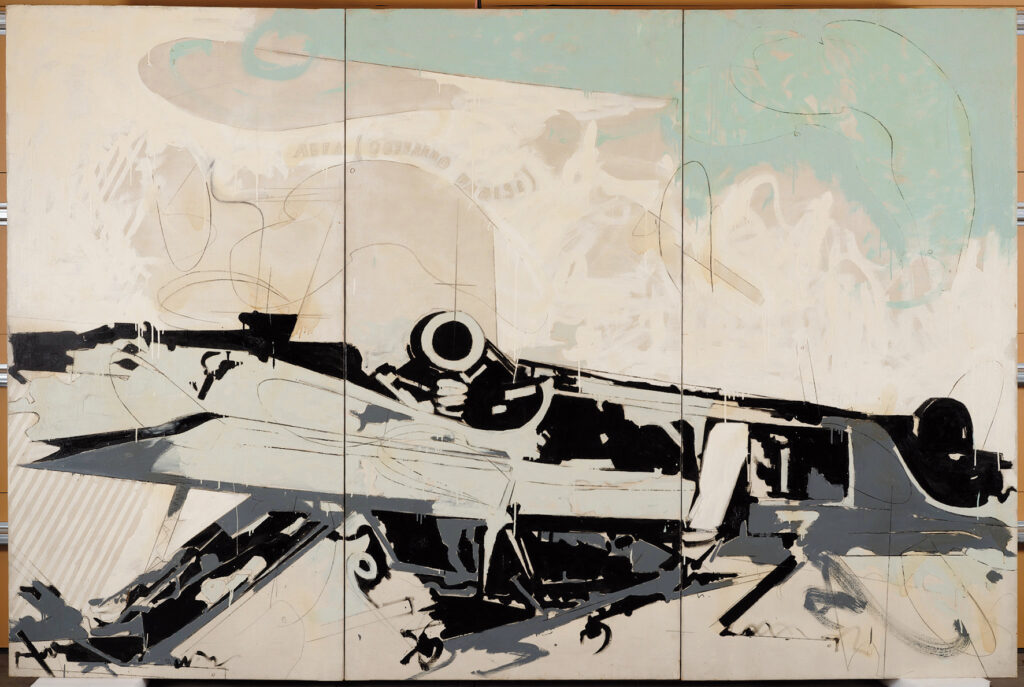
However, the fast pace of life has its drawbacks. Not entirely atypical for the time, Schifano was arrested several times for drug possession and eventually ended up in hospital in 1970, from which he created the large-format work Hospital He leaves a testimony. It is not least due to the gradual withdrawal from the wild life that the artist now views the world primarily through the lens of the television set. Later he undergoes a withdrawal treatment, withdraws even more, and only stabilises in the 1980s, when he begins a quieter family life. His works from this period do not always have the same precision as those of earlier years, yet he remains an experimentalist who, for example, experiments with coloured and textured acrylic glass. His works are rarely as openly political as the four-meter-wide painting. Tearful, which is shown in a photo from Time Magazine based on which an American soldier bids farewell to his young son during the Second Gulf War. Among the most remarkable works of recent years is a panel measuring approximately two by four meters made of hundreds of small screens, photographed, painted or overpainted.
In Italy he is a pop star, after whom the short-lived psychedelic rock band The statues of Mario Schifano named, which was exhibited in 1985 as part of the exhibition Etruscans of the 20th century he completed a ten-meter-wide monumental painting in front of 6,000 spectators, which once adorned the yellow jersey of the Tour de France He designed and sold works that were produced in series on television, even though they may not have been his best ones. He pursued a very unique, transmedia approach that is evident in the use, processing, and reworking of photographs, newspaper clippings, and film and television images. Actually, quite current.
The exhibition runs until June 26, 2026. https://www.schauwerk-sindelfingen.de/de/ausstellungen/aktuelle-ausstellungen/detail_32576.html
The Kunstmuseen Krefeld are dedicating the first retrospective in Germany to Charlotte Perriand’s multifaceted and astonishingly contemporary work.
 7 min read
In the new premises of Plateforme 10 in Lausanne, the Photo Elysée Museum can finally unfold its potential.
 12 min read
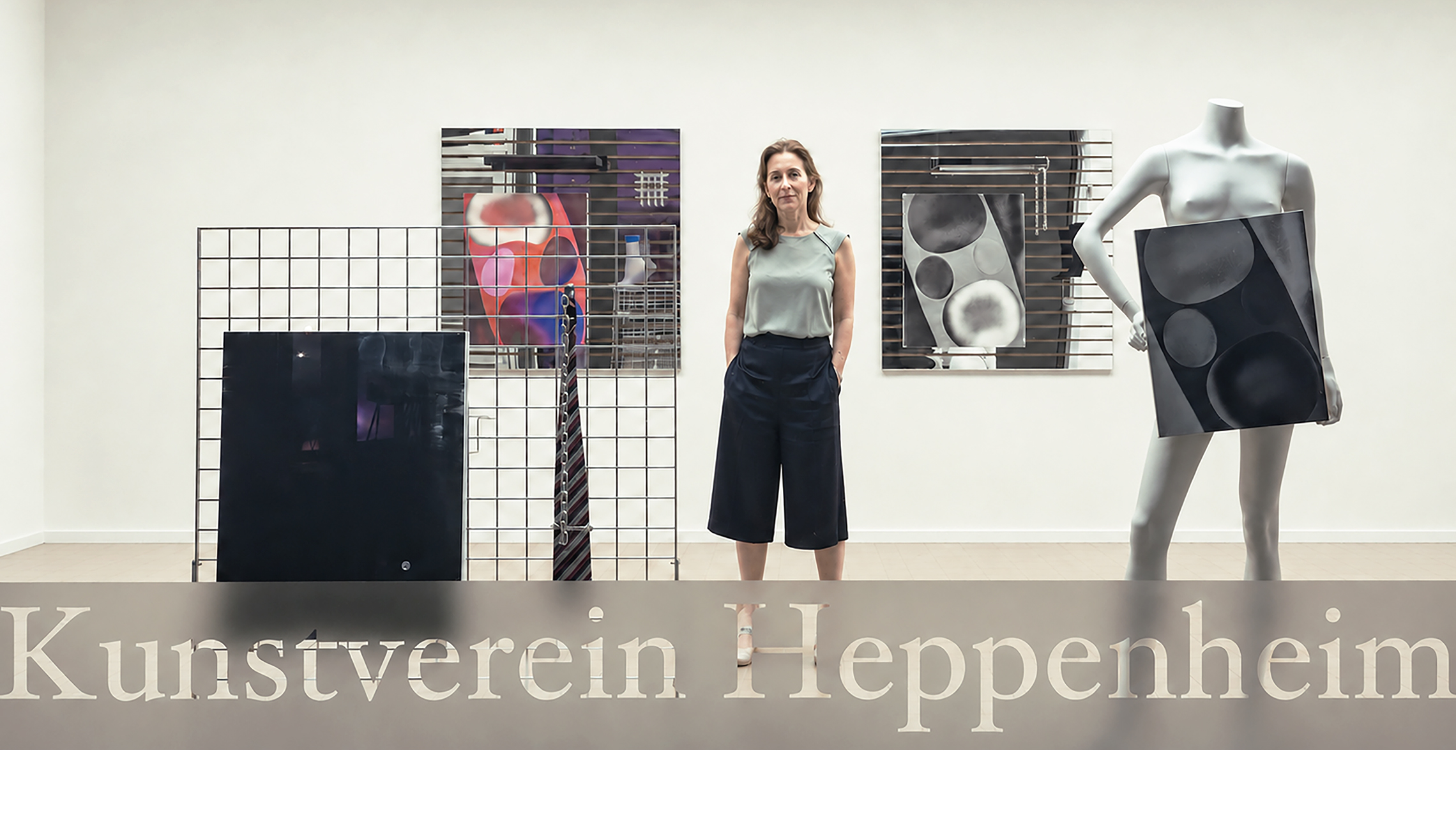
The exhibition "Six Five Four Three Two" featuring works by the New York-based artist Josephine Meckseper at the Heppenheim Art Society.
 9 min read