 7 min read
 7 min read
As is the case with many discoveries, George Segal found material and techniques for his art rather casually, unintentionally. One of his students, whose husband worked in a pharmaceutical company, brought him a few boxes of plaster bandages one day. Segal asked his wife Helen to try them on him. It was as if he had been searching for them.
Segal, born in 1924 as the son of Russian-Jewish immigrants in New York, was already 36 years old at the time. In 1941 he began studying art at Cooper Union, Manhattan, which he had to interrupt to help his parents on their chicken farm in New Brunswick, New Jersey. To support his family, he had raised chickens there after the war. His studio, a panopticon of life-size plaster figures in all imaginable positions, had once been a barn for five thousand laying hens.
His origins from humble circumstances were crucial to Segal’s artistic decisions. He managed to develop his own perspective that differed from the art movements of his surroundings as well as from the old art to which he repeatedly related himself. When he began, current art was almost dogmatically fixed on abstraction. Segal preferred the classical modernism of Paris. He wanted to work figuratively. But his world, between New York and New Jersey, characterized by highways and illuminated signs, was inconceivably far removed from the Paris of the turn of the century.
His teacher in New York, Tony Smith, the father of Kiki Smith, Later known primarily as a sculptor, he was an energetic advocate of abstract art. But he was also a fan of the then still quite new Neorealist Italian film. A realistic representation of everyday life: In the film this seemed possible, not in art. Later he met Allan Kaprow, who taught at Ruttgers University in New Brunswick from 1953 onwards. They exhibited together in the same New York galleries. Kaprow introduced him to John Cage and other artists who invited them to their country home. At Segal, Karpow staged his first happenings. George Brecht and Robert Watts organized here their first Yam Festival. Robert Frank, known for his photo book The Americans, filmed his second film at Segal's farm, The Sin of Jesus, According to a short story by Isaac Babel. It was preceded by Pull My Daisy, the first film about the Beat Generation: both are roughly half-hour short films that seem to slip right into reality.
Happening, Fluxus, the Beatniks, Pop Art: Segal was close to many of the current artists and art movements of his time. But he sought something else. He did not want to abstract from reality; he wanted to get closer to it. Like the Neorealists, who worked with amateur actors who were themselves part of the world they embodied. Like Frank, who in The Americans With a new perspective on the underclasses and remote places that reflected the contradictions of American society, Segal also became interested in those aspects of his surroundings that were overlooked but not noticed: the streets, gas stations, and illuminated signs in the patchwork of suburban areas between New York and New Jersey, which he captured in black-and-white photographs like Frank. He was interested in the reality as it was, not the ideal images of art history. Particularly interesting to him were the people: their daily struggle for survival; their loss.
He wanted to get closer to them. Perhaps he wanted to erect a monument to them. The means and techniques to achieve this were found in the plaster casts. Plaster is a common material in the history of art, although not highly regarded. Plaster was used for modeling, similar to clay, but also in large format. Segal had already made first-size plaster figures before he found his technique. Without the collections of plaster casts of ancient figures, fragments and torsos, Classicism with its preference for white, unpainted sculptures would probably not have existed. Segal reflected on this when, for example, he photographed the art historian Carroll Janis in front of ancient torsos in the British Museum or modeled a plaster torso that he had made The Venus Gesture called.
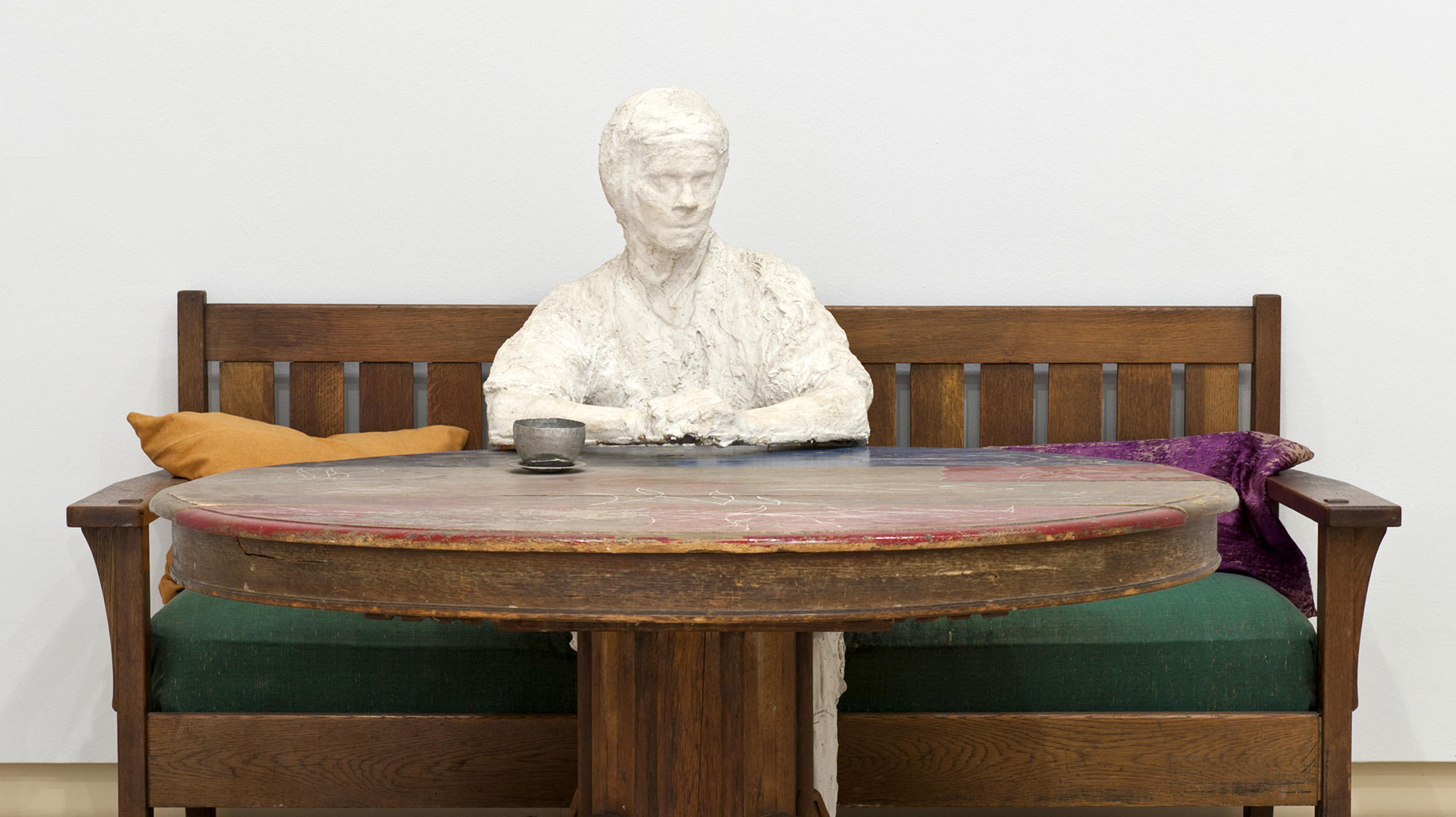
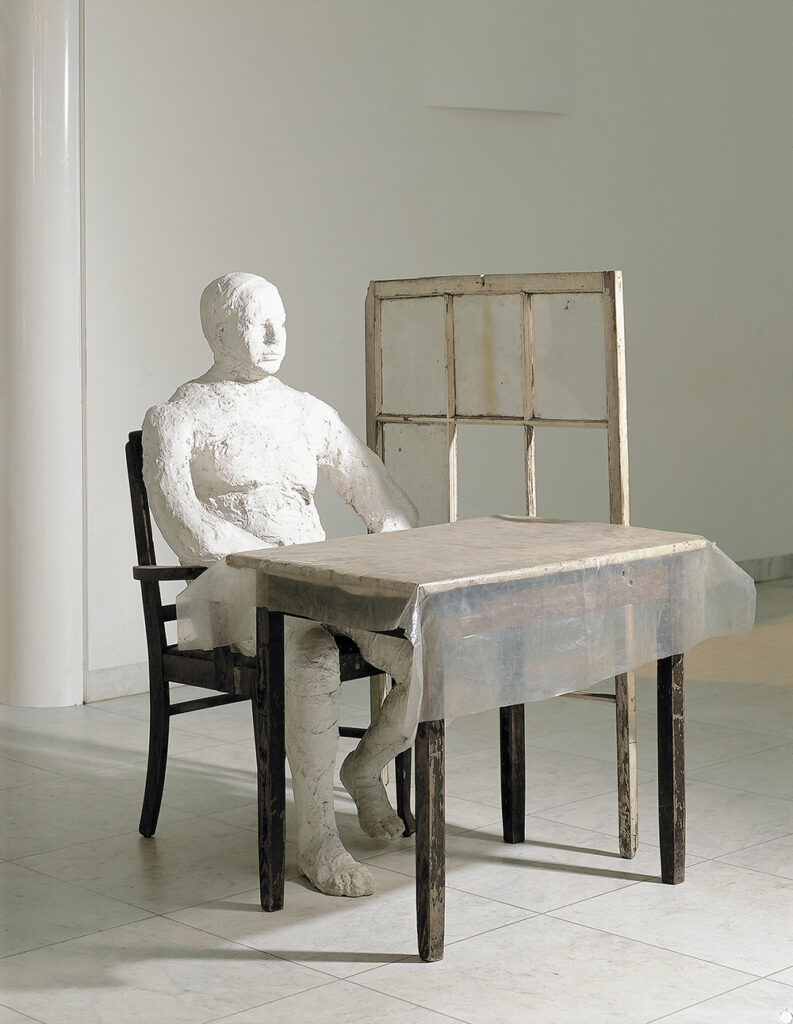
Gypsum was also the material used to make the death masks that preserved a strikingly lifelike image of the deceased. This is exactly what Segal’s work also embodies. Donna Gustafson, senior curator at Zimmerli Art Museum at Ruttgers University, describes her in the catalog of the exhibition celebrating Segal’s 100th birthday as ghostly and uncanny, Spooky and eerie, Kaprow even spoke of living mummies. As with the death masks, the individual features of the formed figures stand out astonishingly clearly – even though Segal’s figures were mostly not created as portraits. Like other artists of his generation, the generation after abstract expressionism, from Pop Art to conceptual art, Segal wanted to move away from the hand-drawn style and thus came even closer to the reality of his figures. Apparently, even to their psychology, their inner life, which interested him more than anything else. Appearing in black and white, without eyes that look at you, they seem lost in thought, dreaming, occupied with themselves.
This corresponds to the emptiness of his sculptural arrangements when he, for example, shows a group of people in a bus, waiting at the bus stop or at a gas station. By placing his figures in the driver's cab of a truck or next to a Coca-Cola vending machine, he transported them into the American reality of his time. The social realism of America is perhaps nowhere more present than in the figures he contributed to the Franklin D. Roosevelt Memorial in Washington, inaugurated in 1997: a radio receiver; a pair from the Appalachian Mountains; and a queue of five men with hats standing in the "Great Depression" to get bread. How much Segal, who was a five-year-old boy at the time of the stock market crash, identified with them is shown by the fact that he places his own effigy in this queue.
Segal also painted and drew throughout his life; he created pastels, lithographs, engravings, and serigraphs. When they were intended for public space, such as the Roosevelt Memorial, he cast his figures in bronze. He sometimes also colored his plaster figures – and vice versa, painting pastels and oil paintings in black and white. Despite all the differences – black and white or color, painting or sculpture – something seems to connect all his works: a certain feeling, a mood that can be rationalized in two directions: On the one hand, there is a tension between the historical references and the American present. The people waiting at the bus stop resemble Rodin somewhat. Citizens of Calais, But without the pathos. They don't tell a heroic story, or rather only of the heroism of ordinary people who have to struggle to cope with their everyday lives. Dancers They remind us of Degas, even though no exact model can be found; yet they are imitations of living people. In this way, the artist gives his figures a stature of their own, something that people in rural New Jersey would otherwise not have had.
This is associated with the artist’s special closeness to his models. This is obvious with the plaster figures: they are relatives and friends whom he literally gets very close to when molding individual body parts – the figure always emerged in several parts. He does not even want to place his figures on a pedestal; he prefers to set them in a room on a chair, like a living person, or on a park bench. In the paintings and prints, the closeness is different. Often only sections of the body are shown, almost as if one sees oneself, without the head. Or, from a slight distance, which seems to convey a special familiarity or even empathy, as if the artist shares the silent thoughts of the depicted figures.
Despite the diversity of the artistic work, it is the plaster figures that leave the strongest impression by far. The bus drivers, passersby, construction workers, and dancers seem to be caught right out of life themselves, like the Pompeii residents who were surprised by the volcano.
To the website of the George Segal Foundation
The Kunstmuseen Krefeld are dedicating the first retrospective in Germany to Charlotte Perriand’s multifaceted and astonishingly contemporary work.
 7 min read
In the new premises of Plateforme 10 in Lausanne, the Photo Elysée Museum can finally unfold its potential.
 12 min read
The exhibition "Six Five Four Three Two" featuring works by the New York-based artist Josephine Meckseper at the Heppenheim Art Society.
 9 min read